Menu Sidebar
Menu

Tailoring Nursing Ambitions: Students’ Guide to Selecting a Nursing Career

Nursing is an increasingly popular job role among aspiring professionals in today’s world. The reason so many people are now pursuing nursing careers is because of the stability and room for career growth in the field.

However, there are a wide variety of nursing roles that your students can pursue. As such, you should expose students with an interest in healthcare roles to the many different nursing career paths they have available to them.

Here is a student’s guide to selecting a nursing career.

Understanding One’s Career Goals

Before committing to a specific nursing education program, students must have a clear idea of their career goals. This will help them pick the perfect school and program, whether that’s an online program or a traditional degree path, for their specific needs.

However, choosing a nursing career path isn’t always a walk in the park. This is particularly true when students aren’t clear about the options they have. For this reason, it’s vital that you acquaint your students with the wide variety of nursing careers that they can pursue.

Different Nursing Careers

From entry-level roles to advanced roles, there are many different roles that nurses can inhabit. Here’s a rundown of different nursing careers that students should be aware of.

Registered Nurse

Registered nurses play an important role in the modern-day healthcare system. These healthcare professionals work in a wide variety of settings, from hospitals to clinics, and provide robust care to patients.

One reason that many healthcare professionals start their careers as registered nurses is because it provides stability and room for career growth. As such, those eyeing an advanced nursing career in their future can start their career journeys as registered nurses.

To become a registered nurse, one must first complete an accredited nursing program. This can either be an associate-level program or a bachelor-level one. After completing these educational requirements, one will have to take a licensing test in order to be qualified to work as a registered nurse.

Advanced Practice Registered Nurse

As has been noted, becoming a registered nurse gives one a great foundation to grow into more advanced roles. One such advanced role that nursing students can work toward inhabiting is that of advanced practice registered nurses.

The most common types of advanced practice registered nurses are nurse practitioners. These professionals can specialize in different types of practices, such as family practice, women’s health, or gerontology.

One reason many aspire to become advanced practice registered nurses and nurse practitioners is because of the lucrative salaries that these in-demand professionals can command. Another key reason many aspire to step into these roles is the increased autonomy and greater level of impact that one can have on patients.

To become an APRN, one should begin with the same steps as becoming a registered nurse. After, one will likely have to gain several years of experience as an RN and then continue one’s education by obtaining a Doctor of Nursing Practice or DNP.

Travel Nurse

Another advanced nursing position that many healthcare professionals aspire to step into is that of travel nurse. In essence, travel nurses are registered nurses who travel to different locations and facilities to lend their services.

These nurses can command premiums on their services because they must travel on short notice. However, it must be noted that these nurses often experience strain on their relationships due to the frequent traveling they must do.

Despite the challenges of the role, many find the ability to travel and help people an exciting and fulfilling career path.

To become a travel nurse, one must first become a registered nurse. After this, it’s vital to gain several years of experience in nursing before one becomes eligible to become a travel nurse. Typically, travel nurses will go to an agency that provides them with various job opportunities across the country.

Connecting Students with Working Nurses

Beyond providing guidance about different types of nursing roles, it can be incredibly helpful to connect your students with other nursing resources as well. Specifically, connecting students with working nurses can help them gain a deeper understanding of various roles and what they can expect in their potential careers.

Students Can Find Fulfillment as Nurses

As a counselor, you’re in an amazing position to help students find fulfilling career paths that benefit their lives. In particular, you have an opportunity to show them how a nursing career can provide them with stability and room to grow as a professional.

Ultimately, being able to clearly explain these different roles and what they entail will help you get your students excited about a career in the healthcare space. As such, do your best to familiarize yourself with various nursing paths so you can be a useful and effective nursing resource to your students.


LINK for Counselors Top 10 Most Read Blogs of 2023

Happy New Year! We published many blog posts in 2023. These were the top 10 posts based on clicks in our e-newsletter last year.

The Benefits of Attending College Out-of-State – https://www.linkforcounselors.com/the-benefits-of-attending-college-out-of-state/

Parents of Special Needs Students Need to Make a Financial Plan for Their Future – https://www.linkforcounselors.com/parents-of-special-needs-students-need-to-make-a-financial-plan-for-their-future/

Local Scholarship Committee Suggestions – https://www.linkforcounselors.com/local-scholarship-committee-suggestions/

College Admissions Officers Reveal What Bugs Them Most – https://www.linkforcounselors.com/college-admissions-officers-reveal-what-bugs-them-most/

Is the New FAFSA as Frightening as we Imagine? – https://www.linkforcounselors.com/is-the-new-fafsa-as-frightening-as-we-imagine/

High School Juniors – Don’t Get Overlooked! – https://www.linkforcounselors.com/high-school-juniors-dont-get-overlooked/

Let’s Get Digital – https://www.linkforcounselors.com/lets-get-digital/

Average High School Counselor Salary by State – https://www.linkforcounselors.com/average-high-school-counselor-salary-by-state-2/

Test-Optional College Admissions Policies: The Pros and Cons – https://www.linkforcounselors.com/test-optional-college-admission-policies-the-pros-and-cons/

The College Planning Calendar for High School Freshmen and Sophomores – https://www.linkforcounselors.com/4-application-mistakes-your-students-should-avoid/

Digital SAT Test Preparation – Free

Do you have students that are struggling with the Digital SAT? Prepaze has created complete and comprehensive computer adaptive practice DSATs, meticulously designed by experts, offering precise, high-quality content that faithfully replicates the actual exam experience for thorough preparation. With the practice test results, your students can also thoroughly examine test outcomes, precisely identifying improvement areas for focused enhancement and progress.

Their free version includes 20 questions and typically takes students about 28 minutes to complete. They also have an upgraded paid version (for $39) that includes 98 questions and takes about an hour and 38 minutes to complete.

Here is the link if you have students that would like to check it out: https://www.prepaze.com/digital-sat

Supporting Jewish Students During a Time of Heightened Antisemitism

The war in Israel has spawned a significant number of antisemitic events on college campuses and in other public spaces. Although there are a variety of perspectives on the conflict, what’s not up for debate is that Jewish students should feel safe and not subjected to hate speech, threats, or violence.


Advice from a counselor about supporting Jewish students:


Check in on them frequently. Make sure they know who the adults are on campus who will listen to them and empathize with them. Be aware that they are seeing terrible things, particularly on social media. Know that many of them feel betrayed by real-life friends as well as personalities that they follow (and feel they know) on social media. Their fears about antisemitism are real and not inflated or dramatic. For progressive students who have always identified with left wing causes, this is a particularly confusing time; many liberal/progressive Jewish students feel betrayed by people/causes/organizations with which they are usually allied.


Some questions that could open a conversation with a Jewish high school student:


It’s important to approach conversations with sensitivity and confidentiality, ensuring that students understand their privacy is respected. Remember: You are not expected to be an expert on Israeli-Palestinian history or the current situation. However, hopefully you are in a position to provide support to Jewish students, to advocate for systemic changes as appropriate, or to connect students with resources. The questions below might serve as helpful conversation-starters.


Personal feelings

  • How are you doing?
  • Do you want to talk about how it feels to be Jewish at this time?
  • Do you have any family in Israel?
  • Would you be comfortable sharing your experiences with me?

School Culture

  • Do you feel that your cultural and religious identity is respected here at school?
  • How do you feel about your interactions with other students in relation to your Jewish identity?
  • Have you witnessed or experienced any form of antisemitism or religious intolerance in school?
  • Would you be interested in having an affinity group or club with other Jewish students to talk about your feelings and concerns?
    o Can I help point you in the direction of a faculty member who might be a good advisor?
  • Are there events you would like to see at school to help educate our community about antisemitism? About the conflict in the Middle East? About Judaism?
  • How can we make our classroom discussions more inclusive of diverse perspectives, including Jewish ones?
  • Are there ways you would like to contribute to the school community that reflect your cultural or religious values?

Safety

  • Do you ever feel unsafe or uncomfortable at school because of your religious identity?
  • What are your thoughts on how our school addresses antisemitism and bigotry?
  • Do you know who to talk to if you feel threatened?
  • If an antisemitic incident were to occur here, do you trust we would handle it appropriately?
    o Why or why not?
  • Is there anything we can do that would make you feel safer or more secure at school?

Support System

  • What can I, as your counselor, do to better support you and ensure you feel safe and respected?
  • Are there any concerns your family has about your school experience that you think we should know about?
  • Do you need help navigating difficult conversations with your friends?
    o Have you had a friend (or anyone) say or do something that was unintentionally offensive to you?
  • Is there anything else you would like to share about your experience as a Jewish student here?

College Choices

  • Have you been doing research about Jewish life on the campuses you are considering?
  • Do you need help reaching out to Hillel, or other Jewish student associations on college campuses, to find out how they are handling any challenges on their campus?
    o Note: Hillel International (hillel.org), the largest Jewish campus organization in the world, has a directory (see “Find a Hillel” on the website) and resources.

A few resources:

If you do an internet search for “supporting Jewish students at this time” (or similar), you’ll find hundreds of articles and blog posts. Here are a few practical documents that do not take a political stand.

Compiled by members of NACAC’s Jewish Schools and Jewish Students Special Interest Group

How to Respond to Negative Parent Feedback on a College Essay

I received this email from a parent last month, shortly after her son submitted his early applications. She was concerned about his supplements for the University of Pennsylvania, where he is applying Regular Decision.
 
For his second essay, I don’t think that his second and third paragraphs answer the questions how Penn will shape his perspective and how his experience and perspective will help Penn. For the third essay, he does not mention how he can take advantage of opportunities at Penn. Can you please guide him to enrich his essays?
 
We were nice about it, but the answer was No. Her son had worked hard. He was done with his essays, and they were very good. But this was a delicate matter. Our challenge was writing something firm yet diplomatic that would alleviate the mom’s anxiety, while also letting her know she needed to let go.
 
Here’s our response:
 
Thanks for reaching out. I’ve read thousands of essays for Penn and other super selective institutions. Your son’s essays are among the best I’ve seen. They are excellent, effective, and answer each part of every prompt.
 
Additional work on the essays will not enrich the application or help him stand out any more than he already does. I fear the suggestion that the essays are not good enough could make him feel bad about himself, and I wouldn’t want to do that.
 
I hope this answers your questions and alleviates your concerns.
 
This type of email or phone call from a parent can throw the most confident counselor off their game. We don’t want that to happen to you.
 

As you move one class past the finish line and start thinking about the Class of 2025, it’s a great time to look back on the season and reflect on how you communicate with parents. Consider what their concerns really are and how you might handle them next year and beyond.
 
At Wow, we try to set expectations up front. We communicate our approach from the beginning (and again in the middle and at the end of the process!) We still get a few emails like the one I’ve shared here, but we know how to respond to just about any situation. And by the way, this mom backed off. She even said thank you.
 
We have dozens of email templates, writing exercises, and review guidelines that help us make good decisions and communicate clearly with parents and students. Get free resources to use with your students.

Kim Lifton is co-founder and President of Wow Writing Workshop, which has been transforming the college essay coaching process for counselors, teachers, tutors, and independent educational consultants since 2009. Whether you’re a brand-new counselor or have decades of experience, essay coaching can be the hardest part of college counseling. It doesn’t have to be that way. We show professionals like you how to teach students to write strong, effective essays with less stress and greater confidence for you, your students, and their parents.


Kim’s articles on the college essay appear regularly in print and on the web, and her work has
been featured in a variety of newspapers, magazines, and online publications. Kim is a former
newspaper reporter and corporate communications manager with a BA in Journalism from Michigan State University. You can email Kim anytime about the college essay kim@wowwritingworkshop.com; she will always respond.

Early Decision 2 – still an option

Notifications for Early Decision (ED), Restricted Early Decision (RED), and Single Choice Early Action (SCEA) will be delivered within the next two weeks. This year, as in previous years, there will be many more tears than fist-bumps.

Here are some of the staggeringly competitive numbers of the ED applicant pool from Princeton Review’s Best 389 College & Universities – 2024 edition:  Brown University – ED (www.brown.edu), 6,146 applied, 15 percent accepted; Columbia University – ED (www.columbia.edu), 6,299 applied, 12 percent accepted; Duke University – ED (www.duke.edu); 4,070 applied, 22 percent accepted; Vanderbilt University – ED (www.vanderbilt.edu), 5,044 applied, 18 percent accepted.

Students who were rejected or deferred will find themselves in phase two of their application process. Many will examine their lists more closely to reevaluate their thoughts on which schools are “reaches,” “targets,” and “safeties.”

There is a relatively new wrinkle in college admissions is an admissions program called Early Decision II (ED II). Traditional ED programs have a November 1 deadline and a December notification. ED II deadlines are typically January 1 with notification by mid-February. This extra time allows students who were deferred or rejected from their first choice school to apply with a binding decision, and perhaps a boosted opportunity to another college.

According to my latest research, 75+ colleges and universities offer ED II including: Emory University (www.emory.edu); Boston University (www.bu.edu); Tufts University (www.tufts.edu); Davidson College (www.davidson.edu) ; and Vanderbilt (www.vanderbilt.edu) . For a complete list visit:https://www.collegetransitions.com/blog/early-decision-ii/.

Benefits of ED II

ED II allows students more time to prepare their strongest application. That may mean rewriting their Common Application essay or refining their supplemental prompts or it may mean another chance to take the standardized tests. ED II also gives students with strong performance in their first semester senior year another quarter or semester of grades to share with colleges. According to Sally Rubenstone, Senior Advisor at College Confidential (www.collegeconfidential.com) “Applying Early Decision does give students a bit of an admissions-odds boost at most colleges. Admission folks are usually willing to lock in strong-but-not-spectacular candidates whom they know will show up in September.”

Why do colleges offer an ED II program option?

Colleges really like Early Decision I and Early Decision II because accepted students are committed to attend, and that increases their yield numbers and the yield number impacts their rankings. Additionally, it helps the admissions office shape the class by allowing them to be pickier with the regular decision applicants. As an example, if a student’s big advantage is that they play the oboe and that was a hole the admissions office filled with an ED I or II applicant, it will be more challenging for that student to be accepted in regular decision.

Potential Disadvantages

Rubenstone also shares that “there can be some financial disadvantages to applying ED in any round because an affirmative decision will eliminate your chance to compare multiple aid packages. But, on the other hand, if an ED school does not offer reasonable aid then it’s okay to wheedle out of the so-called “binding” commitment.”

 Lee Bierer is an independent college adviser based in Charlotte. Send questions to: lee@bierercollegeconsulting.com; www.bierercollegeconsulting.com

2024 Vision: A Strategic Plan for College Counseling in the Age of AI – Free Webinar

As we start the new year, it’s important to have a plan for how artificial intelligence will impact your work with students and college admissions overall. This webinar outlines ways to use AI ethically while staying focused on supporting students one-on-one.

A panel of experts will talk about what’s going on with AI in admissions and share their best ideas for helping consultants, counselors, and students succeed in the AI age. The panel includes Bob Carlton (College MatchPoint), Michele Evard, Ph.D. (Evard Educational Consulting), Jed Applerouth, Ph.D. (Applerouth Tutoring Services), Sydney Montgomery, Esq. (Breaking Barriers), and Dhruva Bhat, Ph.D. (Lumiere).

You’ll leave with practical ideas from the group discussion that you can start putting into action to help your students navigate this changing landscape. The focus is on working together to make sure all students get the guidance they need.

This will be held live on January 4th at 1:00 PM Central time. It will be archived for viewing at a later date. Here is the link to register: https://us02web.zoom.us/webinar/register/WN_gI73rCpETEOdIle_8Ih1MQ#/registration

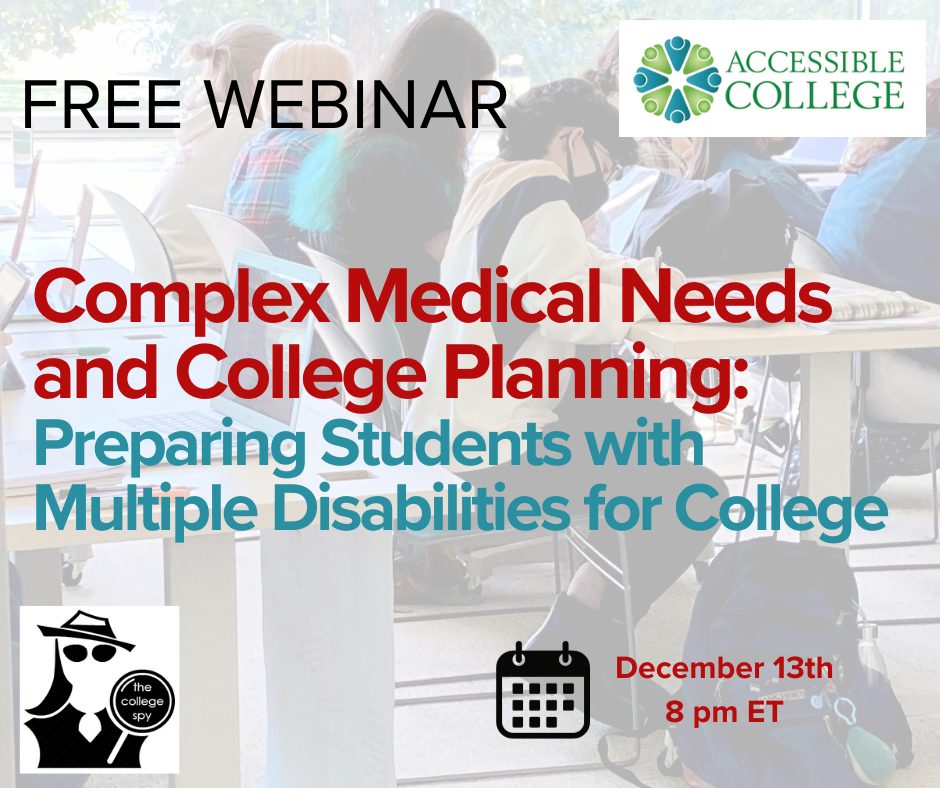
Complex Medical Needs and College Planning: Preparing Students with Multiple Disabilities for College – Free Webinar

Students with co-occurring disabilities have an added layer of complexity as they apply and transition to college. This webinar will provide you with an overview of considerations for students with LD and complex medical needs.

Accessible College (Annie Tulkin) and The College Spy (Michelle McAnaney) are teaming up to talk about the needs of students with multiple disabilities. This free webinar will take place live on December 13th at 8:00 pm Eastern. It will then be archived and available for later viewing. Here is the link to register for it: https://us02web.zoom.us/webinar/register/9816962060108/WN_5KOEuRolRSqXORWFQLefRQ#/registration

Don’t dismiss small-town colleges

As a graduate of one small college (1,000 students in a town of 10,500) and former employee of another (900 students in a town of 10,000), I want to make a suggestion as your students are exploring colleges: Don’t be too quick to cross small-town and rural colleges off the list.

I compiled a bunch of advantages with the help of some small-town college alumni. Here are just a few:

1. Tuition and housing prices may be more attractive. Enrollment at small colleges fluctuates from year to year and a lot of them have sizeable endowments. This means that they tend to give large amounts of merit money to entice students to attend. Plus, in small-towns, most off-campus housing is less expensive.

2. It may be safer. Students, in general, feel safer walking around a small town and a small campus.

3. It’s easier to build relationships with faculty and staff. Professors and administrators tend to live closer to campus, which creates more opportunities for your student to interact with them outside the classroom or office. There may be cookouts at the president’s house and informal gatherings at professors’ houses. “It was nice running into my professors outside of school in random moments and having a non-class-related conversation,” one small-college alum told me.

4. Your student probably won’t need a car. Everything – from the grocery store to the laundromat – is probably within walking distance of campus. Students who patronize the local watering holes (after they turn 21 of course) can walk home instead of driving. “Sometimes we just want on a walk in town,” a former student told me.

5. Small colleges tend to have better organized activities. In cities and larger communities, the colleges may expect students to find their own fun on the weekends. Said one parent, “My kid ended up choosing a small college in a big and exciting city, and there are very few organized on-campus activities. At this school they expect the kids to venture off campus for their activities and entertainment.” I worked for one college that had over 80 organizations for 800 students!

6. It’s easier to focus on academics. There are fewer distractions. Per one small college alum: “College in a rural town can be a cherished time to focus on academics, becoming an adult and building lifelong friends. It can be a very rewarding experience to be in a beautiful, scenic rural college town. There is also something special about being together, ‘in the middle of nowhere,’  in the cold, and just focus on learning.” Another alum said she just enjoyed seeing the stars at night and breathing fresh air.

7. There’s a greater sense of community. With fewer places to go in town, students tend to do things in larger groups. Friendship groups also tend to be larger, more diverse and a bit less cliquey, especially if the college is also small. “Most everyone stays on campus on weekends because it’s too far to drive home,” one alum told me. “I think it helps students learn to cope with issues that might arise because they can’t always go home to escape the situation.”

8. It broadens your student’s perspective. City kids learn what life is like in the country, and country kids can see what city life is like when they accompany their friends home for the weekend. It’s also easier for students to become involved in town activities, like volunteering at the library or tutoring at the local elementary school.

 There are a lot of reasons to cross a college off the list of schools you and your students are considering. Too big, too close, too far away, too expensive. Students should always choose the colleges where they feel most at home, of course, but don’t let them ignore a college just because it’s “in the middle of nowhere.” Trust me… they won’t be bored!

V. Peter Pitts, M.A., is an advisor with My College Planning Team based in the Chicago area. www.CollegePlanningTeam.com . He retired after 42 years in the college admission business, most recently spending 27 years at Monmouth College. Peter holds a master’s degree in sociology from the University of Iowa and a bachelor’s from Wartburg College.

Why Industrial Hygiene is a Smart Career Move in Today’s Health-Conscious World

There is no denying that the COVID-19 pandemic changed the world. Ever since COVID hit the world, everyone has responded a little bit differently. Some in drastic ways, others just had to make slight adjustments in the long run. While many of the behaviors that became commonplace during the pandemic eventually faded with the return to normal, there are plenty of factors in the professional world that were permanently changed.


Much of what occurred in those few years has served to set new policies and procedures at a social, state, federal, and corporate levels. The standards for health and safety that, though they were certainly considered important in the past, have now become vital in some instances.


Industrial hygiene is the study, science, and application of protecting people in the public and private sectors. The overall goal of these employees is to identify, control, abate, and lessen potential risks and dangers that accompany specific environments.


Being that every work environment is just a little bit different, and the demands and needs of certain places change drastically from workplace to workplace, there is a value on this type of professional perspective that is perhaps more important than ever.


Industrial Hygiene at a Glance


Industrial hygienists are deeply invested and tasked with the study, analysis, and implementation of standards by which workplaces can best protect their employees and the customers they serve by establishing and maintaining healthy practices. These professionals do their best to identify, track, and create systems or procedures which best mitigate the chances of dangerous or hazardous workplace conditions.


There are five primary categories in industrial hygiene: Chemical, ergonomic, physical, and biological hazards as well as airborne contamination. Being that every work environment has at least one of these categories present, but more often than not includes multiples of these categories, the need for well trained, industrial hygienists invested in continuing education will always be around.

It is for this obvious reason that there is a solid demand for industrial hygienists, and now more than ever. As such, here are some reasons why industrial hygiene is a smart career move in today’s health-conscious world.

Industrial Hygiene makes a Difference


The world before industrial hygiene standards were not just dark, they were literally dangerous. This is one of the oldest professions known to man. While it may not have always gone by its modern designation, there is evidence throughout antiquity that there have been movements whereby the health standards of workers came under threat.


One of the earliest such examples was in the 4th century BC when Hippocrates made the connection between the presence of lead in mines and ailing workers. In the 1st century AD, a Roman scholar noted that there were health risks for workers handling zinc and sulfur compounds. His discovery also led to the invention of a type of face mask which was meant to protect workers from the dust and fumes of those mines.


Similar examples can be traced through the Middle Ages until, in 1700, a man named Bernardo Ramazzini published what is now considered one of the first books on the topic. From that point forward, most modern civilizations from London, Rome, Paris, and the Americas, all had their own defining moments which contributed to raising and advocating a greater awareness for the necessity of protection for workers. It wasn’t until the early 1900’s though that the U.S. began putting those observations into national legislation.


It is as a result of those legislations that today, most every employer is required to maintain industrial hygiene standards that are regulated by OSHA or the Occupational Safety and Health Administration. Lives have been helped and saved because of these reports and laws.


A Growing Demand


It has already been stated in multiple ways that industrial hygiene is an important factor in nearly every workplace environment. The noteworthy history and the effectiveness of the observations and policies which have been instituted over the millennia can and should be combined with the more recent statistical results that have arisen as a result of the COVID pandemic: The overall employment outlook for occupational health and safety specialists is expected to grow by 13% in the next 9 years.


This, along with the reality of many current workers are about to retire, means that there will be a great demand for the influx of new, qualified industrial hygienists. Between the growing demand and the proven necessity of such work, the career path into industrial hygiene is a smart choice.

Newer Posts
Older Posts

Link for Counselors

Current Publication

View Current Publication

Advertisements

LINK Newsletter for Counselors

Sign up to receive our bi-weekly e-newsletter.