Menu Sidebar
Menu

Form to Help You Organize/Document What You Learn at Conferences

You typically attend 1 or 2 conference meetings per year whether it is NACAC, IECA, or any of the others that cater to the Counseling profession. How do you organize your thoughts and document what you have learned? PEQ Performance Consulting has created an easy to use two-page form you can use to document your purpose of attending the conference, how you should prepare for the sessions you would like to attend, what you learned while attending and what follow up actions after the event. Download the form here: PEQ PD Guide for Counselors

Are Your Students’ Essays Flat? Don’t Blame Brainstorming!

During a Zoom meeting earlier this year, I heard a familiar lament from a bright, successful counseling colleague who was running on fumes, exhausted because her students just weren’t coming through with the essays, she thought they were capable of.

I love brainstorming, she said. I love getting to know my students, but the essays they write seem so flat.

I listened. I wondered why she was connecting flat essays with brainstorming.

The counselor explained that she looks forward to reflecting with her students after they’ve completed extensive brainstorming exercises that ask them to dig deep into their values, priorities, interests, and passions.

Next, with all of this material in hand, she sits down for one or more hour-long brainstorming sessions, where she and the student explore potential topics. They choose something meaningful, and then she sends them home to write a draft.


Aha. Because that’s where the trouble starts. Their essays rarely reflect the depth of their discussion.


Can you give me a better brainstorming exercise? she asked. Maybe if I ask different questions,
I’ll get better essays.


Different questions won’t lead to better essays. Nor will more brainstorming exercises.


Sorry, but no, I responded.


Thinking students will go home to write the essays she envisions based on their engaging discussion is a mistake. We talked about that.


This counselor does not have a brainstorming problem; it’s a process problem. And like so many
of our professional colleagues we meet, this counselor was moving straight from a short discussion about values and passions to a draft with nothing in between.


At Wow, we assign prework exercises that must be completed and returned on time, according to a schedule with deadlines that we provide before every brainstorm appointment. There are 4 prework steps for every essay. We start with Step 1: Understand the Prompt, before moving on to Step 2, Brainstorm for ideas. This process is intentional and repeatable for every type of student.

Step 1 Goal: We make sure the student understands the purpose of the essay, can distinguish between accomplishments and traits/characteristics, and has begun to consider positive characteristics to share in the essay.


Step 2 Goal: Before we meet to brainstorm ideas, we ask students to come up with several ideas on their own. These ideas are conversation-starters, not a menu of choices. The coach and student will explore these ideas, and possibly others, during this 60-minute discussion.


We complete Step 3, Focus on Theme, together at the end of the brainstorm session; we always confirm that the student knows why they chose a particular topic. The idea is to help students leave the discussion with a theme for their essay, a theme that incorporates both what happened in the story (the anchor story) and why it matters (one or more positive characteristics).


Students will use their theme and the discussion as the basis for the writing exercises and reviews that come next.


Many of you have attended Wow webinars, educational sessions, read our blogs, and done our professional training. No matter what tools you use with students, or what you might be considering in the future, you can follow this advice, too. You can take advantage of some of our free resources here. We offer professional development, too.


Meanwhile, here are our ten steps in a colorful graphic. Focus on the top half of the chart, Steps 1-5. Make sure your students understand how the essay fits into the larger application package and why they’ve chosen a particular topic.


Then step back. You may be pleasantly surprised.


As we wind up our work with the Class of 2024, and begin guiding the Class of 2025, please remember to pat yourselves on the back for all the good work you do with your students, year after year.


We think it’s important to mute the noise and the last-minute requests; focus on the great work you do – and the reasons you entered this field.


We don’t do that often enough. We are grateful for you and all the meaningful work you do for your students.

Wishing you a meaningful holiday season and a fabulous new year.

Kim Lifton is co-founder and President of Wow Writing Workshop, which has been transforming the college essay coaching process for counselors, teachers, tutors, and independent educational consultants since 2009. Whether you’re a brand-new counselor or have decades of experience, essay coaching can be the hardest part of college counseling. It doesn’t have to be that way. We show professionals like you how to teach students to write strong, effective essays with less stress and greater confidence for you, your students, and their parents.


Kim’s articles on the college essay appear regularly in print and on the web, and her work has been featured in a variety of newspapers, magazines, and online publications. Kim is a former newspaper reporter and corporate communications manager with a BA in Journalism from Michigan State University. You can email Kim anytime about the college essay kim@wowwritingworkshop.com; she will always respond.

College List Worksheet Template

Are your students putting together a list of all the College’s they are considering applying to and possibly attending? If so, there is a tool developed by Going Merry that is offered free to your students they might consider downloading. It’s free. This worksheet can help them understand the “true cost” of attending any college. It includes information on how to consider the future earning potential of different schools and how merit scholarships and grants can help defer the cost.

Here is the link to it: https://docsend.com/view/medih4ye2vyni727

The Price You Pay for College – Free Webinar

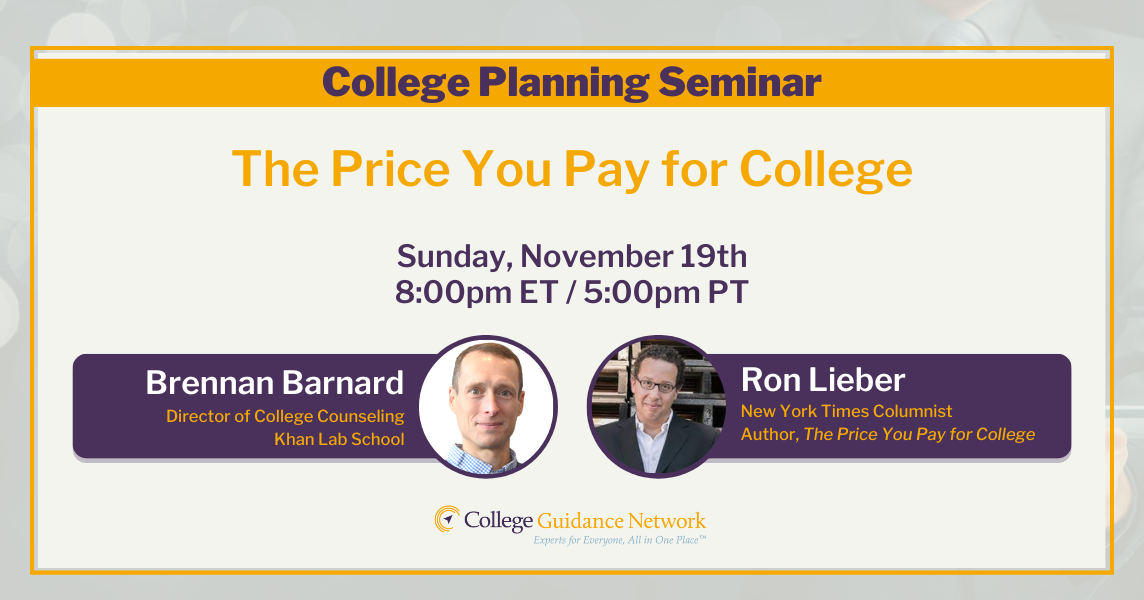
This Sunday (November 19 at 8:00 pm ET / 5:00 pm PT,) a free webinar is being offered that should be of interest to your students and their parents. It is hosted by Brennan Barnard, the Director of College Counseling & Outreach at Khan Lab School and will be a Q&A with “Your Money” columnist and author of “the Price You Pay for College”, Ron Lieber. It will be archived for viewers to watch at a later date.

Here is a link to the registration page: https://tinyurl.com/CGNNov19e

The Truth About Artificial Intelligence and Applying to College- Podcast

A recent podcast hosted by Rick Clark and Brennan Bernard featured Jeff Neill, Director of College Counseling at Graded, the American School of Sao Paulo. He discusses how he has begun to weave Artificial Intelligence into his work life, what it’s meant for how he manages his time, and how others can approach AI as a thought partner.

It’s a pretty interesting podcast that might be of interest. Check it out on Spotify here: https://open.spotify.com/episode/3vua8O2SDsGBz98AstNwKD?si=__USwTpcSjeWyEms4wWTlQ&nd=1

3 Ways Students Can Use AI to Help Build Their Resumes

AI shouldn’t be used to write a students college essay or to write a complete research paper. However, there are some great uses of AI that can help students. One way it can be used it to help them put together an excellent resume that will help them ultimately find that dream job.

Here are ways students can use AI to build out their resume:

1. Use AI to Help Write Your Professional Summary

Front and center at the top of your resume is your professional summary. Often the first thing that recruiters and hiring managers see, your summary should hook their attention quickly.

AI can analyze your career history and the job description. You can generate multiple versions in different tones to help you brainstorm how to weave in keywords and targeted skills.

2. Use AI for Better Bullet Points

Once a recruiter moves past your summary, they will likely scan your resume bullet points. You can leverage AI tools in a few different ways here. For one thing, AI can suggest more concise phrasing. Or, if you’re unsure how to quantify an achievement, AI can offer some suggestions.

When you’ve included the job description, AI can suggest short, punchy statements that match the targeted qualities more closely. That alone can help you rank higher in an ATS.

3. Use AI for Consistent Tone

While you’ll still need to infuse your personality throughout your resume, you can use AI to ensure consistent tone and styling throughout your document.

General AI tools, like ChatGPT and Grammarly, can really shine with this task. These tools will help you polish your resume by highlighting any readability issues, offering more concise phrasing, and ensuring that you’re maintaining your target messaging throughout.

These tips come from a nice blog that FlexJobs published “Using AI to Build Your Resume: Tips & Prompt Examples”. Check the full blog post out here: https://www.flexjobs.com/blog/post/using-ai-to-build-your-resume-tips-prompt-examples/

Top 16 Strategies for Deferred or Waitlisted Students

It may not be obvious, but a “waitlisted” or “deferred” status presents a unique opportunity for your students to demonstrate their motivation and resilience. So, why not seize it? Keep reading to learn about the most actionable strategies that will help them maximize their chances of ultimately securing their spot at the school of their dreams.

1. Determine Next Steps

If their name has been placed on a waitlist, we recommend they immediately work out what they are planning to do next. The best option at this stage would be to understand the reasons behind their waitlisted status and think about the best course of action. In particular, decide whether to continue pursuing a place at this specific school or consider an alternative.

2. Accept or Decline the Waitlist Invitation

After they have cleared their head and reviewed potential options, they can decide on the waitlist spot. If this university is their best pick and they have a real chance of getting off the waitlist, then accept the invitation. If they don’t think so, then decline it and reevaluate backup options.

💡 Quick tip:

Try to complete this step as soon as possible! The university won’t wait forever.

3. Choose a Backup College

We recommend they have a Plan B before rejecting a waitlist spot. Review the list of top universities once again and understand the admission requirements for each one. Ensure they will be able to enroll elsewhere without getting waitlisted again.

If they are waitlisted or deferred at the college of their dreams, try finding a similar one from their backup list. The waitlist decisions are often not made public until after May 1, so they will have time to consider their options.

4. Check Application Status

Keeping in contact with the college where they were waitlisted or deferred is crucial. This way, they will avoid unpleasant surprises. There is usually a special section on the universities’ websites where they can find their application and check its status. If they can’t find it, then contact the staff directly.

💡 Quick tip

We recommend checking on the status of the application as often as they can during admissions season. But don’t overdo it! If they call the committee daily, they may eventually get tired of them, which will lower their chances of getting admitted.

5. Be Realistic

Staying rational will help them objectively evaluate their chances. The following factors can assist them in doing it. Note that:

The more free spots on the enrollment list, the higher their chances.
The admissions committee will favor them if their field of study aligns with the university’s requirements.
If they are motivated and actively demonstrate it, the committee will put them above unmotivated candidates.
The stronger their application is, the higher they will be on the waitlist.
The lower the percentage of admitted students last year, the higher it will be this year.

6. Follow the School’s Instructions

As a rule, colleges publicly announce their instructions for anyone who got deferred or waitlisted. Find these instructions and use them to answer the following questions:

Which documents do you need to prepare?
What is not required of you?
What accomplishments and credentials do you need to have?
In what ways can you strengthen your candidacy?
How long will your college deferral or waitlist last?

If the university provides no instructions, feel free to ask officials for help. They can address their questions to the admissions committee or university secretary. The phone numbers and email addresses are usually found on the university’s website.

7. Send Important Updates

While they are waiting for their waitlist or deferral to end, be proactive! Try to improve their skills and earn some extra credentials. While they are at it, keep informing the admissions committee about their progress. They need to see that you take their requirements and expectations very seriously.

8. Focus on Supplemental Materials

After they have checked the school’s instructions for deferred and waitlisted students, we recommend they pay extra attention to supplemental material. It will improve their chances and make their application more competitive.

There are many things they can do in this regard:

  • Try retaking the SAT to get a better result. It’s a great and relatively easy way to strengthen their candidacy.
  • Start attending extra courses and maybe hire a private tutor. It will help them deepen their knowledge of specific subjects. They can also mention it in their waitlist letter, which we will cover later in this article.
  • Be more active in their extracurricular activities. The more achievements and certificates they have, the more the admissions committee will want them. Also, it’s a great way to boost essential skills and abilities!

9. Stay in Contact with the School

Another good strategy is to remain in contact with the admissions committee. It can give them an upper hand and help university officials make their final decision. Also, we recommend they show them that they are motivated and genuinely want to study at their university. When the time comes and the waitlist or deferral ends, they will be ready to demonstrate how much they have improved and thus become a much stronger candidate.

10. Submit Deposit to Their Next-Choice College

Being waitlisted means they have fewer chances of admission than in the case of deferrals. If they have been waitlisted, we recommend they choose a good backup university, accept their offer, and make a deposit (it’s usually around a few hundred dollars). They can inform the backup of their plan change at any time if they get off the waitlist. Sadly, they won’t be able to get their deposit money back, but it’s nothing compared to having nowhere to study.

11. Let the College Know They Can Pay

Reminding schools that they are able to pay for their studies never hurts, especially during the first year. Admissions committee members know that allowing a full-paying student in can relieve their budget. If they tell them that they have all the required funds and that their family won’t have problems paying for their education, they will be more attentive to their candidacy.

12. Identify Weaknesses in Their Application

This is one of the most effective strategies. If they really want admission, it’s vital to keep their application strong and competitive. They shouldn’t hesitate to ask you about their initial weaknesses and ways to improve them.

To help them with this important task, we present the ways to fix the drawbacks commonly found in applications.

❌ Weakness✅ How to fix it
An outdated application.Add all the recent updates regarding your skill growth and achievements. Don’t forget to mention how much you’ve improved since your initial application.
Making a brand of yourself.Don’t oversaturate your statement with emotions. The committee doesn’t want to hear students bragging about themselves or begging for a second chance. It’s crucial to have self-respect and be professional.
Being too cursory.It’s best to talk more about your personal experience without exaggeration yet with passion.
Forgetting to thank the university.Remember to thank the university and the commission for their time and attention. Be polite and respectful.

13. Get a Recommendation Letter

This is another excellent strategy for improving their chances of getting admitted. If they know any teachers, business people, or other people of influence, ask them to write a recommendation letter. It’s even better when they know somebody from the university they are applying to. Just remember that this letter must highlight their positive aspects only. If it is critical of them, they are better off without it.

14. Visit Campus

A good way of showing passion and motivation is to visit campus. It will allow them to get to know the college from the inside and make new acquaintances that can vouch for them. They should try making friends with professors and other students—they can be of great help later. Some professors may even invite them for an interview, which can become their actual golden ticket!

💡 Quick tip:

Visiting campus is also a great way to learn about the skeletons in the university’s closet. If they think the school is the place of their dreams, this impression may change once they visit it. This way, their expectations will be more realistic.

15. Stay Patient

Staying calm and patient is crucial for conserving their energy and nerves for more important things. If they have done everything they could but still ended up on the waitlist, don’t panic! They must understand that there is nothing wrong with their candidacy. It’s just that there are many things universities consider when making their decisions. Some can’t be changed no matter how hard we try, while others we can influence. Do everything in their power to get admitted, and everything will be fine.

16. Write a Waitlist Letter

This is the most important thing we recommend. If you want to seriously increase your chances, write a waitlist letter. It’s a great strategy that effectively shows interest and devotion to the admissions committee.

This information comes from a blog post “Navigating Waitlists and Deferrals: 16 Winning Strategies” from IvyPanda. Check out the full post here: https://ivypanda.com/blog/navigating-waitlists-and-deferrals-16-winning-strategies/

College admissions officers reveal what bugs them most

Parents and students behaving badly. 

Imagine yourself on the other side of the College Admissions desk.

It’s not so glorious apparently, or at least you need to be thick-skinned and good-natured. Joseph Connolly, a school counselor at New Oxford High School in New Oxford, Pa., wanted to know the pet peeves of admissions officers.

He sent out a request to members of the National Association for College Admissions Counselors and was deluged with responses. Apparently, college admissions officers were waiting for an opportunity to unload their hidden humor and their frustrations.

The following are actual accounts of students and parents behaving badly. The responses fall into several areas:

Communication

  • The E-mail address is silly, stupid, or offensive such as crazysexycheerleader@____.com.
  • Sending e-mails that use Instant Messaging or texting shorthand “im w8ing 4 some1 2 call me.”
  • Cell phone voice-mail messages with 30 seconds of a student’s favorite rap song.
  • Answering a cell phone during an interview.
  • Leaving a message with just a first name and no telephone number, “Hi, this is Suzie, please call me back.”
  • Chewing gum during an interview.
  • Misrepresenting the breadth and depth of activities. Not being able to respond to a follow-up question such as “What did you do as part of your involvement in _____?”
  • Yawning or acting distracted during a one-on-one interview. Nervous habits like hair-twirling, foot-tapping or “ums,” “likes” and “you knows” make a bad situation worse.
  • Not responding to e-mails from the admissions office.

Not doing your homework

  • Declaring in an interview that you want to major in marine biology or some other major that the college doesn’t even offer.
  • Not proofing the entire application — spell check will allow typos such as “Their is no substitute for human proofreading.”
  • Worse yet is the very common case of sending the heartfelt essay of “Why I want to attend (small private college)” to (big state university).

Gimmick overkills

  • Baking goodies: giant cakes of the campus mascot, cookies in the school colors, pizzas with mushroom messages of “please accept me.”
  • Creating life-sized sculptures with the figure holding an acceptance letter.
  • Delivering one sneaker — the old “one foot in the door” gimmick.

Overzealous parents

  • The very common comment “WE are in the process of completing applications.”
  • Parents attending interviews, and worse yet, speaking for their children.
  • Thinking that because Granddad played golf with a member of the board of trustees, Junior should be accepted.

Campus visits

  • Inappropriate clothing: Don’t wear high heels for a campus tour or expose too much skin.
  • Wearing college paraphernalia from another college to an interview.
  • Sitting in on a class and acting disrespectfully, i.e. texting, talking on a cell phone, falling asleep, not paying attention, or asking silly questions.

Essays

  • Writing a “boilerplate essay” and multi-purposing it for many schools without regard to the specific prompt.
  • Not fully answering the essay prompt. Especially the “why” part of the question.
  • Not identifying which essay choice they are responding to.
  • Writing about something they were great at in the seventh grade and haven’t pursued since then.
  • Using overworn cliches and generic statements that anyone could have written.
  • Responding to the “Why this college? essay without specific examples about why the college is a good fit

Lee Bierer is an independent college adviser based in Charlotte.
Send questions to: 
lee@bierercollegeconsulting.com, www.bierercollegeconsulting.com

here

Popularity is Overrated – New Video

You do not have to be popular to be happy. Middle and High school students are so concerned by what others think. This obsession with being popular can lead to anxiety disorders and other mental health issues. This is a great anti bullying video you can share with your students. We judge others by clothes, appearance, economics, and so much more. We do this to be popular and in with the in group. Keith Deltano has a great way of using comedy to get his message across.

Here is a link to the video: https://youtu.be/pfUDDtzLA4c?si=eqYjQMl1NIRLDE2I

Mental Health Resources to Support Students Navigating Life’s Challenges

All students have their own personal struggles. Some might do well in school but are often
bullied by their peers. Others might struggle academically, due to a learning disability, an
unstable home life, or other factors. Some are dealing with mental health conditions that
require extra support.


Regardless of their different challenges, all students need mental health support to some
degree. The pressures of being a high school student today are immense, and many kids are
pushing themselves to the limit in order to keep up in school.


As a counselor, you can help support students as they navigate life’s challenges, whether that’s coping with the loss of a parent or simply trying to get into their first-choice college.
Maintaining good mental health and well-being is difficult for many young people, and it’s
important to provide them with the resources they need to feel supported.


Understanding the Mental Health Needs of High School Students


Mental health overall has been worsening among young people. In 2021, 29% of adolescents
had poor mental health, and 22% considered committing suicide. Students reported a range of mental health problems, but the most common issues were anxiety, depression, and stress.


Certain groups of students are also more likely to experience poor mental health, due to
external factors. Students in the LGBTIQA+ community, for example, often experience these
types of mental health problems due to a lack of familial support, bullying, and other social
problems. Students in racial and ethnic minorities are also more likely to experience poor
mental health, due to the behavior of their peers.


It’s important for teachers and school counselors to understand the signs of mental distress in students. Social withdrawal, changes in behavior, and declining academic performance are just some of the indications that a student might be struggling with their mental health.


The Role of High School Counselors in Mental Health


As a counselor, you do your best to support student mental health and to talk through challenges with the students who reach out to you. However, there aren’t enough hours in the day and some students might also need additional support that is beyond your knowledge and expertise.


With that in mind, one of your most important roles is to assess what the student might need and help them to connect with those resources. Sometimes, that might mean working with school administrators, teachers, parents, and even resources outside of the school.

Staying up-to-date in terms of your knowledge and current best practices for counseling is
critical. This will help you refer your students to the resources that will be most helpful for them and their individual needs.


Accessible Mental Health Resources


In addition to in-house counseling and other school-based resources, you can connect students with accessible mental health resources available in the community. Making sure that students have numbers for crisis helplines is an important step, but you should also make contact with local resources, such as community mental health centers.


Identify support groups, local nonprofits, and online mental health platforms that students can use as additional sources of support. Depending on their situation, different formats or types of support can be helpful, so be sure to provide different options.


You might also need to provide these kinds of resources to students’ families when it’s appropriate. Parents often don’t know what to do when their child is struggling with mental health problems, and you can help by pointing them in the right direction!


Self-Help Strategies for High School Students


Another way to help students with their mental health is to provide them with options for
healthy coping. Teaching students stress management techniques such as grounding and
breathing exercises, mindfulness, and meditation, can help them cope with life’s challenges and maintain their mental health even during tough times.


You can also help them develop skills to cope with academic pressures. Help them learn time management techniques, study skills, and more. These strategies can help students reduce stress and maintain their academic performance when they are dealing with life’s challenges. Also, remind them to seek help when they need it!


Promoting Mental Health Awareness in Your High School


Students don’t always know that they need help and support for their mental health. They
might also feel uncertain or scared about bringing their problems to the counseling office. One way to help with these problems is to promote mental health awareness in your school.


Awareness campaigns, workshops, and seminars on mental health can accomplish two goals. First, they help to normalize seeking help and build an understanding that many people experience these kinds of issues. They also give students basic mental health knowledge that can help them in their own well-being journey.


A Counselor’s Role: Communication and Building Trust

Above all, students need to feel safe when they walk into their counselor’s office. They need to know that you respect them and their privacy. Providing open and non-judgmental communication helps to build trust and allows counselors to better support students in building and maintaining their mental health and well-being.


Being a counselor isn’t always easy. However, when you’re able to provide resources that allow students to thrive, you are truly making a positive difference in the world.

Newer Posts
Older Posts

Link for Counselors

Current Publication

View Current Publication

Advertisements

LINK Newsletter for Counselors

Sign up to receive our bi-weekly e-newsletter.