Menu Sidebar
Menu

Navigating the Discussion on Antisemitism with High School Students: Educate, Engage, and Empower

Addressing complex and sensitive topics like antisemitism in high school environments is crucial to fostering understanding, empathy, and combating prejudice. With the situation in Israel/Gaza this topic is at the forefront of conversation around the country. As educators and mentors, engaging in discussions about such topics is an opportunity to encourage critical thinking and promote a culture of inclusivity and respect. This blog post aims to outline effective strategies and approaches for discussing antisemitism with high school students, emphasizing the importance of education, open dialogue, and empowerment.

Understanding Antisemitism

Before engaging in conversations about antisemitism, it’s essential to establish a foundational understanding of what it is and its historical roots. Antisemitism refers to prejudice, discrimination, or hostility directed against Jewish people. It has a long and troubling history, often manifested in stereotypes, hate speech, violence, and systemic discrimination. Exploring the history of antisemitism, including significant events such as the Holocaust, helps students comprehend the severity and impact of such bigotry.

Creating a Safe and Open Environment

Establishing a safe space where students feel comfortable expressing their thoughts and asking questions is crucial. Emphasize the importance of respectful dialogue and the value of diverse perspectives. Encourage active listening and understanding differing viewpoints while maintaining a zero-tolerance policy for hate speech or discriminatory comments.

Utilizing Educational Resources

Introduce a variety of educational resources to provide context and insight into the topic. This might include documentaries, literature, survivor testimonies, and historical accounts. By incorporating diverse materials, students can grasp the multifaceted nature of antisemitism and its impact on individuals and societies.

Encouraging Critical Thinking

Engage students in critical thinking exercises that challenge stereotypes and encourage them to analyze media portrayals and cultural representations of Jewish individuals. This can involve examining news articles, films, or social media content to understand how biases and prejudices can be perpetuated.

Promoting Empathy and Perspective-Taking

Encourage students to develop empathy by considering the experiences and perspectives of those affected by antisemitism. This might involve role-playing scenarios, where students take on different roles and attempt to understand the emotions and challenges faced by individuals targeted by prejudice.

Empowerment Through Action

Beyond understanding and empathy, empower students to take action against antisemitism. This could involve organizing awareness campaigns, participating in community events, or collaborating with organizations dedicated to combating hate and promoting tolerance.

Continuing the Conversation

Antisemitism is an ongoing societal issue, and it’s important to foster a continuous dialogue. Encourage students to continue discussing these topics outside the classroom, at home, in their communities, and on social media. This fosters a culture of ongoing education and awareness.

Conclusion

Discussing antisemitism with high school students is an opportunity to mold future generations into compassionate, informed, and empowered individuals. By fostering open dialogue, providing education, encouraging critical thinking, promoting empathy, and empowering action, we can instill values of tolerance and understanding, ultimately contributing to a more inclusive and harmonious society.

Engaging high school students in discussions about antisemitism is a powerful step towards a future free from prejudice and discrimination. Through education and open dialogue, we can empower the leaders of tomorrow to build a world where differences are embraced and celebrated.

8 Best Questions to Ask in an Interview

Most of your students will be going on interviews at some point in the next few years so it is important that they begin preparing. Here are 8 questions they should ask the interviewer provided by Resume Genius:

1. How has your company adapted to recent industry changes or trends?
If a company merely acknowledges industry shifts without taking actionable steps, it might indicate a lack of innovation or foresight. Job seekers should look for companies that not only recognize but also proactively adapt to industry changes. By doing so, candidates can also highlight their own keen awareness of industry dynamics and their adaptability.

2. What two or three qualities define a top performer at your company?
Understanding what a company values in its top performers can provide insights into its culture and expectations. If a company’s definition of a top performer is vague or misaligned with a candidate’s values, it might not be the best fit. Job seekers should seek companies where their strengths and values align with those of top performers.

3. How does your company foster professional development and career growth?
A company’s commitment to employee growth is a strong indicator of its overall culture. If professional development is limited to certain roles or levels, it might suggest a lack of equal growth opportunities. According to LinkedIn’s 2023 Workforce Learning report, employees prioritize “progress toward career goals” as their top motivation to learn. By demonstrating a long-term career vision during interviews, job seekers can position themselves as ambitious and prioritize companies that offer clear and inclusive growth paths. 

4. Can you share more about the specific team that I’d be working with if hired?
Understanding team dynamics is crucial for a smooth transition into a new role. Job seekers should look for companies that are open about team structures and dynamics and be able to highlight their skills that could bridge a gap or provide additional support.

5. What do you think is the most challenging aspect of this job?
Addressing potential challenges head-on demonstrates a job seeker’s problem-solving mindset. It also provides an opportunity to demonstrate one’s proactive approach and readiness to tackle challenges head-on. Also, recognizing potential challenges upfront can set realistic expectations and prepare candidates for success. Candidates should seek companies that are candid about the challenges and offer support to overcome them.

6. Can you describe the company’s culture and core values?
A company’s culture and values are foundational to job satisfaction. If a company struggles to articulate its culture or if its stated values seem misaligned with observable behaviors, it might be a red flag. Job seekers should prioritize companies where the culture and values resonate with their own.

7. What do you personally enjoy about working here?
Personal insights provide a genuine perspective on the company’s work environment, so job applicants should look for companies where employees speak passionately and authentically about their experiences. This question not only provides a clearer picture of the workplace but also serves as a powerful rapport builder between the candidate and the interviewer.

8. Could you share a piece of career advice based on our conversation today?
This question showcases a candidate’s commitment to continuous learning, personal growth, and value for diverse viewpoints. This approach can also emphasize the candidate’s eagerness to learn from experienced professionals and apply insights to their career journey. 

Social Media and Cyberbullying: A Guide

The modern world for youth is very different than the environments most of us grew up in. Nowadays, social media is the number one avenue for children to be bullied and cyberbullying is one of many negative effects that we are seeing on kids from social media apps. Cutter Law has compiled a guide that takes a deeper dive into the connection between social media and cyberbullying. This guide includes more information about its prevalence, who is most affected, and how we can prevent it. Check it out here: https://cutterlaw.com/social-media-and-cyberbullying-guide/

Do you know the 5 different types of Test-Optional policies?

Test-Optional for All Students: All applicants have the choice of submitting standardized test scores. No one is required to submit scores, but they can if they wish.

Test-Optional for Some Students: Some specific academic programs or applicants (like homeschooled students or international students) may still be required to submit test scores.

Test-Flexible: SAT or ACT scores can be submitted with this policy, but these schools typically accept other test scores as well, such as Advanced Placement (AP) exam results or International Baccalaureate (IB) scores. 

Test-Blind: Colleges do not consider standardized test scores whatsoever during the application process. Even if a student submits their scores, the college will not review or use them in their evaluation. 

Test-Optional with Scores Required for Scholarships: Some colleges might adopt a test-optional policy for general admission but still require standardized test scores if a student wants to be considered for merit-based scholarships. In this case, test scores are used solely for scholarship purposes, not for admission decisions.

This comes from a guide/blog post that Going Merry recently published which also includes a list of schools that are test-optional as well as more information about why schools are now offering test-optional as a policy. Check it out here: https://www.goingmerry.com/blog/test-optional-colleges/?utm_source=sendgrid&utm_medium=email&utm_campaign=unreg-counselors-oct-26&utm_term=unreg-counselors

Do Your Students and Their Parents Understand the Different Types of Federal Loans?

If not, we found a recently published guide that can help them. U.S. News & World Report just published a blog that outlines the four different types of federal funding with an overview of each.

Four types of federal student loans are available:

  • Direct subsidized loans
  • Direct unsubsidized loans
  • Direct PLUS loans
  • Direct consolidation loans

Here is a link to their post giving an overview of each type: https://www.usnews.com/education/best-colleges/paying-for-college/articles/understanding-federal-student-loan-types

We recommend researching grants and scholarships but realistically those will not cover the entire cost of college so some funding is necessary. Federal loans are typically preferrable to private student loans as they typically will have lower interest rates. This guide can help your students decide which source may be right for them.

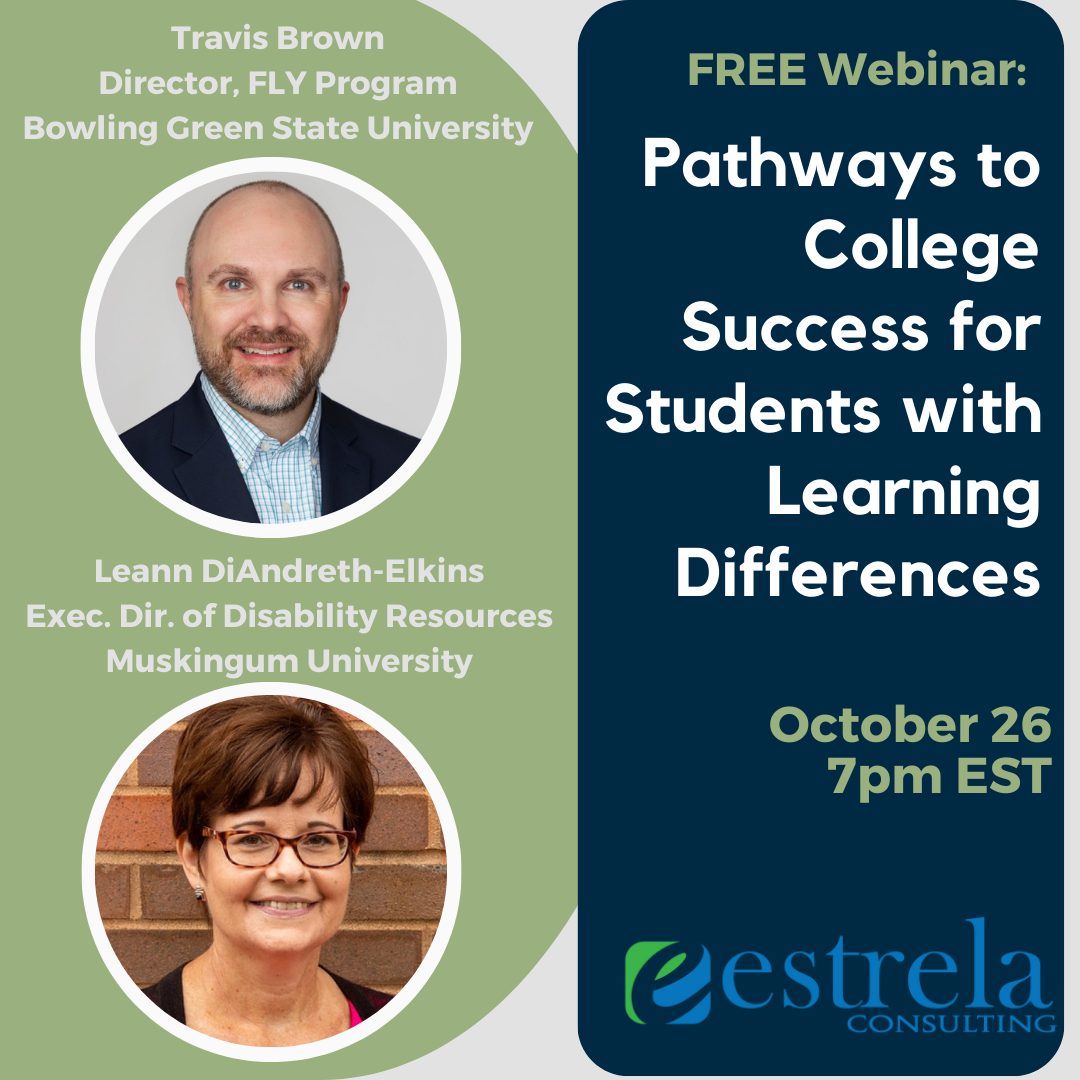
Pathways to College Success for Students with Learning Differences – Free Webinar

Join Estrela team members Alyson Campbell & Amber Gilsdorf as they highlight programs that are committed to post-secondary success for students with learning differences. Many students require different levels of support to be successful in college. This webinar will focus on what to look for when seeking support for your student. Joining them will be Travis Brown from Bowling Green State University’s FLY program and Leann DiAndreth-Elkins representing Muskingum University’s PLUS program. Both schools offer programs specializing in additional academic support services for students with learning differences.

Parents, students, school counselors, IECs and educators are encouraged to attend. There will be a Q & A at the end. The webinar will be live on October 26th and then archived and available to registrants free to watch any time after that date. Here is the link: https://us02web.zoom.us/webinar/register/WN_WHwaQJM9S12SAlXIgdMcQg

One for Two Education Foundation Scholarship

The 1 for 2 Education Foundation is seeking highly motivated applicants of accredited U.S. four-year
colleges and universities.

For the 2023 academic year, the Foundation selected a diverse group of four scholars who attended both
public and private high schools from four states. Grants of up to $20,000 per academic year were made
to attend both public and private colleges and universities across the U.S.

For the 2024 academic year, the Foundation intends to award at least two merit-based scholarships. The
size of the individual grants is determined on the basis of tuition remaining after considering all other
forms of tuition assistance obtained by the scholar.

Requirements to Apply:
• An up-to-date official transcript from the current school
• Indicate a commitment to the Foundation’s Pledge
• All required application questions must be answered and fields completed
• Applicant must be living in the United States but is not required to be a U.S. citizen or permanent
resident
• The college or university must be in the United States
• GPA must be at least 3.7 unweighted, 4.0 weighted


Application Deadline: February 1, 2024


The Foundation considers the applicant’s high school academic record, leadership and community
service activities, and letters of recommendation. Applicants are also assessed on the alignment of their
values with the Foundation’s values as it relates to their intention to fulfill their Pledge to the Foundation.
While receiving a scholarship from the Foundation, scholars are required to attend the Foundation’s
annual gathering. During this event, scholars will have a chance to meet other scholars, graduates, and
directors. They will also participate in personal development and learning sessions aimed at preparing
them for academic, career, and life goals. The 2024 Gathering is planned for August 1-5, 2024, in
Michigan. All reasonable costs to attend the Gathering are covered by the Foundation.
Applicants are required to make the following pledge:
In consideration of the 1 for 2 Education Foundation (“the Foundation”) making this scholarship grant I
pledge to support the mission of the Foundation by:
a) participating in the annual Foundation Gathering while receiving my scholarship,
b) supporting my fellow Foundation Scholars’ academic and career goals during my lifetime, and
c) paying for a comparable scholarship grant for two persons, who are not related to me by blood,
adoption, or marriage, during my lifetime.

Application link: Apply Now – 1 For 2 Education Foundation – https://www.1for2edu.com/scholarship/

College Planning Seminar – Honors and Activities: More Than Just a List – Free Webinar

The College Guidance Network is hosting a free webinar that covers the honors and activities section on the college application. What should your students do? Just list a bunch of stuff they have done. Well, actually there’s more to it than that. The webinar has an interactive Q&A that provides expert advice on: **Ways to emphasize the quality of your commitments over the quantity **What counts as an activity? (Spoiler alert: more than you might think) **How much weight admission offices put on this section.

Featuring Jeannine Lalonde, Associate Dean of Admission, University of Virginia and hosted by
Brennan Barnard, Director of College Counseling, Khan Schools Network

Here is a link to register/view the webinar: https://us02web.zoom.us/webinar/register/WN_Fa6MjPhuShi2iRAj1bP6gQ#/registration

Let’s Get Digital

It has been said (including by me) that the first time you do something it’s innovation, and the second time tradition.

The title of the previous post was a feeble attempt at humor, featuring a bad pun based on a line from a Barry Manilow song. The title of this post features a less bad pun based on a song by Olivia Newton-John. I assure you that this will not become a habit.

One of the joys of writing this blog is finding a community of readers and correspondents. When I started eleven years ago I was far from sure that I had anything worth saying (on many days that is still the case) and far less sure that anyone would want to read my musings. I am grateful for the ECA readers who send me emails about specific articles or who stop me at conferences (I don’t mention that because I’m looking for compliments and comments).

I occasionally get emails from readers suggesting topics for me to address. I remember flying into San Diego for the NACAC Conference a few years back. While I was in the air with my phone in airplane mode, the announcement came out about the introduction of the Coalition Application. By the time I landed I had an email from now-retired loyal ECA reader Jon Reider with the message, “Someone needs to do something about this.” I quickly inferred that “someone” meant me. In 2019 when the Operation Varsity Blues scandal hit and the media insisted on calling it an “admissions” scandal, legendary Georgetown Dean of Admissions Charlie Deacon contacted me to suggest that I point out that none of those charged were admissions or counseling professionals (unless you consider mastermind Rick Singer an independent educational consultant rather than a con man masquerading as one).

Last week ECA reader Tim Gallen reached out to ask that I write about the fiasco regarding the October 11 administration of the new digital PSAT. That day lots of schools and lots of students attempted to administer or take the PSAT only to instead get a message on the College Board test day website, “Sorry! There is something wrong on our end and we’re working hard to fix it. Come back later and try again.” Social media erupted with messages from frustrated counselors.

It is important to stop here and recognize that the failures of the College Board to deliver its product are a minor inconvenience compared with what the people of Israel went through four days before with the terrorist attack, murders, and hostage taking on the part of Hamas. The events in the Middle East quickly put college admissions issues into perspective.

Nevertheless, the digital PSAT failure was beyond annoying for many counselors. Tim recounted his frustrations. “For me, part of the frustration was how little guidance we got from College Board. It seemed like I could never find the answers on their web site that I needed, I spent hours on hold without being able to get through to anyone on the phone before the test, and the emails came very late in the process…I also spent many extra hours going into the exam trying to figure out who had completed their exam setup and who had not because the dashboard forces us to check each student individually.  I provided more free labor for this exam than any other in my 21 years administering the PSAT.” He added that the College Board never reached out to PSAT coordinators to acknowledge the problem or to let them know that the Test Day Toolkit app was back online.

Should the College Board have anticipated that things would go wrong and been more prepared? This is not the first time that technology has failed during a College Board exam, including at least one Advanced Placement exam last spring.

I am willing to give the CB a pass on the tech problems. We all know that technology will fail at inopportune times. I remember the technology administrator at my school doing a presentation about technology as a transformative teaching tool during faculty work week. In the midst of his presentation the internet connection failed, confirming the suspicions of his skeptics. On the very first day of school after we moved to post student schedules on the Student Information System, the SIS went down in the first hour of the day, and when a student who was late to school because of a doctor’s appointment wanted to know where he should go to class, no one could tell him.

I am less gracious about the College Board’s response to the screw-up. I went on the College Board website the morning after the fiasco. There was nothing in the College Board newsroom. The only acknowledgement that there had been an issue was a box at the top of the SAT suite help center with a green check mark and the words “The earlier issue with Test Day Toolkit has been resolved. You can proceed with testing. We apologize for the inconvenience.”

I’m not sure that’s sufficient. Apologizing for the “inconvenience” sounds corporate, the kind of apology you get when an airline cancels your flight. It’s not far from the classic non-apology, “I’m sorry if anyone was offended.”  There’s no responsibility taken and no acknowledgement that the screw-up upended school days all over the country, wasting time and generating stress for both students and counselors.

There is a bigger issue here. Why should schools provide free labor for the College Board? Why should counselors do the work while the CB collects the revenue? It’s not like the College Board is poor. In 2021 (the most recent year for which a Form 990 is available), it made $112 million in profit. That’s a pretty profitable non-profit.

It’s a question worth considering. A College Board presentation at the recent NACAC conference in Baltimore indicated that 60 percent of SAT administrations are now done through school day testing rather than at test centers. School day testing and the digital test will place more burden on schools and school counselors. When we administer the PSAT or SAT in school, are we acting as agents of our school or for the benefit of the College Board? It’s mostly for the College Board. So where is the compensation?

Is administering the PSAT still necessary in a test-optional college admissions world? And is it time for school counselors who administer College Board tests to join Hollywood writers and auto workers and go on strike for better pay and better working conditions, i.e. technology that works?   

The prior post mentioned and all of James Jump’s prior posts can be found on his blog at the Thoughtful College Search. Here is a link – http://www.thoughtfulcollegesearch.com/

Newer Posts
Older Posts

Link for Counselors

Current Publication

View Current Publication

Advertisements

LINK Newsletter for Counselors

Sign up to receive our bi-weekly e-newsletter.