Menu Sidebar
Menu

Senior Checklist for 4-Year College Pathway

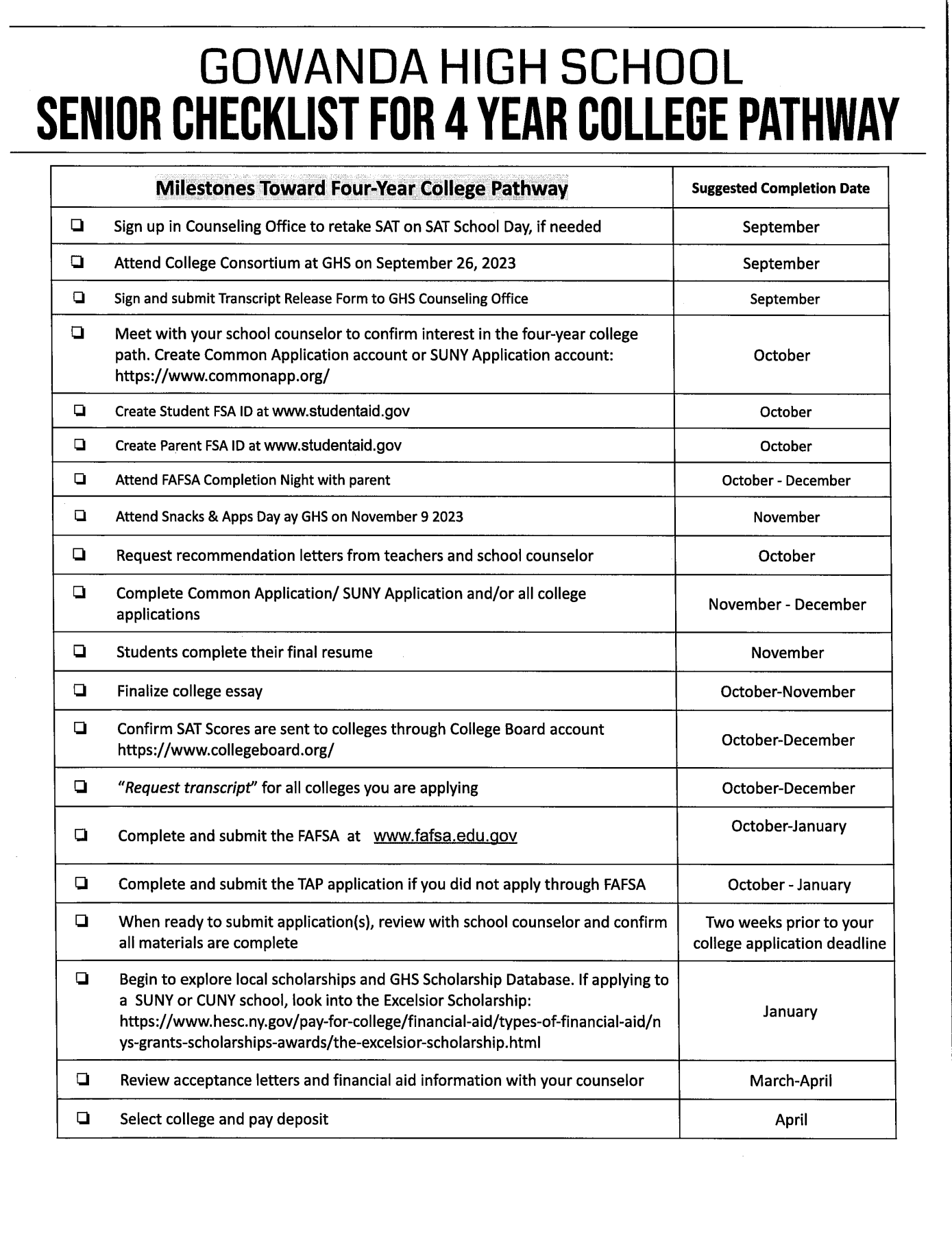
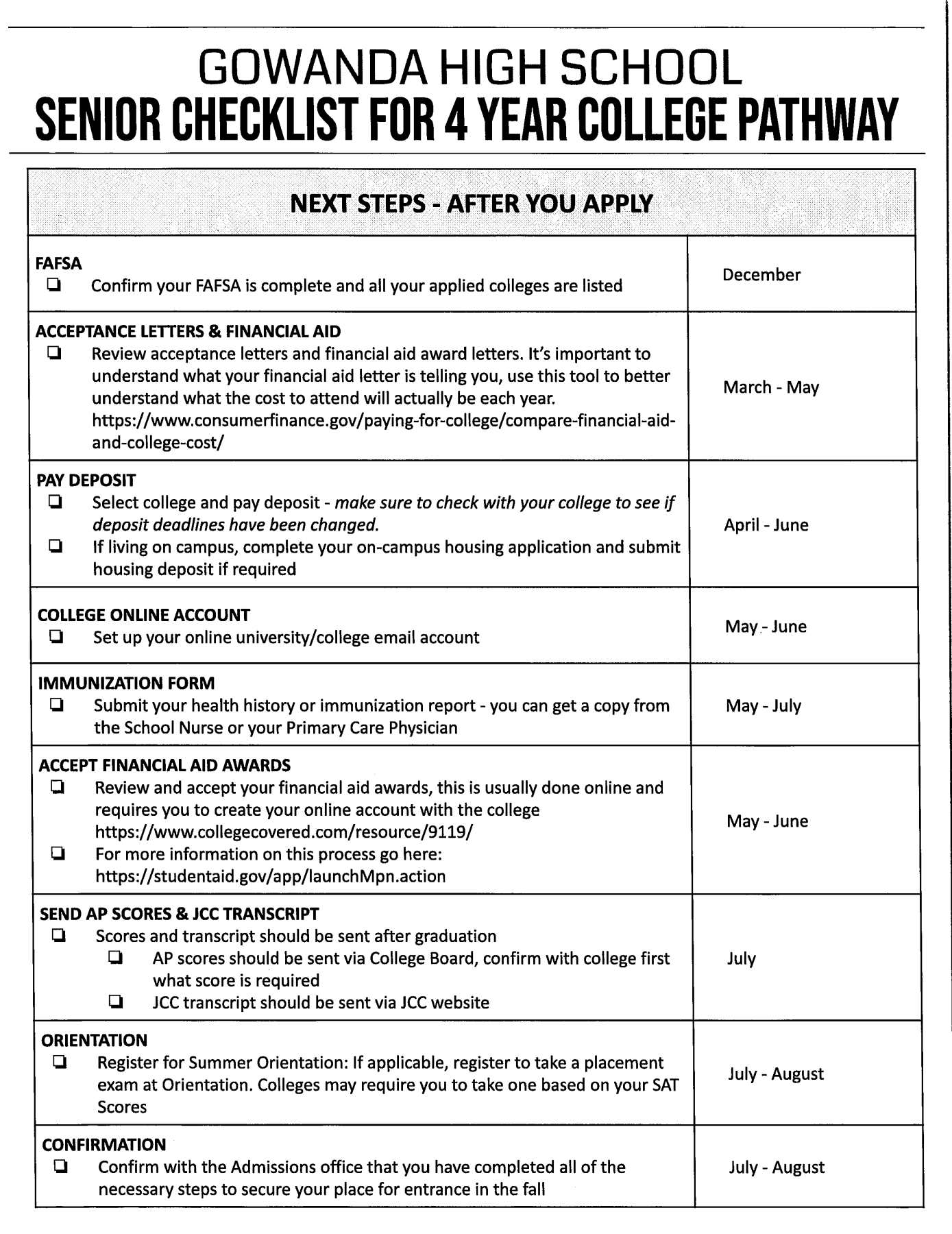
The Counselors at Gowanda High School have put together a nice checklist you can use with your students that are looking to attend a 4-Year College next year:

They also have checklists for students that plan to join the workforce right after high school, those that are considering embarking in a military path and those that want to attend a junior/community college after they graduate. here is a link to their document: Senior Pathway Checklist

Organizations That Provide Support for Students With Disabilities

Many organizations provide advocates, resources, and empowerment for students with physical and sensory disabilities. If you’d like to learn more, check out the following.

American Speech-Language-Hearing Association

With an audiologist network of more than 228,000 members and affiliates, the American Speech-Language-Hearing Association (ASHA) supports individuals with speech, language, and hearing disorders. Its goal is to improve communication and accessibility for people with hearing impairments by providing timely resources.

Autistic Self Advocacy Network

The Autistic Self Advocacy Network (ASAN) is dedicated to promoting and supporting the rights of those with autism as well as boosting their self-advocacy and inclusion. It focuses on community-building, public policy advocacy, and educational initiatives to ensure that individuals with autism have a voice in decision-making.

Disability Rights Education & Defense Fund

The Disability Rights Education & Defense Fund (DREDF) is a leading national civil rights law and policy center dedicated to advancing the rights of people with disabilities. To ensure equal access and opportunities for individuals with disabilities, it provides legal advocacy, education, and resources.

Learning Disabilities Association of America

The Learning Disabilities Association (LDA) provides support and resources for individuals with learning disabilities, their families, and professionals. By providing information and advocacy, it claims to be “the voice for individuals with learning disabilities of all ages.”

National Center for Learning Disabilities

The National Center for Learning Disabilities (NCLD) focuses on education and research to empower students with learning challenges. This organization believes that students with learning disabilities often fail in school because of a lack of support from their peers, not because they are less capable. Specifically, NCLD works to improve outcomes for people with learning and attention issues.

This information was compiled from a blog post made at Architectural Digest. It included other great information such as how college students can support students with disabilities, how to design a dorm room to be more comfortable for students with disabilities and more. Check it out here: https://www.architecturaldigest.com/reviews/moving/accessible-college-dorm

FAFSA Made Simple: What You Need to Know – Free Archived Webinar

There continue to be a lot of questions pertaining to the changes to the FAFSA particularly due to the delay of its implementation. In an archived webinar sponsored by Polygence, Mark Kantrowitz, President of Cerebly, Inc. covers all the new changes to the 2024-2025 FAFSA, Mark noted these key consequences for families. For example, the new net price calculators will not be accurate until mid-winter for families. Access the webinar here: https://drive.google.com/file/d/1yW8DDOMjj8H3YQq1bpIn9t9wQKpUox3d/view?_hsmi=0&_hsenc=p2ANqtz-_35XNqv1l6TEE3qXI2_fejNxaUpYeqwQf49TtAB5fxLG6MVvx2iBtfIjTuzeGUwT3-Qtf3eWEIfOsQYdimTxlxJPw1nA

8 Reasons a Student Should Work a Part-Time Job During College

College is a thrilling and transformative period for young adults. It’s a time when students are not only expanding their knowledge, but also developing crucial life skills and figuring out who they are and where they may fit career-wise upon graduation.

An excellent way to enhance this experience is by obtaining part-time employment while pursuing a college degree. Though balancing academics and work may seem daunting, the benefits of employment during college are vast and can significantly impact one’s future success.

Below are some of the most notable benefits to working while in college.

Financial independence and responsibility

College is expensive. Besides tuition, textbooks and living expenses, there are “extras” like laptops and study abroad. Employment provides students with a steady source of income, reducing the financial burden on themselves and their families and, ultimately, their reliance on student loans. In other words, they have “skin in the game.”

It also teaches financial responsibility and budgeting, skills that are invaluable in adulthood. Students who become more responsible with their money are less likely to accrue excessive debt or fall into financial traps that may hinder their post-college lives.

Improved Time Management

Juggling multiple responsibilities forces a student to prioritize tasks, meet deadlines and make efficient use of their time. These skills are not only beneficial in college, but also in future careers.

Real-World Experience

While classroom learning is vital, real-world experience is equally important. A part-time job offers students the opportunity to apply what they have learned in their coursework to practical, everyday situations, whether that’s customer service, problem-solving, communication or teamwork. These skills are transferable and highly valued by future employers, giving employed students a competitive edge.

Career Exploration

Jobs in college can provide a lot of insight into potential career paths. By working in a field related to their major or interests, students can gain first-hand experience and a clearer understanding of their future career goals, which in turn, leads to making more informed decisions when it comes to academic and career choices.

Networking Opportunities

Employment exposes students to a diverse range of people, including coworkers, supervisors and customers. Networking is a powerful tool for future job opportunities, forming connections that can one day provide valuable references and recommendations when entering the job market upon graduation.

Resume Enhancement

Being employed during college adds substance to your student’s resume. Employers appreciate candidates who demonstrate the ability to balance work and academics. It showcases a strong work ethic, responsibility and dedication, all of which are desirable qualities in potential employees.

Personal Growth

The challenges that come with balancing academics and work can lead to immense personal growth and ultimately, increased self-confidence. Overcoming obstacles and achieving success in both areas can boost your student’s self-esteem and resilience.

Higher Earnings Later On

Research shows that students who were employed throughout college earned more immediately upon graduation, and still up to 15 years later. A 2019 study completed by researchers at Rutgers University and the City University of New York (CUNY) found that those who held a paying job throughout their college careers earned up to $20,000 more than their classmates who did not work during college.

Keep in mind that research also shows that working more than 15 hours a week can keep a student from graduating on time, so it’s important to not become over-invested in work and lose sight of that diploma.

Still, being gainfully employed during college offers numerous benefits that extend beyond the financial. Students obtain important real-world experience, enhance their skills and prepare themselves for the challenges of the future job market. While it may require diligent time management and effort, the long-term rewards make it a valuable investment in one’s education and future career.

Samantha Bartek is community outreach director for My College Planning Team, which helps families plan and pay for college. As a National Certified Counselor (NCC), she has worked in both public and charter schools with a focus on college and career readiness for 11th and 12th graders. She lives in New Jersey.  www.collegeplanningteam.com

Is the new FAFSA as frightening as we imagine?

Ghouls and goblins aren’t the only thing lurking around the corner this season. Big changes are coming to the Free Application for Federal Student Aid (FAFSA), and they may be just as frightening!

The FAFSA Simplification Act has resulted in many changes meant to make it easier for students to file. The application is being streamlined to reduce the number of questions from 108 down to 46, and depending on a student’s answers, some questions may not be asked at all. How this simplification will change the landscape of federal student aid remains to be seen and is giving some the shivers.

One of the most significant changes will be a transition from the previously used Expected Family Contribution (EFC) to the Student Aid Index (SAI). Those already attending college are familiar with the EFC, and some are convinced it doesn’t quite hit the mark on what families can afford. The SAI will result from a different evaluation, one that changes who and what contributes to a family’s ability to pay for college.

One change affects which parent or parents file the FAFSA. For example, if a student’s parents are divorced and not remarried, the parent whose information is included on the FAFSA will be the parent who provided the most financial support, not the one the student lived with more, as it has been in past years.

Applicants will now be required to use the Direct Data Exchange with the IRS to pull their tax information into the application. This mechanism is different from the optional Data Retrieval Tool previously available to applicants. The number of people in the household will no longer be a consideration in determining the SAI, though the question will still exist. There is also the possibility that the SAI could be minus-1,500, whereas the EFC didn’t go below zero.

The way these results are used to determine a student’s aid offer has always been a bit shadowy, but these changes will require financial aid offices to rethink how they determine awards and interpret a family’s ability to pay. The new application is anticipated to be live sometime in December, later than previous years when the FAFSA became available October 1.

Income information will come from a family’s 2022 tax return. If the current financial situation is different from what was reported then, students and families may consider appealing their financial aid application. Administrators can exercise professional judgment that may impact eligibility, so families shouldn’t feel they have no recourse.

The impact of these momentous changes remains to be seen and will be like emptying your bag of Halloween candy to see what you get. For me, I’m just hoping for more candy bars than black licorice or toothbrushes!

Jennifer Harpham is a client services manager with My College Planning Team, www.collegeplanningteam.com . A financial aid professional with more than 30 years of experience, Jennifer is passionately committed to helping students and their families afford the dream of a college education. She is an active member of both national and state financial aid associations. Jennifer holds an MBA from the University of Findlay and a bachelor’s in business administration from Mount Vernon Nazarene University.

Navigating Early Decision and Early Action Deadlines

As the college application season kicks into high gear, parents of college-bound students may find themselves trying to figure out which of the various deadline options are best for their student. Two of the most common application deadlines are Early Decision (ED) and Early Action (EA).

Understanding these options, their differences, benefits and important deadlines is crucial to helping your student make informed decisions about their college journey. In this article, we’ll break down the distinctions between Early Decision and Early Action and provide you with the key dates to keep in mind.

Early Decision (ED): The Binding Commitment

Early Decision is a college application process that offers a unique advantage and, at the same time, requires a significant commitment. Here’s what you need to know:

1. Binding Commitment: When your student applies ED, they are making a binding commitment to attend that college if accepted, regardless of other offers. This means they can apply to only one college under the Early Decision option and must apply to all other colleges under the regular admission schedule.

2. Application Deadline: The ED deadline at most schools is November 1. However, this can vary from school to school, so it is always best to have your student check in with their admission counselor at the school they are applying to. Some schools may have two ED deadlines, ED1 and ED2, so be sure to pay attention to the options, requirements and deadlines.

3. Advantages: Applying ED can boost your student’s chances of acceptance since colleges often admit a higher percentage of their incoming class through this route. It also demonstrates strong interest, which some colleges consider in the admission process.

4. Financial Considerations: ED applicants receive their admission decision earlier, often in December. However, it’s crucial to be aware that financial aid offers may not be finalized before this date. Ensure that you can meet the financial obligations if your student is accepted. My College Planning Team can help you figure out the best way to pay for college based on your family’s unique circumstances.

Early Action (EA): The Non-Binding Option

Early Action provides some of the advantages of Early Decision without the binding commitment. Here’s what you need to know:

1. Non-Binding: Students applying EA are not obligated to attend the college if accepted. They can apply to multiple colleges under EA. If your student is struggling to finalize their college list or complete their application, schedule a call with My College Planning team as soon as possible to see if working with a private counselor will help your student meet these deadlines on time.

2. Application Deadline: EA deadlines typically align with ED deadlines, with November 1 being the most common. However, EA applications are non-binding and some schools also have two deadlines for applying Early Action. The EA1 deadline is often November 1st, but just like with ED, this can vary from school to school. The EA2 deadline is typically in December. Your student can confirm these dates by checking in with their admissions counselors or on the college admissions website.

3. Advantages: Many colleges also admit a higher percentage of students during their Early Action round. EA applicants receive their admission decisions early, often in December or January. This allows your student to have more time to consider their options and compare financial aid packages.

4. Flexibility: EA provides flexibility, as students can apply to a range of colleges all under EA and still have plenty of time to make an informed decision.

Single Choice or Restrictive Early Action is an additional application plan offered by some colleges. This plan is typically non-binding like other EA plans, but restricts students from applying ED or EA to other schools.

Key Dates to Keep in Mind

Here are some essential dates to remember as you and your student navigate the Early Decision and Early Action process:

November 1 is the most common deadline for both Early Decision and Early Action. It’s important to research deadlines for each college as some may be as early as October 15.

Notification Dates: Most colleges notify ED and EA applicants of their admission decisions in December or January. Be prepared for the possibility of some decisions arriving before the winter holidays.

Regular Decision (RD) Deadlines: For colleges that offer Regular Decision, these deadlines are typically in January. Students applying RD will receive their admission decisions in the spring. This is slightly different from Rolling Admission, in which there is not a deadline.

Both Early Decision and Early Action can be beneficial for college-bound students, depending on their preferences and circumstances. Early Decision offers a binding commitment and, even though it is a more competitive process, it can still increase the chances of acceptance. Early Action provides the advantage of early notification without the binding agreement. It’s essential to research each college’s policies and deadlines carefully, considering your student’s academic and financial situation, to determine which option is best for them. By staying informed and engaged in the process, you can help your student make the right decision for their future.

Amanda Gohl is director of Student Services for My College Planning Team. A high school counselor for 12 years, she is a member of the American School Counselor Association (ASCA), Michigan School Counselor Association (MSCA), Michigan Association for College Admission Counseling (MACAC) and Oakland Counseling Association (OCA). She is the current vice president of OCA and MCAN School Counselor Fellow.  Amanda holds a master’s in school counseling from the University of Detroit Mercy and a bachelor’s in psychology from Michigan State University.  www.CollegePlanningTeam.com

The Updated FAFSA Rollout Has Been Delayed Until December

  • Typical opening date is October 1
  • This year it has been delayed until December (no definitive date has been announced)
  • The Department of Education has communicated with families that completed the FAFSA last year
  • The New FAFSA was simplified and will require 36 questions to be completed, rather than the 108 on the previous version.
  • A new Student Aid Index (SAI) has replaced the Expected Family Contribution (EFC) as a metric used to calculate need-based aid.
  • The FAFSA deadline for the 2024/2025 school year is June 30th.

Creating a Budget for College Expenses: Money Management Tips for Parents

As parents of college-bound students, you know that higher education comes with not just academic challenges, but financial ones as well. The cost of college can be significant and can put a strain on your family’s finances if not managed wisely. That’s why it’s essential to create a budget for college expenses early on. By planning and budgeting strategically, you can help your child pursue their dreams without compromising their financial future. In this blog post, we’ll share some valuable money management tips for parents to create a budget for college expenses effectively.

1. Start Early and Set Clear Expectations

Ideally, begin discussing college expenses and financial planning with your child during their early years of high school. Be open about the budget you can allocate for their education, so they understand the limitations and can make informed decisions about college choices. The earlier you begin the more potential for growth in any investments put aside for college such as a 529 plan. Ask family members to contribute to a 529 college plan in lieu of gifts.

2. Research College Costs

Different colleges have varying tuition fees, housing costs, meal plans (different meal plans carry different costs), and other expenses. Research and compare the costs of the colleges your child is interested in attending. Take into account in-state vs. out-of-state tuition and the potential for scholarships and financial aid. See if you can negotiate tuition and fees not increasing. Research health insurance – oftentimes the school’s plan is less expensive than staying on the parent’s insurance. Factor in an annual increase in tuition, find out from the school how much their tuition has increased over the past 5 years and what they expect the next four years to look like and build this into your budget. At the same time confirm that any merit or gift aid is renewable every year.

3. Estimate Total Expenses

Consider both direct and indirect expenses. Direct expenses include tuition, fees, and housing costs. Indirect expenses include textbooks, transportation, personal expenses, and entertainment. Living off campus is often less costly than on campus. Make sure your student always uses their student ID to capture all the discounts offered to students. 

4. Explore Financial Aid Options

Encourage your child to apply for scholarships, grants, and financial aid. Completing the Free Application for Federal Student Aid (FAFSA) is a crucial step in determining eligibility for federal and state aid programs. Some colleges require the CSS Profile. Make sure that you become familiar with the appropriate document. Appeal for more aid with any change in circumstances at any time, the doors to the FAO are always open.

5. Factor in Savings and Income

If you’ve been saving for your child’s education, now is the time to factor in those savings. Additionally, discuss whether your child will contribute to their education through part-time work during college. For the 24/25 FAFSA year (2023 calendar year) students can earn up to $9,410 without it adversely affecting financial aid.

6. Consider a 529 Plan 

A 529 savings plan is a tax-advantaged investment account designed to save for education expenses.  Contributions are not federally tax-deductible, but many states offer a state tax deduction. Earnings grow tax-free and are not taxed when withdrawn to pay for qualified education expenses – a win-win for both the tax-free growth and tax-free withdrawals!

Explore this option to maximize your savings and minimize the financial burden.

7. Create a Monthly Budget

Once you have a clear understanding of the expenses, create a monthly budget that encompasses all the costs associated with college. Include essentials like tuition, housing, meal plans, textbooks, and transportation, as well as discretionary spending for personal needs. Begin with your monthly cash flow and any other liquid assets available for college. Consider other sources to pull from such as home equity or loans and whether government or private loans are best for you. Always take out a loan as a last option but if you do

research points paid up front, interest rates and payback options. Stay on top of your credit score, this will matter with private lenders.

Look for easy places to save at home while paying for college, increasing your deductibles, switching cell phone plans etc..

Are you eligible to claim the American Opportunity Tax Credit? If so, factor this in as money (up to $2,500) back in your pocket at tax time.

8. Reevaluate and Adjust

Life is unpredictable, and financial situations may change over time. Reevaluate the budget periodically and adjust it accordingly. Be prepared to adapt to unforeseen circumstances.

Creating a budget for college expenses is a crucial aspect of ensuring your child’s higher education journey is financially sustainable. By starting early, researching costs, exploring financial aid options, and encouraging smart spending, you can alleviate some of the financial stress associated with college. Remember to communicate openly with your child about the budget, involving them in the process and teaching them valuable money management skills that will serve them well beyond their college years. With careful planning and a sound budget, you can help your child focus on their studies and make the most of their college experience without the burden of excessive financial worries.

Billie Jo Weis is vice president of client services for My College Planning Team and is a FAFSA and CSS Profile specialist. She has more than 20 years of experience in accounting and finance at a variety of companies and, as the mother of three boys in high school, knows first-hand the challenges and concerns of preparing for the cost of college. www.CollegePlanningTeam.com
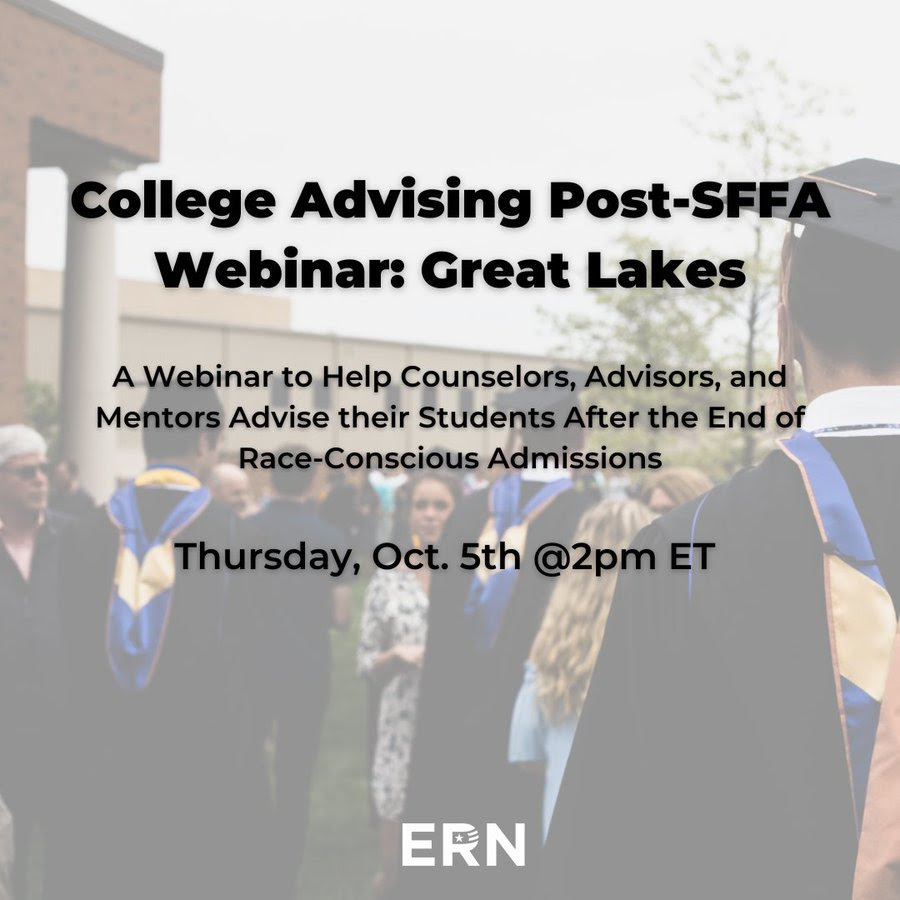
College Advising Post-SFFA – Free Webinar

A webinar will be hosted by Beth Arey (Evanston Township High School), Veronica Hauad (U Chicago), Meredith Lombardi (Common Application) & Aya Waller-Bey (U of Michigan) to talk about advising students post-SFFA. It will be live on October 5th and then archived for later viewing.

This summer’s Supreme Court’s decision in SFFA vs. Harvard/UNC banned the consideration of race in college admissions decisions, but it left many questions unanswered and has created confusion for students and the professionals who help them apply to college. This webinar is intended to help school counselors and advisors at community-based organizations (CBOs) answer those questions and provide the best advice to help them advise their students. The focus will be on best practices and include experts from higher admissions offices, high schools, CBOs, and other organizations.

Click here to register/view the webinar: https://us02web.zoom.us/webinar/register/WN_YJFexv17TKKoajQ_05hEQg?fbclid=IwAR3xCvdCDmV0eYhg1FMFtTk2pOI62TgQ7wFVSU0W9QIiRyJ7y7DYI14SSMI#/registration

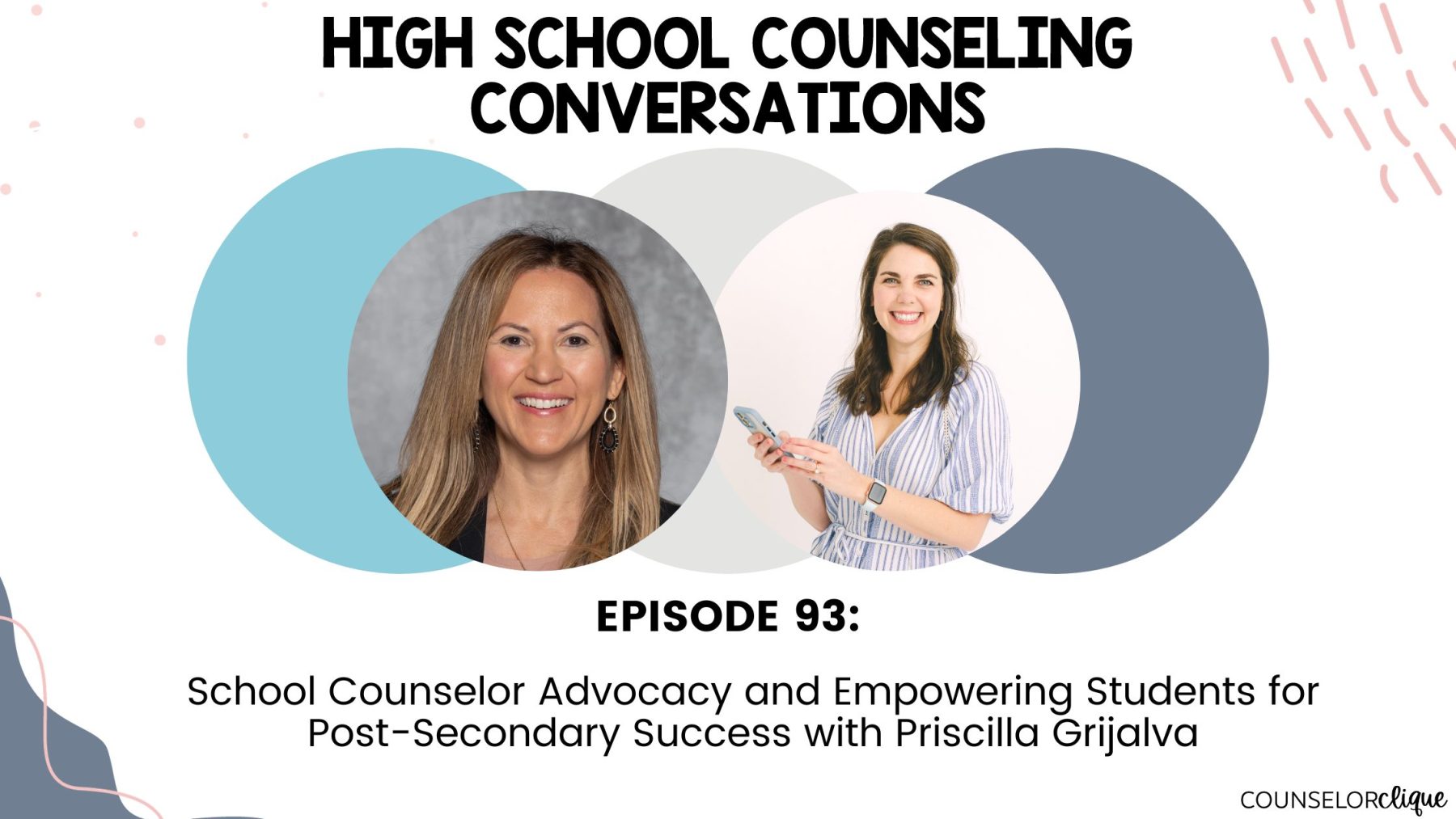
School Counselor Advocacy and Empowering Students for Post-Secondary Success – Free Podcast

After witnessing a student feel defeated about plans to attend community college rather than a University, Priscilla Grijalva knew that she needed to change the narrative. That’s when “Reach Higher Thursdays” were created, leading to more support and celebration for all post-secondary options. 

Priscilla Grijalva is a highly accomplished school counselor with over 18 years of experience and an incredible drive for her students. In our conversation, Priscilla discusses the importance of advocacy and perserverance in helping students overcome obstacles and achieve their educational goals.

You’ll hear about some of the initiatives Priscilla has implemented to broaden awareness of post-secondary options at her school. Her journey is a testament to the power of advocacy and the impact that school counselors can have on their students and communities! 

Hosted by Lauren Tingle of Counselor Clique

Topics Covered in This Episode:

  • What the Reach Higher initiative is, and what kind of impact it’s had on Priscilla’s students
  • Advice for counselors who don’t have a mentor to lean on
  • Examples of initiatves Priscilla put in place to increase college access and broaden awareness for post-secondary success options
  • Building partnerships with your staff and community
  • How networking with educational and community partners can play into college initiatives 
  • What Priscilla would say to school counselors who don’t see themselves as a leader in their school

Click here to listen to the podcast: https://counselorclique.com/post-secondary-success/

Resources Mentioned in This Episode:

Other Blog Posts You Might Like:

Newer Posts
Older Posts

Link for Counselors

Current Publication

View Current Publication

Advertisements

LINK Newsletter for Counselors

Sign up to receive our bi-weekly e-newsletter.