Menu Sidebar
Menu

Complete Guide to Helping Your Students and Their Families Complete the 2022-2023 FAFSA

The FAFSA can be very intimidating for families. Nitro College has put out a very thorough 2022-2023 Step-by-Step Guide to help families complete the FAFSA.

They break down each section into several easy steps to complete it. Here are direct links with help for each specific question:

Step 1: Student Information

Step 2: Student Financial Information

Step 3: Student Status (Determines Whether You Will Need Parental Information)

Step 4: Parent Information

Step 5: Student Household Information

Steps 6 & 7: Send, Sign and Date

This is one of the most thorough guides I have seen so please share with any of your parents and students that can use help on their FAFSA.

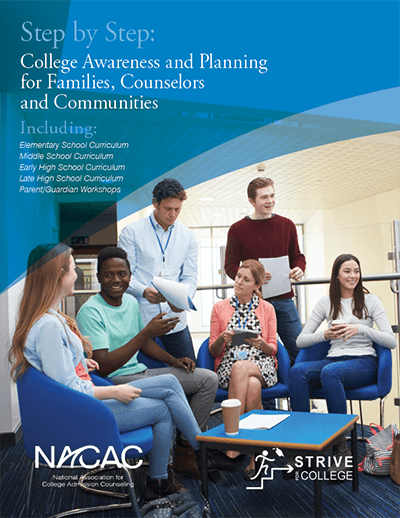
Step by Step: College Awareness and Planning for Families, Counselors and Communities

NACAC has combined the Guiding the Way to Higher Education: Step-by-Step to College Workshops for Students curricula with resources from the Families, Counselors and Communities Together (FCCT) manual to create the Step by Step: College Awareness and Planning for Families, Counselors and Communities.

Revised in 2017, the curricula—presented in four sections, for elementary school students (grades K-5), middle school students (grades 6-8), early high school students (grades 9 through first semester 11) and late high school students (grades 11-12), offer training for counselors and others who work with underrepresented and under served students to provide comprehensive tools for meeting the needs of first-generation students and their families.

Developed by NACAC members Mary Lee Hoganson, Phyllis Gill and Joan Mudge, the Step by Step curricula were presented at the NACAC national conference in 2008. NACAC Human Relations Committee members Nancy Caine, Patty Montague and Bridget Herrera conducted training on the FCCT manual during the session, and the program has had continued success.

Since its creation, the Step by Step curricula has been updated and maintained by NACAC’s Education and Training Team; the Inclusion, Access, and Success Committee; and the Professional Development Committee. The Elementary School modules were created with the assistance of ASCA School Counselor of the Year Finalists, Rebecca Lallier and Samantha Vidal.

Step by Step: College Awareness and Planning: Download for free

Download Elementary School (Grades K-5)
Download Middle School (Grades 6-8)
Download Early High School (Grade 9-Semester 1 of Grade 11)
Download Late High School (Grades 11-12)
Download Additional Resources (Financial Aid)

Powerpoint Presentations:

Building a Foundation for Educational Success
Setting the Stage for Dreams to Become Reality
Charting a Challenging High School Experience
Follow the Road to College
Paying for College

Suggested Questions for your Students to Ask You!

The Texas Education Agency has published a list of questions by grade that students should ask their Counselor. These might be thought provoking for your students and prod them to ask questions of you that they should be asking:

For students finishing 9th grade:  

• I need to learn more about college and career options. When is the college and career fair?

• What career and technical education (CTE) opportunities are offered at my school that lead to an industry-based certification or work-based learning opportunity?

• What other college credit and career preparatory classes can I take in 10th, 11th, and 12th grade? How should I prepare for dual credit or Advanced Placement courses?

• How do I sign up to take the PSAT, and/or the ACT Aspire exam? How should I prepare for it? Is there financial support available?

• Where can I find information about local summer enrichment and career-building skill programs?

For students finishing 10th grade:

• I need to learn more about college and career options. When is the college and career fair?

• What career and technical education (CTE) opportunities are offered at my school?

• Which dual credit, Advanced Placement, or International Baccalaureate classes are available, and which ones will help me achieve my college and career goals?

• What are the upcoming exam schedules for the ACT and SAT? What college-exam prep does our district offer?

• What is the National Merit Scholarship Qualifying Test (NMSQT), and how can I take advantage of it?

• Where can I find information about summer internships, job-shadowing opportunities, and career skill-building programs?

• How do I change my endorsement? In Texas, students are allowed to make this change through their 10th grade year. (After this year, I am only able to drop an endorsement.)

For students finishing 11th grade:  

• When is the next opportunity to attend a college tour or meet with visiting college admissions representatives?

• Where can I get assistance completing college applications (and essays) needed for the Common App?

• Which community college programs have the best career training programs related to my endorsement and coursework?

• What other college credit and career preparatory classes can I take in 12th grade? Which dual credit, Advanced Placement, or International Baccalaureate courses will best help me achieve my goals?

• What are the upcoming exam schedules for the ACT and SAT? What college-exam prep does our district offer?

• Where can I find information about summer internships with local businesses and other organizations?

• Where can I learn about completing the FAFSA? How do I create a PIN?

• Where can I find information about potential college scholarship opportunities?

How Long Do College Applications Take?

Applying to college is never a one-and-done deal. As we’ve observed in previous articles, applying to college extends beyond the application itself, encompassing other activities like essays, test scores, and recommendations, all of which take time to complete or “collect” – in addition to the hours spent researching where you’d like to apply first! If you’re a regular reader of this blog, you know that our mantra is apply early. But, you may be saying to yourself, “Surely, I can get my college applications done in a day or two.” How long do college applications really take?

The College Application Timeline (A Quick Overview)

In the end, college applications take longer than you think! The application process starts your junior year, and when all is said and done, can take at least 100 hours from start to submission. As noted above, the application process goes beyond the application form itself. It includes completing your standardized tests, researching colleges, asking for recommendation letters from your counselor and teachers, writing essays, and more. Here’s a breakdown of the time it takes to complete each task in order to guide you in completing your applications without missing critical deadlines:

  • Junior Year
    • Choosing which colleges to apply to (20-40 hours)
    • Studying for and taking the SAT/ACTs (40-60 hours)
    • Gathering letters of recommendation (5-10 hours)
  • Senior Year
    • Writing essays for your college applications (20-30 hours)
    • Filling out the college application (2-4 hours)
    • Applying for financial aid, scholarships and grants (10-20 hours)

Junior Year

Choosing the Colleges You’ll Apply To (20-40 hours)

Much of your junior year focus will be on choosing the colleges you’ll apply to. At this point, some students already know the schools they’re interested in, but the majority do not. Junior year is an excellent time to conduct in-depth research. How to do that? There are a number of effective ways: First, nothing replaces an in-person visit, if possible. However, virtual tours and information sessions can be equally helpful in your college search. You can dig deep into a college’s website and even arrange to communicate with a current student or a faculty member in a specific department. You can also scour more subjective, yet reputable, resources like the Fiske Guide to Colleges or The Princeton Review’s The Best 385 Colleges, both of which offer trusted reviews from independent sources. You may spend time on a site like College Board’s Big Future to gather more data. The possibilities seem endless – a carefully crafted college list may take time! After you’ve gathered information about your schools of interest, whittle down this lengthy list to a reasonable number of colleges. We suggest between eight and twelve, comprising of a few “safeties” and “reaches,” with the bulk of your list consisting of schools within your target range. Forming your list may take months, so start early, doing a little research each month so as to arrive at senior year with a nearly complete list. When you’re not researching colleges, you can attend to other tasks, such as preparing for the SAT and ACT.

Studying for and Taking the SAT/ACT (40-60 hours)

We’ve discussed testing at length in myriad previous posts, but one more reminder – study, study, study! Preparing for the SAT or ACT takes time. Each practice test takes over three hours to finish, and optimally, you’ll want to complete one practice exam per week during the eight weeks leading up to a test date. Since not every student can successfully self-prep, you may wish to work with an experienced tutor to review homework tests and learn strategies. These meetings will take time, and considering that most students will sit for the ACT or SAT two to three times – or more! – you’ll have to make room in your junior year schedule accordingly. Don’t forget that summers are a great time to sign up for test prep.

Gathering Letters of Recommendation (5-10 hours)

Before summer break, request letters of recommendation from teachers and/or counselors. While this might be as simple as sending an email, it likely will involve greater effort on your end. You may be asked to fill out a “brag sheet” or some other printed form to help your recommender write a highly personalized letter. The recommender may ask you to share a detailed résumé. At the very least, we suggest that when you request letters of recommendation, you email your teacher a list of your favorite moments from his or her course, and remind your recommender of your stand-out contributions in the classroom. If you haven’t taken care of this task prior to summer break, be sure to request letters of recommendation as soon as you start your senior year.Teacher Helping Student with College Admissions

Senior Year

Writing Essays for Your College Applications (20-30 hours)

Ideally over the summer – but certainly by the start of the school year – work on your college essays. Good essays take time – that’s no secret! You’ll want to begin with your personal essay — a story from your life that provides insight into your personality, interests, and growth. This narrative essay will go through multiple drafts until it’s ready for submission…and once it’s finished, you may have additional, mostly shorter essays to work on. These are supplemental responses that some colleges ask for, which may include prompts asking you to reflect on your chosen major, why you are applying to that college, or the importance of an extracurricular activity. There are myriad prompts, and most of these essays must be unique to each school. Our best advice is to create a spreadsheet to track all colleges and number of essays, and plan your writing time to allow for multiple drafts of multiple essays.

Filling Out the College Application (2-4 hours)

The college application form itself (almost always on line) doesn’t take quite as long as other components. Most students use the Common App or Coalition App platforms, which allow you to enter the same information once for all schools to which you’ll apply. There, you’ll also find colleges’ own questions, including any supplemental essays. Relatively straightforward, the application will still take several hours to carefully complete and review with a parent or other trusted adult before you hit submit. Allotting yourself sufficient time will help you avoid careless errors and put your best foot forward. Also, don’t be afraid to ask for help with your college applications.

Applying for Financial Aid, Scholarships and Grants (10-20 hours)

One of the final application steps will be applying for financial aid, scholarships, and grants. The FAFSA, required for obtaining need-based aid, opens October 1. Apply early to ensure that you receive your financial aid package in a timely manner. In a recent post, we recommended using the summer between junior and senior years to research and apply for scholarships. This summer is also a great time to have a conversation with your parents about college affordability. Remember that the best source of scholarships are colleges themselves, so pay attention to priority deadlines to optimize any merit-based award opportunities. Some colleges may ask you to write additional essays or complete an interview in order to receive a scholarship. Plan accordingly.

Now that you’ve finished all major components of college applications, all you need to do is wait to get accepted. Enjoy this feeling of accomplishment – and don’t forget to keep up your senior year grades!

In Conclusion

It’s clear: applying to college takes time, but you can keep your schedule manageable with careful planning. Starting early in junior year will give you the freedom and flexibility to complete all tasks with minimal rushing, setting you up for a successful senior year.

This post was written by Barbara Leventhal of JRA Educational Consulting and Score Academies. Since 1980, thousands of families have turned to Judi Robinovitz, Certified Educational Planner, and her team of seasoned professionals to help them choose, apply to, and get admitted to their “best fit” schools, colleges, and graduate schools. Check them out at https://www.jraeducationalconsulting.com/

Scholarship Opportunity for Your Students

A new scholarship was recently announced that your students that are considering attending Medical School in the future (high school students are eligible to apply). Any future doctors out there?

The name of the scholarship is “Dr Eugene Kramer Scholarship for Future Doctors of America”. This scholarship is available for students in the United States who are currently enrolled in a University or High School, and have plans to attend a University and plan to attend medical school in the future.  The cost of medical school is rising and the scholarship is meant to give back to the next generation of doctors in America.

 Here is some brief information about the scholarship: 

  • This is a one-time award of $1,000 
  • Deadline for this scholarship is February 15, 2022
  • A winner will be announced by March 15, 2022 

All of the details and criteria can be found on here: https://dreugenekramerscholarship.com/dr-eugene-kramer-scholarship/

Thesaurus words in college essays … how you can help!

Have you ever had a student turn in an essay draft with a few words that seem way too big?

Are the words different from the words they’ve used in meetings, in writing exercises, or on a quick chat on the phone?

I think we all know the culprit: the thesaurus!

Time and again, we advise our students to ditch the thesaurus: they don’t need it; their authentic voice matters; they should use the words they use every day.

It’s on our Do’s and Don’ts list (as a Don’t) in our book for students! (If you don’t have a copy of our book for students, you can download a free one here). And you can share it with your students!

But to be honest, students don’t always listen. You know why? Because they don’t always trust themselves. Our job, and yours, is to encourage them to trust themselves.

If an applicant uses a thesaurus to find words, rather than trust the words they know and use every day, the essay will not sound like them. In the process of writing, they might even use a few big words incorrectly, and that will never impress an admissions officer. 

Either way, it’s problematic. For you. For us. For our students.

We have a few tricks up our sleeves to help reduce the number of awkward/thesaurus/misused words in college essays.

Here’s our best one: We make short and sweet notes in the margin, asking them politely and respectfully to explain what they wrote in the same words they would use to explain it to a friend.

We don’t write all over the draft; that can be overwhelming and fuel more stress.

Here’s an example:

A student used the phrase “the adrenaline was seething through my body” in a very long and winding sentence in an early draft of a personal statement; it didn’t sound like the student who wrote it.  In the margin, I asked how he would describe this feeling to a friend. He responded, “I felt a huge rush of adrenaline, and that was incredibly intense.”

Much better. It sounded like the student who wrote it. He liked it, too.

At Wow, we put the student in charge, and make it okay for them to use the words they know, the words they like, the words that make them sound like themselves.

We allow them to make choices, and we make suggestions. But if they don’t take our advice, we leave it alone.

And guess what? Our students write beautiful essays that they are proud of – even with occasional awkward sentences or big words.

ABOUT THE AUTHOR

Kim Lifton is a MACAC Board Member and President and Co-founder of Wow Writing Workshop, which teaches students and educational professionals a simple, step-by-step process for writing effective college essays, so students can stand out and tell their stories. Kim leads a team of writers and teachers who understand the writing process inside and out. Since 2009, Wow has been leading the college admissions industry with our unique approach to communicating messages effectively through application essays, including personal statements, activity and short answer essays and supplements.  We teach students – and we train professionals.

Coming Up 

We cover a new topic in our Pro Chats each month – Wednesdays at 1:00 p.m. Eastern! Click here to register for our free sessions!

December         12/08/21        Reflection: 2021 Wrap-up

January           01/12/22         A Taste of the College Essay Experience (a special 60-minute webinar)

Our free gift to you!

And, if you’d like a free electronic copy of our book for counselors, How to Write an Effective College Application Essay, the Inside Scoop for Counselors, download it here.

Free College?

There is a lot being written in the press about “Free College” for students. What does it mean? What programs are possibly going to be implemented? Which schools are on board with this effort? We will have a great focused article on this subject in the Spring 2022 issue of LINK for Counselors so stay tuned. The writer of the article, Jim Paterson, a former Counselor, included several sources in the piece. After press time for the article, he received some great information from Martha Kanter, the Head of College Promise. We wanted to make sure we shared that with you too:

(Jim Paterson) First, I know this is probably a very fluid situation, but can you provide your thoughts about what will happen at the national level with support for 2-years of college for free?

(Martha Kanter) Right now, while “free community college” was stalled like so many other critical priorities due to Congressional gridlock, we have overwhelming public support for this to happen from our nation’s students, families, and communities. If enacted, it will be a major step forward to keep college affordable and attainable for all Americans. When we look at the local and state bipartisan support for College Promise, especially over the past decade, these leaders are paving the way forward to fund the first two or more years of college through a Federal-State Partnership. The value proposition has been confirmed many times over in the Promise research and public policy reports that investing in free community college will accrue significant economic, social, and civic benefits for our nation. We will continue our advocacy and look forward to other ways we can realize the Promise at the federal level in partnership with the states. This is a setback but we’re still on the road!

(JP) And, more importantly, since the audience here is admissions officials, college consultants and high school counselors and prospective students and their families, what advice would she have for them about how to find the best opportunity for free college? Are there pitfalls to avoid or problems with any of the programs? If she was speaking to this audience, what two or three tips would she provide — and it can be brief.

(MK) Start by reviewing the 2021 College Promise Catalog of Local and State Programs. It includes comprehensive information about Promise program locations, eligibility requirements, the college(s) committed to the Promise, wrap-around support services provided, whether a student may attend college full or part-time, website, and contact information. The roadblock that students most often encounter is meeting specific Promise program eligibility requirements. Students may or may not be eligible given the criteria individual Promise programs have established – some programs are more targeted or restricted while other programs are more universal and inclusive. 

Some tips for college consultants, high school counselors, and prospective students and their families:

  1. Take time to learn about the benefits, locations, and eligibility requirements of Promise programs that you are interested in, especially for regions and institutions where the majority of your students are likely to enroll.
  2. Consider whether the program is offered at both the local and state level (often there are more resources provided if this is the case).
  3. Reach out to visit the actual program, either virtually or in person, to learn as much as you can about how the program is delivered to prospective students

(JP) Are there many or any free college programs kids should be aware of that aren’t designated as College Promise programs?

(MK) Students might also look at opportunities sponsored by companies (e.g., Amazon, Walmart, Starbucks, etc.) that offer to pay for college tuition and fees while students are in college since so many of our nation’s students are learning and working at the same time.

College List Spreadsheet with Contact E-mail addresses

When students are looking to contact Admissions at multiple College’s where do they go to get the contact information? Searching for the information can be time consuming and frustrating.

Tiffany T. Grimes of Alamogordo High School in New Mexico has put together a nice spreadsheet of many College’s that her students have applied to. You can copy these over and expand to include other College’s in your area. It makes it easy for your students to e-mail admissions direct to ask any specific questions they may have. It also make it easy for you when you have a question for a specific College. Here is a link: https://www.linkforcounselors.com/wp-content/uploads/2021/11/College-List.xls-1.pdf

You can also find contact information for any of LINK for Counselors advertisers on our site here: https://www.linkforcounselors.com/colleges/

College Swag Request Template

Did you know that many Colleges will provide “swag” for your office and your students if you just ask? This includes pennants, t-shirts, koozies, posters, and many other types of promotional items. It benefits them to get their name out their to prospective students. Oftentimes, all you have to do is to ask for it?

Tiffany T. Grimes, a Counselor at Alamogordo High School in New Mexico has a template of a letter she sends to schools that can be crafted to send out to the College’s in your area. Here is a link: https://www.linkforcounselors.com/wp-content/uploads/2021/11/College-Swag-Request.docx.pdf

College Visitation Form

Many of your students will want to visit College’s to check them out and see if they are a good fit. It is a good idea for them to visit during the week when classes are taking place and they can get a feel for the campus during normal school hours. Unfortunately, there are times when students might liberally take advantage of the opportunity to miss a school day under the auspices of visiting a College for a “College Visit”. JB Jones, a Counselor at Rockwall-Heath High School in Texas, has developed a form you can adapt to your school that students can take when they are visiting a College Campus to get signed and use as an excused absence.

Here is a link to the document: https://www.linkforcounselors.com/wp-content/uploads/2021/11/College_Day_Visitation_Permit.pdf

Newer Posts
Older Posts

Link for Counselors

Current Publication

View Current Publication

Advertisements

LINK Newsletter for Counselors

Sign up to receive our bi-weekly e-newsletter.