Menu Sidebar
Menu

Options for those Students not looking to go to a 4-Year College after High School

There area many career paths a students can take after High School. College is the most popular path that parents and Counselors ingrain in their children/students as they go through the education system but for various reasons many students decide College isn’t for them. Those can range from the cost of College, to a lack of interest in attending College or just that they have other interests. Some careers don’t require any formal training at all; an artist, writer, or musician could hit it big without ever studying their art in a classroom setting. Here are some options for those students that are investigating other career paths:

  • Gap Year: After High School one option for students is to take a gap year. This enables them to travel, investigate other options, etc. before starting that college journey. At the end of a gap year, a student should have a clearer idea of what they enjoy doing and what they do not and have learned what the rest of their life after college may be like.
  • Community Colleges and Trade Schools: Community Colleges are less expensive and many schools offer an easy seamless transfer of credits to a 4-year University. Some community colleges also offer ‘dual enrollment’ with nearby high schools, so you may have earned some credits from there before graduating. Trade schools offer great programs to help students learn skills in many disciplines that are needed in society (AC/Heating, Welding, Graphic Design, CAD, etc.). Because of their shorter length, they are often more affordable than universities or even community colleges.
  • Online Classes: Not wanting to attend classes in person? Many schools now offer online only classes where the student can earn a degree without ever having set foot on the campus.
  • Military Careers: Military careers can be a great option. Students that pursue this career path can earn money that can be used for college later and also earn other great benefits for later in life (Pension, Healthcare, etc.)
  • Internships: Not sure what they want to do in life yet? An internship can be a great way to explore career options. While internships are often done through schools or colleges, it’s entirely possible to apply for and gain an internship without the help of an institution. Employers are always looking for students they can hire as interns on an interim basis. There are many cases of interns that years later ended up running the company they interned for when they were in High School or College.

Want more information? Study.com put out an “Alternatives to 4 Year Universities Guide” you can check out here: https://study.com/resources/degree-alternatives

Seven ways universities check for plagiarism in academic papers.

Plagiarism is unethical and unprofessional. It might seem like a tempting option to some students, but beware- you can never get away with that sort of thing. Blatantly copying someone else’s work and passing it off as your own is not only morally wrong but also illegal. Yes, you read that right, plagiarism can cost you your academic career.

Teachers often have to check several assignments and research papers. As they will be handling more number of student’s work. The time constraints and pressure can lead to mistakes. Plagiarism checking tools save teachers a lot of time and trouble.

The most used tool by the universities is Turnitin. These tools are designed to help the university to meet with deadlines without any mistakes. All you have to do is run your paper through Turnitin and you get a list of all the possible sources that your content may be copied from.

Have you ever wondered how the plagiarism checking tool works though? Well, here is a brief of the technology behind plagiarism checking software that you might find insightful:

Fingerprinting:

In this process, first a collection of multiple substrings are chosen. These strings showcase fingerprints. The elements that show a match/ are the same is called minutiae. The fingerprints are calculated in the form of a document. The minutiae are mapped to the index of fingerprints. The source value is set to give results of the process. It is adopted to increase the speed of the process.

String Matching process.

This technique is used in the information science industry to create a second approach. Postfix trees used to approach. The lengthier documents are not advisable to be scanned. Bag of the word is another method applied to locate plagiarised content. This approach displays the adoption of vector space retrieval.

Citation based plagiarism detection

This examination depends on the citation. Text form content analysis is not measured in this. Computer science assignments can be the best example to describe this approach. The uniqueness in this source is searched in other citation distributions. The model of this process lives. Yet techniques are not yet fostered. The order is searched to see the relatability between two documents. Relative fractions are the framework giving good search.

Here are some way university check plagiarism in academic papers

1.    Writing Styles

Experience with a student’s writing style helps to discover if the paper is plagiarized or not. There can be crude and complicated sentences; this indicates the content is plagiarized. Unusual phrases that seem inconsistent with past writing samples are also good indicators. If a doubt arises, the teacher may ask a conference to assess a student’s knowledge with his paper. Uneven order of sentences is wrong according to anti-plagiarism guidelines.

2.    Plagiarism Tools

Teachers and university professionals often have a fair idea when a student submits unoriginal or copied assignments. The writing style and structure of the paper is a dead giveaway. Other than that most colleges also prefer to run the papers through a plagiarism checking software.

Duplichecker, Plagiarism Detector, Small SEO tools etc. are some other popular tools used by the university to prevent plagiarism. Teachers often ask students to submit their work straight through the service site. It produces email if any plagiarism is detected. These services can scan students’ papers. Additionally, essays upon a database of earlier submitted papers. Meeting web links and phrases are then organized into a report for the college review.

Best thing students can do is write their own words. Always cite the sources and use good plagiarism tools to avoid errors.

3.    Screening Software

Universities were using software programs as a shield against plagiarism during 1990. Professors can detect if the material comes from an online essay or paper mills. This can be a cheating method. But many sites recycle similar content and sources. This can increase the student’s risk of detection.

Universities also run college application essays and research paper proposals through these screening platforms. Any detection of unoriginal content would result in your application getting rejected.

Ensure that you follow the proper structure and add citations in your application essay. Attaching a statement of purpose, recommendation letters and certificates to your application improves your chances of getting into your dream university. 

4.    Format review and references

 Suspicious papers may have differences that teachers are habitual to over their career. Unsuitable subheads, mixture tables, margins are often a red flag. If students do not follow the norms of writing style is also plagiarism. Mixed statement style can also show students have copy-pasted the paragraph. Using resources that are not at the university shows students have stolen the text.

5.    Other Applications

Anti-plagiarism platforms put applications above academia. According to “The Los Angeles Times”, more than 100 college use programs like turnitin.com. It helps to evaluate essays in admission packages for plagiarism. More of this analysis occurs at the graduation level.

Any form of plagiarism detection can cost you an entire year or worse at the university. Teachers also check for plagiarism when reading through college application essays. Be very careful about your application, a few common mistakes can lead to your application getting rejected.

6.    When the paper does not fit the topic

 It is better to give a prompt for assignments. This helps students to get a better view of the assignment. So that they avoid writing paper by another writer. If teachers can brief out the assignment, then you can get slightly crooked from what you asked for.

7.    Change inflow

 Sudden change in the sentence/flow gets lost then there is a chance of text getting plagiarised.

This can be the most found error. This can be more complex than other factors above.

Here are ways to avoid plagiarism:

  • When applying an idea or words that’s not your own add a citation to your writing. Ensure you state the name of the source, date published and other things related to citation.
  • If you are inserting source words into your content, use quotation marks around the text. This can be an easy way to avoid plagiarism. A direct quote must also cite the source that readers know who have written those content.
  • Paraphrasing is applying a source’s idea in your own words, without altering its meaning. One should be careful paraphrasing can also turn into plagiarism if done the wrong way. Uniquely format your words and try evading using similar words from the source. The objective is to do without changing the meaning of the idea itself.
  • Instead of repeating the source idea or word, try putting what you want to say about the topic in your way. Think how uniquely you can share an idea or words. If you are implying the source idea to your point, you must follow guidelines to avoid plagiarism.
  • While writing your paper, some phrases you might have to include without citation. When in doubt use plagiarism checking tools. It helps you to detect issues before submitting.

Conclusion:

 The technology has forced universities to embrace trending strategies to tackle plagiarism. While checking the high volume of papers, teachers can use tools to examine words and phrases. When time grants traditional methods like reviewing/writing styles can be followed. In other cases, most universities may choose a service to secure academic honesty.

As an assignment expert, Jane Crighton delivers online sessions at Expert Assignment Help(UK), helping students with writing essays and assignments. She is also one of the co-founders and education consultants at Top My Grades. Beyond work, you can find her at community homework workshops as a volunteer helping students in need of private tutoring with their homework.

The Importance of Experiential Learning

Since the turn of the 20th century, education researchers have been interested in a phenomenon known as summer learning loss, summer setback, or summer slide. [1] Research shows students who do nothing during the summer months experience decreased academic performance at the start of the school year. This phenomenon is why many students opt to extend their learning into the summer months. School vacation is a perfect time for students to explore their passions and interests and build skills to prepare them for the transition from high school to college.

How can you prevent the summer learning slide?

Pre-college academic enrichment programs provide opportunities for students to experience both living and learning on a college campus. With academics being the cornerstone of most pre-college summer programs, students can choose courses in subjects not typically taught at the high school level. Small, seminar-style learning provides opportunities for students to learn through group discussions and projects. These experiential learning environments are designed for high school students to thrive.

The academic pace in a pre-college, non-credit academic enrichment program is often less stressful due to little or no emphasis on grades and more focused on engaging with the teacher or faculty and the subject matter.  Students should not see these types of programs as remedial or as a form of punishment but rather embrace these opportunities as transformative, and as an opportunity to expand their minds.

In addition to the academics, a pre-college program allows students to engage in a vibrant and diverse community, making friends from around the world and participate in recreational, social, and cultural immersion events and excursions. Another key component of an experiential learning experience is the opportunity to develop soft skills necessary for success in college and beyond.

What should you look for in pre-college programs?

Look for pre-college programs that are operated in partnership with a university to ensure that courses are taught by university instructors and the program provides opportunities for students to use the campus facilities. In addition to world-class academics that are a blend of classroom instruction with hands-on or experiential learning, programs should include a balance between learning and fun.  A full complement of recreational and social activities, as well as proper and age-appropriate safety and supervision from professional and experienced staff are essential for the happiness and well-being of the student.


The Importance of Experiential Learning Outside of the Classroom was written by Esteban Olivares, Summer Discovery’s Director of Educational Development & University Partnerships.  For help in finding the best fit program and make of the most of your school vacation, please contact info@summerdiscovery.com.

Summer Discovery is the leading pre-college program provider for middle and high school students – www.summerdiscovery.com

[1] Cooper, H., Nye, B., Charlton, K., Lindsay, J., & Greathouse, S. (1996). The Effects of Summer Vacation on Achievement Test Scores: A Narrative and Meta-Analytic Review. Review of Educational Research, 66(3), 227–268. https://doi.org/10.3102/00346543066003227

Scholarships Available for Students Interested in the Field of Robotics

The mission of FIRST® is to inspire young people to be science and technology leaders and innovators, by engaging them in exciting mentor-based programs that build science, engineering, and technology skills, that inspire innovation, and that foster well-rounded life capabilities including self-confidence, communication, and leadership.

For 2021 they have more than 200 scholarship providers that are giving away more than $80 million to qualified students.

FIRST Scholarship Opportunities

  • FIRST Scholarships are offered and administered by the listed Provider and applications are submitted directly to them.
  • Click on the Provider Name to view their website and learn more about them; Click on Details and Application to access and submit the application.
  • To search for non-school specific scholarship use the Location filter and select –All Areas–
  • Click on the following link to access a downloadable report of all current FIRST Scholarship Opportunities
  • Additional questions? See our FAQ.

Do you have students that would be interested in these scholarships? Check them out at https://www.firstinspires.org/scholarships

The list provides information on scholarships available to students that they can use at their University of choice as well as ones that are offered by specific schools.

Survey Says: Close to half of all High School Seniors have not started applying to Colleges yet

Niche Marketing and Tudor Collegiate Strategies recently conducted a survey of more than 31,000 High School Seniors nationwide. They conducted the survey online and using social media. Here is a link to the actual survey: Class of 2021 Fall Survey

The survey results to date have shown that Forty-seven percent of all high school seniors, and 56 percent of those from low-income families, have not started applying to college.

Other findings from the survey:

  • Students in New England and the West Coast are furthest behind.
  • Forty-two percent of students have not taken a standardized test, and 53 percent of low-income students have not. More than a third — 36 percent — of those who have taken a test still do not plan to submit a score with their application.
  • An overwhelming majority (92 percent) of students are feeling fear or anxiety right now. Their top concern is being able to afford college.
  • A majority of students (56 percent) have attended a virtual event by a college. Of those who have, 79 percent are interested in attending another one.
  • Most students (79 percent) aren’t willing to participate in a virtual event that lasts longer than 45 minutes.
  • Students prefer Instagram, by a very wide margin, over other social media to look up colleges.
  • Nearly half of students (48 percent) said the communications they’ve been receiving from colleges and universities all look and sound the same. Only 8.1 percent said they feel very personal.
  • The pandemic has not drastically changed how close to home students plan to enroll. Less than 1 percent of students plan to enroll online, and 40 percent say that distance from home doesn’t matter in their decision making. Of those who did have a preference, only just over a third wanted to stay under two hours from home.

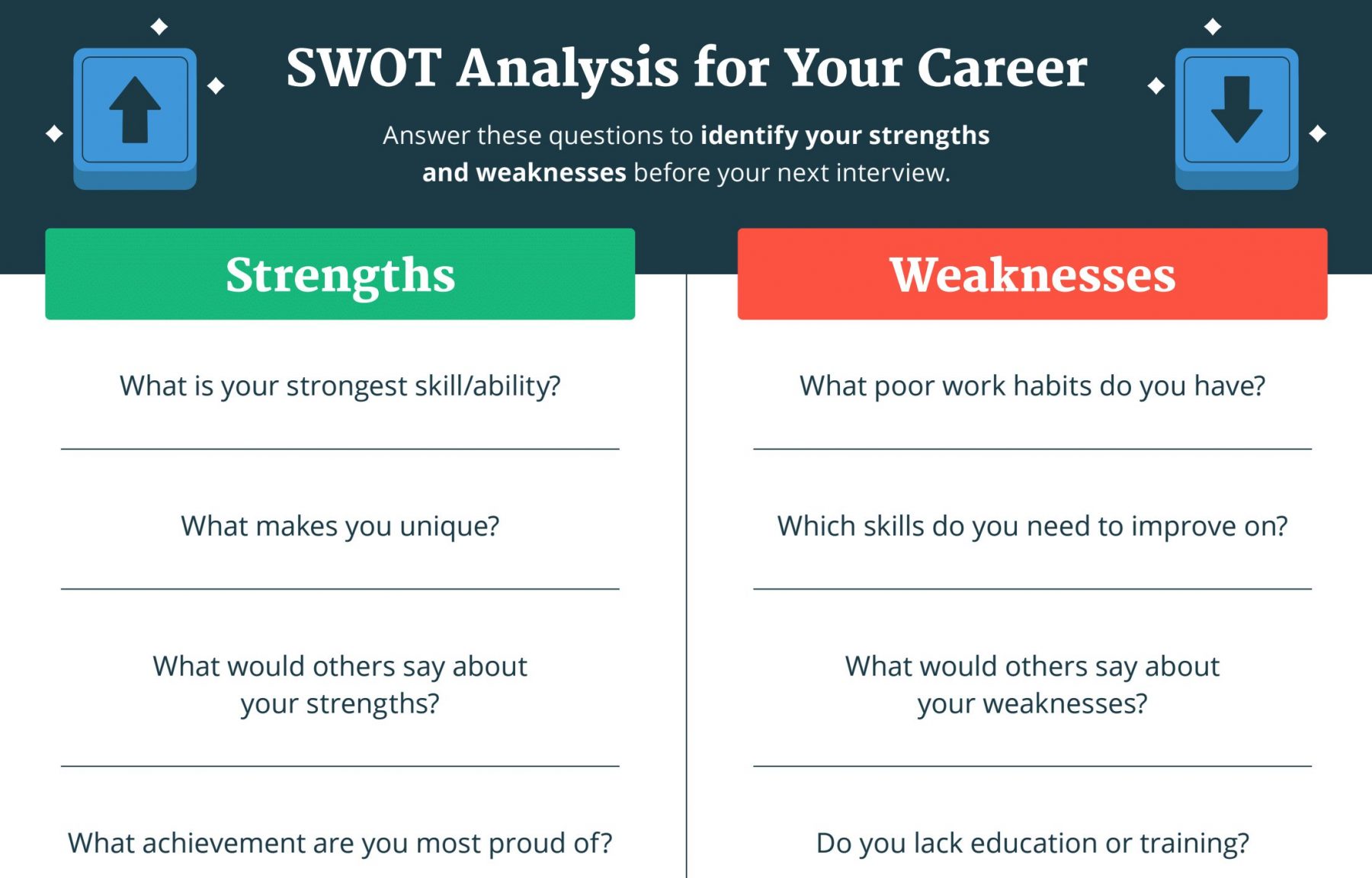
SWOT Analysis your students can use to help them choose a possible career path

One of the most common competitive analysis frameworks is the SWOT analysis. SWOT, which stands for strengths, weaknesses, opportunities and threats, helps highlight and uncover opportunities that aren’t immediately apparent. This information is useful when preparing for interview questions about strengths and weaknesses and identifying areas that might otherwise reduce the chances of getting a job.

Instructions

To conduct a personal SWOT analysis, get a pen and paper and answer the questions below. After you finish, highlight some of your greatest strengths and prominent weaknesses and make a plan of action based on the information.

Step One: Strengths

The first step of the SWOT analysis is to highlight every relevant strength you have. These can include experience, education, skills or circumstances that make you a valuable candidate. Try to focus on assets that set you apart from your competitors. For example, if you are a graphic designer, proficiency in design software will not set you apart from others. Choose a unique skill or ability that will help you stand out.

Ask yourself:

  • What are you an expert at?
  • What is your favorite skill?
  • What skill do you get the most compliments about?
  • What abilities come easy to you?
  • Which skill are you most proud of?
  • What areas do you notice others lacking in?
  • Do you have any unique background?

Step Two: Weaknesses

Once you identify your strengths, begin highlighting your weaknesses. Though this exercise can be a challenge, do your best to be honest about areas that could use improvement. Acknowledging your shortcomings will help you prepare to answer questions about them and make a plan to develop these areas.

Ask yourself:

  • What area has held you back in the past?
  • What is your least favorite work-related task?
  • Do you have any education gaps?
  • Which areas do you get negative feedback?
  • Do you have any bad habits that you have at work?
  • What scares you most about your job?

Step Three: Opportunities

Like your strengths, opportunities set you apart from competitors. These assets can be network access, available technology or any other advantage that you can use. If you are having a hard time coming up with opportunities, look at your strengths list and identify areas that you could further develop.

Ask yourself:

  • Do any of your skills lead to opportunities?
  • Can you get trained in any missing skills?
  • Do you have a strong network of contacts?
  • Is there any upcoming tech that you could be trained in?
  • Are there any areas where you see others failing?

Step Four: Threats

Threats are aspects of your career, experience or qualifications that might hurt your chances of landing a job. These can include technology that you don’t have experience with, bad references or questionable work history. Identifying these threats is crucial in the interview preparation process. For each threat, you should brainstorm solutions.

Ask yourself:

  • Is your industry shrinking or growing?
  • Does emerging technology threaten your job?
  • Could any of your weaknesses lead to threats?
  • Could new applicants be more qualified?

This is a great exercise your students can use to help map out their future career paths.

Here is a link to a SWOT analysis graphic your students can download and use: https://www.dropbox.com/s/cw6ptyisob12j80/competitor-frameworks-swot-analysis.1a.pdf?dl=0

Common Substance Abuse Disorders

There are many things involved with your job as a school Counselor. As you help students with College prep and preparing to take that next step in life you get to work very closely with them. Unfortunately, many students at this age are experimenting with drugs and alcohol so it is important to know about the abuse that can occur with these substances. The Addiction Group had put together a great primer that describes what these substance disorders are, how you can spot the signs and where to go for help.

What are Substance Use Disorders (SUD)?

Substance use disorders (SUD) occur when someone’s use of a substance (drug or alcohol) causes health problems or problems at work, school, or home. A common sign of a SUD is when someone is unable to stop using a substance despite adverse consequences. Commonly associated terms include substance abuse, drug abuse, drug use disorder, and drug addiction.

Drugs from the following eleven categories are the source of most substance-related disorders:

Substance Use Disorders and Mental Health

Substance use disorders are progressive, chronic, relapsing, and treatable diseases. They alter the way your brain functions, resulting in changed behaviors, priorities, and the ability to work, go to school, and maintain healthy relationships.

It is common for people with mental health disorders to develop substance use disorders, and vice versa. If someone is diagnosed with a substance use disorder and mental disorder at the same time, they have a co-occurring disorder or dual diagnosis.

Substance Use Disorder DSM 5 Definition

The DSM 5 states that for someone to be diagnosed with a substance use disorder, they must meet at least two of the following criteria:

  • Taking larger amounts of the substance or using it longer than you should
  • Unable to cut down or stop using the substance
  • Spending excess time obtaining, using, or recovering from substance use
  • Cravings and urges to use
  • Unable to meet work, home, or school responsibilities because of substance use
  • Continuing to use the substance, even when it causes relationship problems
  • Giving up social, occupational, or recreational activities in favor of substance use
  • Using substances regardless of danger
  • Realizing you have a physical or psychological problem caused or made worse by the substance and continuing to use it
  • Developing a tolerance (needing more of the substance to get the effect you want)
  • Having withdrawal symptoms, which go away when you take more of the substance

SUDs get categorized in terms of their severity. If a patient exhibits two or three of the criteria, they have a “mild” substance use disorder. Four or five means they have a “moderate” substance use disorder, while six or more makes it a “severe” diagnosis.

The Diagnostic and Statistical Manual of Mental Disorders, Fifth Edition, referred to as the DSM-V or DSM 5, is the American Psychiatric Association’s current manual for assessing and diagnosing mental disorders. It is the gold-standard text of the diagnostic criteria for all mental health issues in the United States.

Causes

The causes of SUDs and addiction are only partially understood by researchers. Typically, users progress from occasional to heavy substance use and then proceed to develop a substance use disorder. This progression is very complex and depends on the interaction between the person, setting, and drug.

Person

Different people have different risk factors for developing a SUD. Both genetics and environment play a role in the likelihood of someone misusing or abusing drugs.

People whose families have a history of addiction or mental health disorders are more likely to develop one themselves. People who live in high-risk environments, such as lower-income families, the LGBTQ+ community, and people without access to healthcare are also more at risk.

Anyone can develop a substance use disorder, regardless of their background. However, certain types of people are more susceptible, such as:

  • People with mental disorders
  • Individuals who experience social isolation
  • Anyone who has undergone trauma
  • People with chronic pain.
Setting

A person’s environment can play a huge role in drug use. Family, peers, and even doctors can contribute to someone’s substance use.

Certain environments are more conducive to drug abuse. For example, someone who grows up watching a family member struggle with addiction, or whose entire friend group starts doing drugs, has a higher chance of developing a SUD.

Drug

Drugs are categorized by how likely they are to cause use disorders or addiction. This is also known as assessment of abuse, potential of drugs, abuse liability, or addiction liability. This liability depends on:

  • How the drug is used
  • How strongly the brain’s reward pathway is stimulated
  • How quickly the drug takes effect
  • How quickly tolerance and withdrawal symptoms develop

People tend to use drugs that are legal, or easier to obtain, such as tobacco, alcohol, and marijuana, first. These can cause addiction, or make people feel comfortable with drug use, leading them to try stronger or illegal drugs.

Symptoms

Symptoms of drug abuse and addiction include, among others:

  • Feeling that you need to use the drug daily or several times a day
  • Intense urges for the drug
  • Needing more of the drug to get the same effect
  • Taking larger amounts of the drug or using for a longer period of time than intended
  • Ensuring you have a constant supply of the drug
  • Spending too much money on the drug, even if you can’t afford it
  • Not meeting social or work responsibilities, or cutting back on recreational activities due to drug use
  • Continuing to use the drug regardless of it causing problems in your life or physical or mental harm
  • Doing things you normally wouldn’t do, like stealing, to get the drug
  • Engaging in risky activities such as driving when you’re under the influence of the drug
  • Spending too much time getting, using, or recovering from the drug
  • Failed attempts to cut back or stop using the drug
  • Getting withdrawal symptoms when you stop taking the drug
Recognizing signs of drug use or intoxication

The signs of drug use will vary by the type of drug, but some of the most common signs that someone is intoxicated include:

  • Red eyes
  • Dilated pupils
  • Poor judgment
  • Decreased coordination
  • Slowed reaction time
  • Drowsiness
  • Difficulty concentrating or remembering
  • Anxiety or paranoid thinking
  • Agitation or mood swings
  • Behavior changes
Recognizing unhealthy substance use in friends or family members

Some of the most common signs of unhealthy substance use include:

  • Problems at school or work — being absent, or developing a sudden disinterest in activities at school or work, or a decrease in grades or work performance
  • Health issues — loss of energy and motivation, fluctuations in weight, increased blood pressure, mouth sores, and tooth decay
  • Neglected appearance — neglecting showering, grooming, or caring about their clothes
  • Changes in behavior — increased secrecy, changes in morals, lying, changes in friend groups, and dropping activities that they used to enjoy
  • Money issues — borrowing or stealing money, complaining about not having enough money when they did before

It’s important to note that not everyone showing these symptoms has a substance use disorder. Many mental health disorders, such as depression and anxiety disorders, will cause people to act these ways as well. It’s also possible that someone is going through a rough patch, or has just had a negative reaction to something, and will recover on their own.

Types of Substance Use Disorders

A person’s SUD diagnosis depends on the type of substance that they misuse. If someone misuses multiple types of substances, this is known as “polysubstance use disorder.

The most common types of substance use disorders include:

Alcohol Use Disorder

Alcohol is one of the most commonly consumed substances in the world. It’s legal almost everywhere and very easy to obtain. The three main categories of alcohol problems are binge drinking, alcohol abuse, and alcohol dependence (alcoholism).

Tobacco Use Disorder

Nearly 500,000 deaths each year make cigarette smoking the number one cause of preventable death in the United States. Over 30 million people are current smokers.

Marijuana Use Disorder

Marijuana is the third most used substance in the United States, after alcohol and tobacco. According to the National Institute on Drug Abuse (NIDA), Marijuana use disorder is similar to other substance use disorders. However, the long-term effects may be less severe.

Opioid Use Disorder

Opioids are pain relievers that are generally safe when taken as prescribed by a doctor for a short period. However, they also produce a euphoric high, which makes people misuse and abuse them frequently. Opioid misuse can lead to dependency, addiction, overdose, and even death. Common opioids include hydrocodone (Vicodin), oxycodone (OxyContin and Percocet), oxymorphone (Opana), morphine (Kadian, Avinza), codeine, and fentanyl.

Stimulant Use Disorder

Stimulants are a class of drugs that increase alertness and energy, as well as blood pressure, heart rate, and breathing. They include illicit drugs such as cocaine and methamphetamine, as well as prescription drugs like Adderall and Ritalin. Prolonged use of stimulants can have significant negative effects, including heart damage, memory loss, and psychotic behavior.

Sedative Use Disorder

Sedatives are central nervous system (CNS) depressants that slow brain activity. They are used to treat anxiety and sleep disorders. However, they are also abused frequently. Tolerance and dependence can develop quickly when someone misuses or abuses sedatives. Examples of common sedatives include alprazolam (Xanax), lorazepam (Ativan), diazepam (Valium), and zolpidem (Ambien)

Hallucinogen Use Disorder

Hallucinogens are either synthetically produced, like LSD, or occur naturally, like shrooms and peyote. They produce visual and auditory hallucinations, feelings of detachment from one’s self and environment, and a distorted perception in time and space. Most hallucinogens do not cause physical addiction. However, users may develop a psychological dependence. They may also develop hallucinogen persisting perception disorder (HPPD), which is spontaneous, recurring flashbacks.

Substance Use Disorder Treatment Options

What’s best for one person may not be best for someone else. Several factors will determine what type of treatment program is best for each individual, including:

What’s best for one person may not be best for someone else. There are several factors that will determine what type of treatment program is best for each individual including:

  • Type of substance use disorder
  • The severity of your disorder
  • Work, familial, or school responsibilities
  • Living situation
  • Existing support system
  • Financial situation

Researching Whether a College Might Possibly Close

The pandemic has made it very difficult for many College’s to meet their enrollment targets. Many pundits have predicted that some Colleges may even have to close their doors permanently.

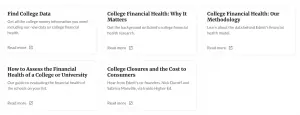
When your students make a commitment to attend a College it is for four-years so researching how financially stable a College is should be one of their priorities. How do you or they do this? Thankfully, Lynn O’Shaughnessy of the College Solution has outlined some resources that can help:

No. 1:

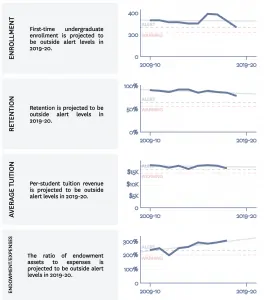
Hechinger Report, a higher-ed nonprofit news operation, recently released its Financial Fitness Tracker. The tracker shares the results of its financial stability analysis of 2,662 private and public four-year and two-year colleges and universities by examining key metrics including enrollment, tuition revenue, public funding and endowment health.

Among the information you will get for each school is a chart (see sample below) that breaks down an institution’s trends for enrollment, retention, average tuition and ratio of endowment and expenses.

No. 2:

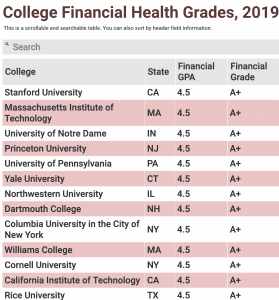
Another good tool to evaluate a college’s financial strength is through an annual report that Forbes produces called the College Financial Health Grades.

You can use the built-in search function in the online report to discover the financial grade of  933 college or university. The best grade is an A+ and D is the worst.

The report only covers private, non-profit institutions and not public ones.

It should be noted that while state universities have and will continue to experience troubles, they do have support from their own state governments (even if it’s woefully inadequate and almost certainly will be), which is a luxury that private institutions don’t enjoy.

The latest health grades tool was released in November 2019 so I hope an update will be coming soon!

Here is a screenshot of the schools at the top of the Forbes report card:

No. 3:

College Financial Health Center from Edmit, an admissions resources for families, is another tool to check the financial viability of 937 private colleges and universities. It shares a school’s endowment and its endowment per student and also shares the Forbes Financial

Health Grade and the financial responsibility score from the U.S. Department of Education. Edmit is actually a handy tool to research important statistics about individual schools including:

  • Average merit scholarships.
  • Percentage receiving merit scholarships.
  • Average net price.
  • Average percentage of need met.
  • Percent receiving aid.

Here is a screenshot of what you’ll find at Edmits:

No. 4:

Scott Galloway, a serial entrepreneur and a larger-the-life marketing professor at New York University, has been a thorn in the side of the higher-ed industry for years. Undeterred by conventional wisdom and sacred cows, Galloway doesn’t hold back with his opinions of the higher-ed industry. And it is an industry.

Galloway says a reckoning is coming with overpriced schools, bloated administrations and hidebound ways. Galloway received considerable press when he suggested in his recent higher-ed analysis that roughly 90 colleges could perish due to the pandemic.

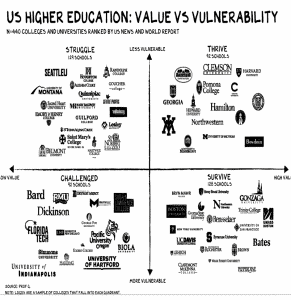
Here is the link to his value vs. vulnerability spreadsheet on 442 undergraduate institutions. He gave each schools two scores. The value-to-cost ratio seeks to quantify each school’s value relative to its tuition cost and the vulnerability score seeks to quantify a school’s vulnerability to COVID-19.

In his gloom-and-doom analysis, which has yet to come to fruition, he places schools in four categories:

Thrive. Elite schools and those that offer strong value have an opportunity to emerge stronger as they consolidate the market, double down on exclusivity, and/or embrace big and small tech to increase the value via a decrease in cost per student.

Survive: Schools that will see demand destruction and lower revenue, but will be fine, as they have the brand equity, credential-to-cost ratio, and/or endowments to weather the storm.

Struggle: Tier-2 schools with one or more comorbidities, such as high admit rates (anemic waiting lists), high tuition or scant endowments.

Challenged: This last category Galloway had originally named “perish.” There was such a strong blowback to predicting that schools in this lowest category could disappear or merge that he changed the description to “Challenged.” He said this group has high admittance rates, high tuition, low endowments, dependence on international students and a weak brand equity.

In the following chart, you will see some of the schools that Galloway placed in each of the four categories:

Lynn has some great resources. Check out her popular online course:  The College Cost Lab.

Learn more about the invaluable course that will help you potentially save tens of thousands of dollars or much more and find wonderful schools here.

Common Black College Application

The Common Black College Application is now available for your students. Here are some commonly asked questions about it:

Although you will be asked to list your top four college choices when completing the Common Black College Application, your application is made available to all 58 Member Institutions.

Q. How do I submit my Common Black College Application?

A. Click on APPLY NOW on any of our webpages to begin the application process.

Q. What is the difference between a Log In and Registration?

A. You have to register first to create an account. Once you have created an account, you will Log In anytime you want to track the progress of your application including seeing what Member Institutions have downloaded, printed or viewed your application.

Q. What is the difference between downloaded, printed and viewed my application?

A. Downloaded – A Member Institution has uploaded your application from our database to their system automatically.

Printed – A Member Institution has printed your application, transcript or test scores.

Viewed – A Member Institution has opened and looked at your application, transcript or test scores.

Q. Can I make changes to my application?

A. You can not make changes to your application once it has been submitted.

Q. How much is it to complete the Common Black College Application?

A. It is $20 to complete the Common Black College Application.

Q. Why am I asked to select my top four colleges?

A. Although you are asked to select your top four colleges, your application is made available  to all of the Member Institutions.

Q. How will the Member Institutions receive my application?

A. The Member Institutions log into our database to download, print and view your application, transcript and test scores.  (We suggest you contact all of the Member Institutions you are interested in attending).

Q.Why do I have to contact the Member Institutions I am interested in attending?

A. Although you do not have to complete another application or pay another application fee, some of the Member Institutions will only process your application if you select them as one of their top four choices.

If you did not select one of the Member Institutions as one of your top four choices,  we encourage you to contact them via our Direct Messaging, by phone, email or letter to let them know you are interested in attending their college.

Q. Who do I ask for when I contact the Member Institutions to ensure my application is processed?

A. Please ask for the person who works with the Common Black College Applications. If you have any concerns, please ask for the person’s name and we will contact the college on your behalf.

Q. Will I have to complete another application or pay an application fee to the Member Institutions?

A. You will not be asked to pay another application fee or have to complete another application.
(Some of the Member Institutions may ask you to provide additional information to complete the application process).

Q. Can the $20 application be waived?

A. The $20 application can not be waived.

Q. Is the $20 application fee refundable?

A. The $20 application fee is nonrefundable.

Q. What forms of payment can be used to pay the application fee?

A. You can make the payment with PayPal using a major debit or credit card. You do not need a PayPal Account to make the payment.

Q. Can I pay with a check or money order?

A. You can pay by money order. Please address the payment to:

EDU, Inc. Common Black College Application
2625 Piedmont Road
Suite 56315
Atlanta, GA 30324

Q. How do I send the Member Institutions my transcript, test scores, recommendations and essay?

A. When you complete your application, you can provide your School Counselor’s name and email address. An email will then be sent instructing your Counselor on how to create an account to upload an Official Copy of your transcripts and test scores.

Please note, if you do not enter the high school CEEB code, your will Counselor will not be able to upload your documents.

Q. Can I upload my transcript and test scores?

A. Yes you can upload an unofficial copy of your transcript and test scores to our system. (Please allow 10 business days for the Member Institutions to receive your documents).  As we suggested earlier, you can track the progress of your application by logging into our system using your email address and password.

Q. What happens if I forget my password?

A. You can request a password reset here.

Q. How do I send my recommendations and essay to the Member Institutions?

A. Most of our Member Institutions do not require an essay or recommendations to complete the application process. We suggest you contact the colleges you are most interested in attending to inquire.

Q. How long will it take for me to start to hear from the Member Institutions?

A. Every Member Institution has the ability to access your application, transcript and test scores immediately after they have been submitted. Due to the number of applications the Member Institutions receive daily, we suggest you wait 15 business days before contacting the college. We encourage you to log into our system to track the receipt and processing of your application.

Q. I completed the Common Black College Application and I have been asked by a Member Institution to complete another application or pay another application fee. What should I do?

A. Please contact the college and let them know you completed the Common Black College Application.

Q. Can this application be used to apply to graduate school?

A. The CBCA can not be used to apply to graduate school.

Q. Can I use this application as a transfer student?

A. Yes you can use this application to transfer to one of our Member Institutions. (Please note, you must send an Official Transcript to all of the Member Institutions you are interested in attending).

Please contact us at contact@commonblackcollegeapp.com if you have further questions.

If you would like to set up a Counselors account so you can input the information for any interested students here is the link: https://commonblackcollegeapp.com/portal/register/high-school-counselor

Here are the list of the 58 schools which accept the Common Black Application:

ALABAMA A&M UNIVERSITY
ALABAMA STATE UNIVERSITY
ALBANY STATE UNIVERSITY
ALCORN STATE UNIVERSITY
ARKANSAS BAPTIST COLLEGE
BENEDICT COLLEGE
BENNETT COLLEGE
BETHUNE-COOKMAN UNIVERSITY
BLUEFIELD STATE COLLEGE
CENTRAL STATE UNIVERSITY
CHARLES R. DREW UNIV. OF MED. & SCI.
CLAFLIN UNIVERSITY
CLARK ATLANTA UNIVERSITY
CLINTON COLLEGE
COPPIN STATE UNIVERSITY
DILLARD UNIVERSITY
EDWARD WATERS COLLEGE
ELIZABETH CITY STATE UNIVERSITY
FLORIDA MEMORIAL UNIVERSITY
FORT VALLEY STATE UNIVERSITY
GRAMBLING STATE UNIVERSITY
HARRIS-STOWE STATE UNIVERSITY
HUSTON-TILLOTSON UNIVERSITY
JACKSON STATE UNIVERSITY
JOHNSON C. SMITH UNIVERSITY
KENTUCKY STATE UNIVERSITY
LINCOLN UNIVERSITY (MO)
LANE COLLEGE
LIVINGSTONE COLLEGE
LeMOYNE OWEN COLLEGE
MISSISSIPPI VALLEY STATE UNIVERSITY
MILES COLLEGE
MORRIS COLLEGE
MORGAN STATE UNIVERSITY
NORFOLK STATE UNIVERSITY
PAINE COLLEGE
PAUL QUINN COLLEGE
PHILANDER SMITH COLLEGE
RUST COLLEGE
SAINT AUGUSTINE’S UNIVERSITY
SHAW UNIVERSITY
SOUTH CAROLINA STATE UNIVERSITY
SOUTHERN UNIV. AND A&M COLL.
SOUTHERN UNIV. (NEW ORLEANS)
STILLMAN COLLEGE
TALLADEGA COLLEGE
TENNESSEE STATE UNIVERSITY
TOUGALOO COLLEGE
TUSKEGEE UNIVERSITY
UNIV. OF ARKANSAS PINE BLUFF
UNIV. OF MD. EASTERN SHORE
UNIV. OF THE VIRGIN ISLANDS
VIRGINIA STATE UNIVERSITY
VIRGINIA UNION UNIVERSITY
VOORHEES COLLEGE
WEST VA. STATE UNIVERSITY
WILBERFORCE UNIVERSITY
WILEY COLLEGE
Newer Posts
Older Posts

Link for Counselors

Current Publication

View Current Publication

Advertisements

LINK Newsletter for Counselors

Sign up to receive our bi-weekly e-newsletter.