Menu Sidebar
Menu

The College Board is taking the SAT 100% Digital

The College Board announced that the SAT test will be going all digital. In November 2021, College Board piloted the digital SAT in the U.S. and internationally; 80% of students responded that they found it to be less stressful and 100% of educators reported having a positive experience.

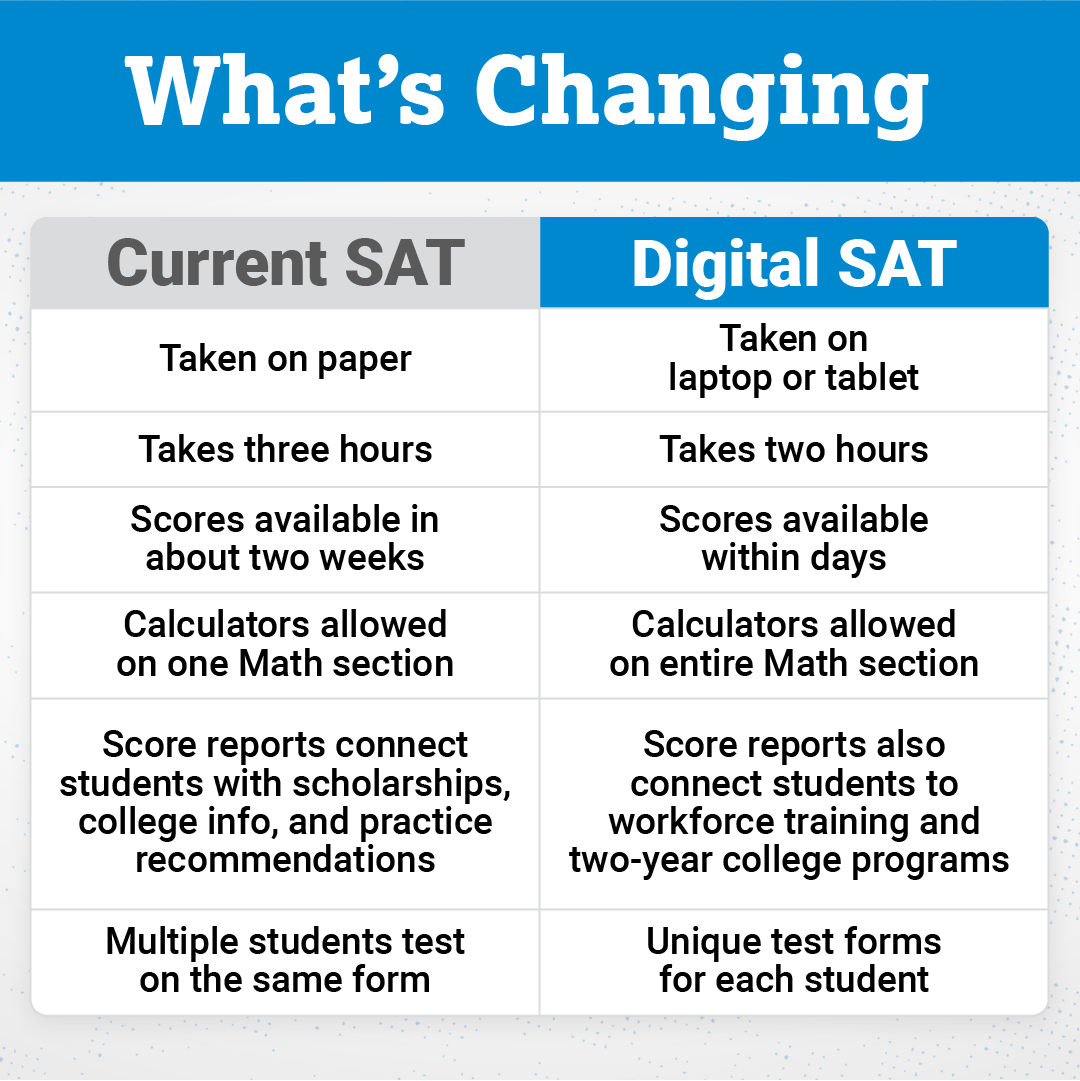
What’s Changing


“The digital SAT will be easier to take, easier to give, and more relevant,” said Priscilla Rodriguez, vice president of College Readiness Assessments at College Board. “We’re not simply putting the current SAT on a digital platform—we’re taking full advantage of what delivering an assessment digitally makes possible. With input from educators and students, we are adapting to ensure we continue to meet their evolving needs.”

Among the changes: the digital SAT will be shorter—about two hours instead of three for the current SAT, with more time per question. The digital test will feature shorter reading passages with one question tied to each, and passages will reflect a wider range of topics that represent the works students read in college. Calculators will be allowed on the entire Math section. Students and educators will get scores back in days, instead of weeks. And, to reflect the range of paths that students take after high school, digital SAT Suite score reports will also connect students to information and resources about local two-year college, workforce training programs, and career options.

With the transition to digital tests, College Board is working to address inequities in access to technology. Students will be able to use their own device (laptop or tablet) or a school issued device. If students don’t have a device to use, College Board will provide one for use on test day. If a student loses connectivity or power, the digital SAT has been designed to ensure they won’t lose their work or time while they reconnect. 

The changes will also make the SAT more secure. With the current paper and pencil SAT, if one test form is compromised it can mean canceling administrations or canceling scores for a whole group of students. Going digital allows every student to receive a unique test form, so it will be practically impossible to share answers.

The SAT will be delivered digitally internationally beginning in 2023 and in the U.S. in 2024. The PSAT/NMSQT and PSAT 8/9 will be delivered digitally in 2023 with the PSAT 10 following in 2024. More information about the changes can be found at SAT.org/digital.

New Scholarship Announcements for Your Students

We try to keep you apprised of new scholarships announcements that cross our desk as we know the cost of college continues to rise. These are all new ones that are available if any of your students are looking to apply:

  1. Jeremy Schulman Scholarship for First Generation Americans – This scholarship is available for students in the United States who are currently enrolled in a University or High School, and have plans to attend a University.  The scholarship is meant to create awareness for the problems faced by first generation Americans and to give back a little to students.

There are five (5) one-time awards of $1,000 for 5 different students

Deadline for this scholarship is April 15, 2022

A winner will be announced by May 15, 2022 

Link to apply and more information about the scholarships: https://jeremyschulmanscholarship.com/jeremy-schulman-scholarship/

2. Barry Epling Scholarship for Young Entrepreneurs – This scholarship is available for students in the United States who are currently enrolled in a University or High School, and have plans to attend a University.  The scholarship is meant to help a deserving student with scholarship funding who wishes to start their own business in the future.

Award of $1,000 for a single student

Deadline for this scholarship is April 15, 2022

A winner will be announced by May 15, 2022 

Link to apply and more information about the scholarship: https://barryeplingscholarship.com/barry-epling-scholarship/

3. “Marika Tolz Scholarship for Women in the Workplace – This scholarship is available for students in the United States who are currently enrolled in a University or High School, and have plans to attend a University.  The scholarship is meant to help a deserving student with scholarship funding and help to bring awareness to the issues facing women in the workplace.

Award of $1,000 for a single student

Deadline for this scholarship is May 15, 2022

A winner will be announced by June 15, 2022 

Link to apply and more information about the scholarship: https://marikatolzscholarship.com/marika-tolz-scholarship/

4. Mens College Scholarship – Men are choosing paths other than college. To counter this trend, a diverse group of fraternity alumni founded the Men’s College Scholarship which will award $50,000 in scholarships this year to inspire college attendance and academic success by young men.

Award of $50,000

Deadline for this scholarship is April 1, 2022

A winner will be announced by May 2, 2022

Link to apply and more information about the scholarship: https://foundationfe.org/highschoolscholarship/

5. Christopher Nohl Scholarship for Diverse Backgrounds – This scholarship is available for students in the United States who are currently enrolled in a University or High School, and have plans to attend a University.  The scholarship is meant to help a deserving student with scholarship funding who wishes to start their own business in the future.

Award of $1,000 for a single student

Deadline for this scholarship is July 15, 2022

A winner will be announced by August 15, 2022 

Link to apply and more information about the scholarship: https://christophernohlscholarship.com/christopher-nohl-scholarship/

Class of 2023 – College Application Guide

A Counselor, A Thomson, of Hillsborough Township HS in NJ, has put together an excellent online College Application Guide that should be of interest to Counselors around the country that are looking to create something similar for their school.

It includes the following pages (with links):

SCOIR (link to site)

Presentations and Videos

Class of 2021 Outcomes

Building a College List

College Visits

Majors and Careers

Application Info

Athletics

Community College

Financial Aid

Trade/Career Schools

Here are three tips for student success in closing from their guide:

  1. Read your email. Every day.
  2. Be an active participant. Students, this is your future.
  3. Ask questions and ask for help when you need it.

Taking A Gap Year Between High School and College: Six Reasons to Defer Admission after Acceptance to College and Two Reasons to Think Twice

Deferring admission (sometimes referred to as deferring enrollment) is the process of choosing a college to attend and postponing the start date for a semester or a year. The college agrees to hold the student’s place in the following year’s freshmen class and the student agrees (by paying a deposit) to attend the college the following year.

Why would a student choose to defer admission?

There are a variety of reasons why a student would choose to defer admission. Some students want to take a gap year to travel, volunteer, work and save money, or complete an internship. Other students might need to take time off before college to address a medical concern or due to responsibilities at home such as working for the family business or caring for younger siblings or a parent who is ill. Additionally, some students might not feel they are “college ready” and need additional time to develop maturity and skills such as independent decision making and time management.

What are the benefits of applying to college during senior year of high school and then deferring admission?

There are several benefits to applying to college during high school and then deferring enrollment rather than waiting until after high school graduation (during the gap year) to apply to college. These include:

  • While in high school, the student has ready access to many of the resources needed to apply to college. For example, the school counselor is available to answer questions about the process of applying and assist in building the college list. It is also convenient to ask for letters of recommendation from teachers after class.
  • The momentum provided by peers who are also applying to college can serve as a motivator.
  • The student’s gap year experience will not be interrupted by the process of applying to college.
  • The student will be able to execute their plans for the year after high school in comfort, knowing they have been accepted at a college they want to attend.
  • Parents are often reassured by a college acceptance and commitment by their child to attend college. The worry that their child will lose the motivation to attend college during the gap year is alleviated by having a definite college plan.
  • The student might change their mind about the gap year and want to attend college the following fall. It will be a great relief that their applications were submitted and they are on track for receiving acceptances.

Can students take courses at another college during the deferral period?

Colleges vary in their rules regarding taking courses at other colleges during the deferral period. Many do not allow students who have deferred admission to enroll at another college full-time or as a degree-seeking student. Some colleges will limit the number of courses a student can take at another institution, even if they are not enrolled as a full-time student. Students who choose to study at a community college or state university during a deferral may have to reapply as a transfer student in order to receive college credit for the courses they took during the deferral period.

Make sure to ask about the rules for taking courses at another college and avoid assuming that you will be able to do so during a deferral. Also, inquire about the process for ensuring the credits will transfer and be useful towards obtaining a degree.

What is the process of applying for a deferral?

The process to apply for a deferral varies across colleges. However, in general, students will be asked to submit their request to defer admission in writing and, if granted by the college, the deferral will apply for no more than one year. Students may be asked for a confirmation of their plans during their gap year. Some colleges grant deferrals to all students who request them, while others make a decision to grant deferrals on a case-by-case basis. Colleges who grant some deferral requests, but not others, are looking for a “good reason” for making the request. Examples of acceptable reasons for a deferral could include travel, volunteer work, employment to pay for college, the student’s health and family concerns. Once a deferral is granted, the student will need to send a deposit (if they haven’t already) to hold their place in the following year’s freshmen class. The amount of the deposit will vary depending on the college.

Students should call the admissions office of the college where they would like to defer enrollment and ask for specific details of the requirements and timeline for requesting a deferral.

What questions should students ask about deferring enrollment?

What is the process of applying for a deferral?

What documentation is required?

Is my application likely to be approved?

Is there a deadline for requesting a deferral?

Will my financial aid award (including scholarships) be affected? Will I need to fill out the FAFSA again? Will money I earn during my gap year affect my award?

What do I have to do to reenter the college? Are there deadlines for housing, registration, and orientation that I should be aware of?

Am I permitted to take courses at another college or university during the deferral period and if I do, will the course credit I receive be recognized toward graduation or other requirements?

Are there any downsides to applying to college and then deferring admission?

It is possible that a student will be a more competitive applicant after they complete a gap year. The gap year experience could provide students with the skills and experiences that colleges seek in applicants. These new experiences could inspire a student to write a winning college essay. Overall, a gap year experience could enhance a college application enough to move the student from the deny to the accept pile.

In addition, students will grow and change as a result of the gap year experience. As students learn more about themselves, they may realize what type of college would be best for them. Students might also identify a new major and career to pursue that they were not aware of in high school. The gap year experience could inform the student’s choice of which colleges may be a good fit for them. Had they applied and made an early commitment to college, they may land in the wrong place.

How can I learn more?

Deferring enrollment is just one of many topics Michelle McAnaney, founder of The College Spy, will be discussing in College Admissions 101, a live online course being taught on Sunday evenings in February. The course is meant for parents of students in grades 9, 10 and 11. Students are also welcome to attend. To learn more about this course and register click here.

Deferring admission (sometimes referred to as deferring enrollment) is the process of choosing a college to attend and postponing the start date for a semester or a year. The college agrees to hold the student’s place in the following year’s freshmen class and the student agrees (by paying a deposit) to attend the college the following year.

Why would a student choose to defer admission?

There are a variety of reasons why a student would choose to defer admission. Some students want to take a gap year to travel, volunteer, work and save money, or complete an internship. Other students might need to take time off before college to address a medical concern or due to responsibilities at home such as working for the family business or caring for younger siblings or a parent who is ill. Additionally, some students might not feel they are “college ready” and need additional time to develop maturity and skills such as independent decision making and time management.

What are the benefits of applying to college during senior year of high school and then deferring admission?

There are several benefits to applying to college during high school and then deferring enrollment rather than waiting until after high school graduation (during the gap year) to apply to college. These include:

  • While in high school, the student has ready access to many of the resources needed to apply to college. For example, the school counselor is available to answer questions about the process of applying and assist in building the college list. It is also convenient to ask for letters of recommendation from teachers after class.
  • The momentum provided by peers who are also applying to college can serve as a motivator.
  • The student’s gap year experience will not be interrupted by the process of applying to college.
  • The student will be able to execute their plans for the year after high school in comfort, knowing they have been accepted at a college they want to attend.
  • Parents are often reassured by a college acceptance and commitment by their child to attend college. The worry that their child will lose the motivation to attend college during the gap year is alleviated by having a definite college plan.
  • The student might change their mind about the gap year and want to attend college the following fall. It will be a great relief that their applications were submitted and they are on track for receiving acceptances.

Can students take courses at another college during the deferral period?

Colleges vary in their rules regarding taking courses at other colleges during the deferral period. Many do not allow students who have deferred admission to enroll at another college full-time or as a degree-seeking student. Some colleges will limit the number of courses a student can take at another institution, even if they are not enrolled as a full-time student. Students who choose to study at a community college or state university during a deferral may have to reapply as a transfer student in order to receive college credit for the courses they took during the deferral period.

Make sure to ask about the rules for taking courses at another college and avoid assuming that you will be able to do so during a deferral. Also, inquire about the process for ensuring the credits will transfer and be useful towards obtaining a degree.

What is the process of applying for a deferral?

The process to apply for a deferral varies across colleges. However, in general, students will be asked to submit their request to defer admission in writing and, if granted by the college, the deferral will apply for no more than one year. Students may be asked for a confirmation of their plans during their gap year. Some colleges grant deferrals to all students who request them, while others make a decision to grant deferrals on a case-by-case basis. Colleges who grant some deferral requests, but not others, are looking for a “good reason” for making the request. Examples of acceptable reasons for a deferral could include travel, volunteer work, employment to pay for college, the student’s health and family concerns. Once a deferral is granted, the student will need to send a deposit (if they haven’t already) to hold their place in the following year’s freshmen class. The amount of the deposit will vary depending on the college.

Students should call the admissions office of the college where they would like to defer enrollment and ask for specific details of the requirements and timeline for requesting a deferral.

What questions should students ask about deferring enrollment?

What is the process of applying for a deferral?

What documentation is required?

Is my application likely to be approved?

Is there a deadline for requesting a deferral?

Will my financial aid award (including scholarships) be affected? Will I need to fill out the FAFSA again? Will money I earn during my gap year affect my award?

What do I have to do to reenter the college? Are there deadlines for housing, registration, and orientation that I should be aware of?

Am I permitted to take courses at another college or university during the deferral period and if I do, will the course credit I receive be recognized toward graduation or other requirements?

Are there any downsides to applying to college and then deferring admission?

It is possible that a student will be a more competitive applicant after they complete a gap year. The gap year experience could provide students with the skills and experiences that colleges seek in applicants. These new experiences could inspire a student to write a winning college essay. Overall, a gap year experience could enhance a college application enough to move the student from the deny to the accept pile.

In addition, students will grow and change as a result of the gap year experience. As students learn more about themselves, they may realize what type of college would be best for them. Students might also identify a new major and career to pursue that they were not aware of in high school. The gap year experience could inform the student’s choice of which colleges may be a good fit for them. Had they applied and made an early commitment to college, they may land in the wrong place.

Michelle McAnaney is the founder of The College Spy, a full service independent educational consulting firm that assists students and families across the US and internationally with the college selection and application process. Prior to founding The College Spy, Michelle was a guidance counselor and educator for more than 15 years, including serving as the Director of Guidance at two high schools, an adjunct college professor and a GED tutor. Michelle holds a master’s degree in school counseling and a bachelor’s degree in human development. She completed UC Irvine’s certificate program in educational consulting and is a MBTI (Myers-Briggs Type Indicator) Certified Practitioner and a NLP (Neuro-Linguistic Programming) Master Practitioner. Michelle visits over 40 colleges each year so that she has first-hand knowledge of the colleges and universities her clients will be considering. You can find her on Facebook, Twitter, Instagram, LinkedIn.

How can I learn more?

Deferring enrollment is just one of many topics Michelle McAnaney, founder of The College Spy, will be discussing in College Admissions 101, a live online course being taught on Sunday evenings in February. The course is meant for parents of students in grades 9, 10 and 11. Students are also welcome to attend. To learn more about this course and register click here.



A Toolbox for Teen Anxiety

Selected excerpts from Conquering Fear: One Teen’s Guide to Overcoming Anxiety

My name is Carter Weinstein. I am an 18-year-old high school senior born in New York and raised in Texas. At first glance, I may seem like any other busy student who takes school seriously. I work hard in my classes, strive to make good grades, play sports, and participate in community service projects. I also spend time on social media and hang out with my friends.

Like many of my peers, I have been faced with a challenge that has affected me for my whole life—severe anxiety. Despite the recent focus in schools on both mindfulness and mental health, there seems to be a lack of first-hand personal perspectives. I’m here to change that.

Before I dive into some tips and tricks that help me work through my anxiety, a couple of important notes:

First, for the most part, I worked with a coach/therapist over time to identify many of these tools. Some of the things we discussed worked, and some did not. It took time to curate a good “toolbox” for my anxiety. Also, there are some small modifications I made on my own along the way that helped to really personalize the strategies for me.

Second—and super important—these tools work for me but may not work for you.  I am simply presenting them so you know there are tactics out there that can help. If you choose, you can use these as starting points when you are ready to start developing your own coping strategies with a parent or counselor.

Here We Go!

First, establish your goal. Although you could decide your motivation is to completely expel any stressful events/emotions from your life, that kind of goal would almost be setting yourself up for failure. With so many life changes ahead, some anxiety is inevitable for everyone. Instead, what if your goal were to lower your anxiety response to some of your triggers?

Deep Breathing and Meditation

You don’t need any equipment besides your lungs and your mind for deep breathing and meditation, so they are always accessible! There is a proven biochemical effect that takes place in your body—relaxing the mind—when you can take calm, deep breaths. The focus inspiring these breaths is the meditation part.

As easy as it is to suggest these tactics, I understand it could be hard to employ them when your anxiety is high. There are many books and easy-to-use apps available to help you practice, so you won’t have to look far for guidance. But practice is key so that you’re ready with the tools when you need them.

Visualization

Visualization is the process by which you form a mental image of something. The impact of visualization has been significant for me. Whether I am trying to pull myself out of a stressful situation, or charting future plans/success, it has been an incredibly impactful tactic.

When you feel as if you are consumed and inundated by negative emotions, imagine yourself in a place where your anxiety levels are near zero. Once you are there, open your eyes and realize that moment of panic does not last forever. There is a world existing outside of your anxious bubble. I cannot stress this enough: Whatever you are feeling right this minute, you’ll probably be feeling something different five minutes from now.

Distraction

Redirecting your mind with outside influences can also work. Whether it’s a means of entertainment (movies, video games, etc.), a book or magazine, or even music, focusing on characters, plot lines or lyrics can also be meditative and help redirect negative thinking. It just takes a minute to focus on another situation to get untwisted from an anxious spiral.  Distraction stimulates subconscious relaxation. When the show or song is over, I re-emerge, often with a new perspective and a cleared mind.

Exercise

Exercise is essential to managing both acute and generalized anxiety. Although I play sports both in and outside of school, that’s not where my level of activity stops. Your physical activity doesn’t have to be anything competitive. If you like yoga classes or playing tennis at the local rec center, that’s great. By taking part in any kind of aerobic activity, you are not only helping your body to release stressful toxins but you are also focusing on something other than your anxiety.

Sleep

When you’re sleep-deprived, everything you have to manage seems bigger and more cumbersome than it actually is. It sounds so basic, but we all need a good night’s sleep—and scientists are continuing to discover more and more reasons why that’s true. It is really hard in high school when you have so many things on your mind—so much you need to do and so much you want to do—to put your schoolwork away, get off social media, put your phone down, and go to sleep.  Even when I’m exhausted, I’ll continue to scroll through TikTok.

According to the U.S. Center for Disease Control, teenagers ages thirteen through eighteen should average eight to ten hours of sleep per night. Set the alarm for yourself every night, guaranteeing that you will be in bed by that specific time. You may even need to put your phone outside your room so that you won’t be tempted to pick it up.

Medication

For some people, medication can become an integral part of addressing anxiety. Each one of us is absolutely unique. Many people never need medication. Others might determine with a professional that a prescription should be implemented right away or may be part of their plan down the road.

Please note that you should never take any medication without oversight of a physician and the consent of your parents or guardian. Your medical doctor (pediatrician, psychiatrist, etc.) is the only professional who can give you appropriate advice about whether or not medication could be helpful for you—and if so, which one.

Just like therapy itself, I believe the use of anti-anxiety medication should never be stigmatized. If I had atrial fibrillation (irregular heart palpitations), a cardiologist would not hesitate to put me on medication if that were appropriate. No one would ever think less of me for taking it; I wouldn’t think less of myself, either. Doctor-prescribed medication for challenges related to your mind should be just the same—no stigma, no judgment.

No Matter What You Try . . .

Don’t give up. It’s easy to try any of these coping mechanisms—or ones that you identify for yourself—once and then give up. Maybe you just don’t get the hang of meditation the first time you try it. Or you put your phone away, sleep straight through one night and still feel anxious the next day. With that said, if you cycle through a specific method a few times and you still don’t feel it has any benefit, definitely move on. You don’t want to stick with something that’s not working when a better coping mechanism could be just around the corner.

But never give up hope. You will find what works for you.

Find a partner to join your team. Whether it’s a parent, a school counselor, or a coach, having some adult in your corner will make things easier for you to navigate options and stay committed. There is no shame in seeking out help.

Lastly, don’t be afraid to talk about your anxiety. You will be shocked to find out how many people around you have similar struggles—even though their struggles might look different than yours. Sharing your journey will not only take a huge weight off your shoulders, but you may also find that your openness helps others. That in and of itself is therapeutic and rewarding.

I hope you are as excited as I am for you. I know how hard it is. I have been there. And I will be back there again. Remember, you are never alone.

Carter Weinstein is a freshman at Georgetown University and the author of Conquering Fear: One Teen’s Guide to Overcoming Anxiety. Carter hopes to get this book into the hands of every incoming high school freshman or college freshman, so out of the gate, they know that everyone has struggles and they are not alone.

What’s the Best Way to Structure a College Essay?

Recently, I had a conversation with a counselor who wondered how he might help students select the right structure for their college essays. The counselor asked me which of these approaches I prefer for college essay coaching:

  • Selecting multiple scenes to illustrate your most important values.
  • Starting the essay with a hook.
  • Outlining the beginning, middle and end of the essay before starting to write.

Hmmm… none, I responded! That was easy enough.

Truth be told, this was not a new question for me. High school counselors, independent educational consultants and teachers who work with students applying to college ask my business partner Susan Knoppow and me these sorts of questions all the time:

  • Which structure do colleges prefer?
  • Which structure is best?
  • Which is easiest to write?

Our answer remains the same: There is no best, easiest or preferable college essay structure.

At Wow, we don’t tell our students how to structure their essays.

We don’t even show them samples so they can choose a structure they like.

Instead, we give them simple instructions, and teach them how to make their own editorial choices.
 
The BEST structure for any college essay is the one that emerges organically as a student goes through the process of writing the essay.

Want to learn more?

Here’s a webinar Susan recorded a couple years ago about what we like to call the messy middle – the point during essay-writing when structure emerges from the freedom and chaos of an early draft.
 
The messy middle can be unnerving for students (and the pros who work with them). It’s unpredictable and leaves many otherwise confident folks feeling out of control. But take our advice – roll with it and trust your students to revise their essays with a little bit of guidance.

You don’t have to know where they’re going to end up.

Be willing to be surprised.

Kim Lifton, of Farmington Hills, MI, is President and Co-founder of Wow Writing Workshop, which teaches students and educational professionals a simple, step-by-step process for writing effective college essays, so students can stand out and tell their stories. Kim leads a team of writers and teachers who understand the writing process inside and out. Since 2009, Wow has been leading the college admissions industry with our unique approach to communicating messages effectively through application essays, including personal statements, activity and short answer essays and supplements. Kim is also a board member of MACAC. When she is not teaching students or training professionals, Kim likes to write her own stuff, do yoga at her synagogue, drink coffee, and swim laps (slowly but steadily) a few mornings a week at the high school she attended a very, very long time ago.

Coming Up 


We cover a new topic in our Pro Chats each month – Wednesdays at 1:00 p.m. Eastern! Click here to register for our free sessions!

February 9       Improve in the New Year: Help Students Write Their Best Possible Essays

March    9        Cliches: “My Students Can’t Stay Away from College Essay Cliches”

Our free gift to you!

And, if you’d like a free electronic copy of our book for counselors, How to Write an Effective College Application Essay, the Inside Scoop for Counselors, download it here.

Let your students know we have a free class for them, too!

If you want to help students with the basics, encourage them to sign up for our monthly free student class or Wednesdays at 7 p.m. Eastern.

Next up

Wednesday, Feb. 9, Wow Writing Workshop at 7 p.m. ET! You are welcome to sign up, too.

Free Access Membership Available for Counselors to the Southern Association of College Admission Counseling (SACAC)

The mission of the Southern Association for College Admission Counseling (SACAC) is to promote professional growth, access, advocacy, and outreach to help all students realize their post-secondary education goals. In support of their mission, they have introduced a new membership model, Free Access Membership. All public high school and community based organization college access counselors and staff are invited to join SACAC at no cost through their Free Access Membership. Interested in joining SACAC as a new member? Register for access here. 

Current SACAC members working in public high schools and community based organizations will be eligible for the Free Access Membership in the next membership cycle which runs September 1, 2022 – August 31, 2023.

Who Qualifies for Free Access Membership?

Public High School College Access Counselors and Staff

Any staff member supporting students and families with post-secondary college planning at a public high school in the SACAC region* that provides free education through public funds.

Non-Profit/Community-Based Organizations College Access Counselors and Staff
For professionals who work for a non-profit organization 501(c)(3) in the SACAC region* that serves students and promotes or provides access to higher education. Must have been in business for the past three years.

SACAC Region*
Alabama, Arkansas, Georgia, Florida, Louisiana, Mississippi, North Carolina, South Carolina, Tennessee, Caribbean 

Why should someone consider joining SACAC?

The Southern Association for College Admission Counseling is dedicated to supporting counseling and enrollment professionals as they help students transition from high school to higher education.SACAC includes counselors, college admission officers, and independent counselors from high schools, colleges, and organizations in Alabama, Arkansas, Florida, Georgia, Louisiana, Mississippi, North Carolina, South Carolina, Tennessee and the Caribbean. Their 1,700 members promote high professional standards by exchanging ideas, sharing goals, preparing counselors to serve students, and adhering to a set of ethical guidelines and practices. They are an affiliate of the National Association for College Admission Counseling (NACAC), which represents over 10,000 members worldwide.

Benefits To You:

SACAC provides an array of tools to keep members connected with seminars and workshops. Stay in touch electronically through their email lists. Members also have access to their full membership directory, allowing them to reach out directly to their peers. Take advantage of their online Knowledge Center, where you’ll find an array of articles and resources that will help you do your job better. You can become or find a mentor. They will pair you at the beginning of your careers with veterans who can offer “beginning of your career” advice. Southern Scope, their blog, helps keep our members informed and provides updates on the profession and anything SACAC related. You even have the opportunity to write and share your own article to contribute to Southern Scope. Grants: SACAC tries to provide funding for members with limited budgets to attend the Annual Conference, workshops, and programs. Government Relations: They keep you up-to-date on legislative happenings in the region and in your state and provide opportunities and information for members to reach out to state leaders on issues related to higher education preparation, financing, and access. Outreach to students: Their Extending the Dream fund targets students in their communities, helping their parents and counselors prepare them for college. They also organize Mini Camp College Workshops, where admission officers and school counselors from throughout the Southeast present information on planning for college admissions. Topics include the college search, making the best use of the next day’s college fair, and the scholarship/financial aid process.

Interested in joining? Register for membership here.

here

How to Make Stress Your Friend

Here is a great TED Talk about Stress. Many Counselors (as you know) and students are stressed particularly with the challenges from operating through COVID-19 and the recent Omnicron surge.

Stress. It makes your heart pound, your breathing quicken and your forehead sweat. But while stress has been made into a public health enemy, new research suggests that stress may only be bad for you if you believe that to be the case. Psychologist Kelly McGonigal urges us to see stress as a positive, and introduces us to an unsung mechanism for stress reduction: reaching out to others.

Here is a link to the video: https://www.ted.com/talks/kelly_mcgonigal_how_to_make_stress_your_friend?utm_campaign=tedspread&utm_medium=referral&utm_source=tedcomshare

Implicit Bias in College Counseling – Free Course Being Offered to all High School Counselors

UCLA Extension is offering a free course to all Counselors – “Implicit Bias in College Counseling”. The webinar will allow participants to identify and interrupt biases in their role as college counseling professionals.

About the Course – Implicit bias affects how we interact with the world, take in information, and make decisions. Our biases inform how we view our students and the resulting guidance we offer. Whether in your first or 40th year in college counseling, this course offers you the opportunity to renew and reaffirm your alignment and commitment to the NACAC College Counseling Competencies by confronting this subconscious phenomenon.

What Counselors Will Learn – 1. Understand what implicit bias in college advising looks like. 2. Identify how and when implicit bias shows up in your professional life. 3. Understand how implicit bias can negatively affect your students. 4. Learn how to combat and debase implicit bias in the work you do with your students

Want to view it. Here is the link for the free registration: https://www.uclaextension.edu/education/higher-education-adult-educators/course/implicit-bias-college-counseling-educ-7241?fbclid=IwAR3T2KHaN_MJVW82KXZ98xov-YCWdro3DRKqsjWKo2ABQdjUmP34mA7UsUo

19 Tips on How Your Students Can Pay Less for College

Forbes put together a nice article with tips on how students can pay less for College. Here is the summary of the tips and a link at the end to the article:

  1. Focus on Free Money First: There are a lot of grants, scholarships and tuition wavers available that cost nothing.
  2. Apply for Financial Aid: Everyone should fill out the FAFSA even it they don’t think they will get any money. They may be surprised at what they do get.
  3. Military funding: ROTC and other programs can pay for a larger portion of College.
  4. Work Study or Part-Time Job: Working while in College can cover funds that don’t have to be borrowed and paid back over time.
  5. Appeal for Financial Aid: Financial aid appeals are sometimes called negotiation, a professional judgment review or a special circumstances review. Many Colleges have funds held back to help students with special circumstances.
  6. 529 Plan: These tax advantaged plans can really help fund a lot of College costs (Note I paid for both of my children’s College with these types of funds).
  7. American Opportunity Tax Credit: The AOTC provides a partially-refundable tax credit worth up to $2,500 based on up to $4,000 in tuition and textbook expenses each year for up to four years. The AOTC is an above-the-line exclusion from income, which means you can claim it even if you don’t itemize.
  8. Lifetime Learning Tax Credit: The LLTC is a less generous tax credit for people who don’t qualify for the AOTC.
  9. Student Loan Interest Deduction: This can be claimed on the tax return and is an above-the-line exclusion from income for up to $2,500 in interest paid on federal and private student loans.
  10. Live off-campus: Living off-campus with a roommate or parents can substantially reduced housing costs.
  11. Buy used textbooks: This is an easy no-brainer cost savings but many students continue to buy new books from the on-campus college bookstore.
  12. Adopt an austere lifestyle: You are a college student so live like one.
  13. Ask for discounts: Many are available if you just ask.
  14. Track spending: This seems easy but many students don’t do it and as an example don’t realize they spend $150 a month at Starbucks.
  15. Tuition installment plans: These really help with budgeting but may not be great for that student that gets their student loan money upfront and has a tendency to spend that money on things they shouldn’t.
  16. Budget before borrowing: Aim to have total student loan debt at graduation that is less than your annual starting salary, and, ideally, a lot less.
  17. Borrow federal first: Federal student loans are less expensive and have better repayment options than private student loans. They are also easier to get.
  18. Crystalize a choice of academic major early: Students who change majors or transfer to another college are less likely to graduate on time, because some of their college credits may not count toward the new major or college and colleges offer less financial aid to transfer students. Take an interest or skills inventory test to help you identify the right academic major sooner.
  19. Plan a path from enrollment to completion: Students who plan which classes they will take when are more likely to graduate on time.

Here is a link to the Forbes blog with additional information on each of the tips: https://www.forbes.com/sites/markkantrowitz/2021/12/26/how-to-pay-less-for-college/?sh=627bcf107266

Newer Posts
Older Posts

Link for Counselors

Current Publication

View Current Publication

Advertisements

LINK Newsletter for Counselors

Sign up to receive our bi-weekly e-newsletter.