Menu Sidebar
Menu

The Truth About IEP’s and 504 Plans

Many counselors believe students with disabilities or “differences” should have an IEP, or at least a 504 Plan, when transitioning to college. Prior to any further discussion on this topic, we must ask whether the submission of these documents is for admission to college or to receive accommodations.

For admission the simple answer is that no documentation is required, with a few exceptions. Out of approximately 4000 colleges in the US there are only about 250 with specific fee-for-service programs primarily for students with learning disabilities, attention deficit hyperactivity disorder or with autism spectrum disorder. Less than a quarter of these colleges evaluate applicants applying to the college and the program simultaneously. These colleges must take the disability into consideration for admission to their special program, thus the college. There are two colleges in the US that are exclusively for students primarily with ASD, LD, ADHD and of course they must consider a student’s disability as detailed in the documentation.

For the vast majority of colleges documentation is not requested or expected at the time of application. In fact, if documentation is sent to an admissions office it is usually returned to the applicant, forwarded to the disability/accommodation office in event the student is accepted, enrolled and requests accommodations, or possibly deleted/shredded. Generally, college admissions counselors are not trained to interpret this information.

Many colleges do not consider disability information at the time of application to avoid potential lawsuits. If a college admissions office considers disability information and then decides to deny the applicant, the college runs the risk of being accused of discrimination. Attorneys representing these colleges advise them NOT to consider an applicant’s disability to avoid a lawsuit based on the claim the applicant was denied because of the disability.

Colleges walk a fine line. It is not illegal to use information about a student’s disability to accept an applicant; however, it is illegal to use the same information for the purpose of a denial.

Other colleges are willing to risk the chance of a lawsuit. As we know, and probably relate to our students and parents, colleges do not look for reasons to deny. They look for reasons to accept. In varying degrees, colleges may use a “holistic approach” when evaluating an applicant. Everything matters. Was there some disaster affecting the applicant’s living arrangements such as a fire, flood or hurricane? Was there a major family disruption such as a divorce or death? During the past couple of years, we have seen many colleges with an essay prompt as to how Covid 19 affected the applicant. These colleges are very interested in how the applicant has dealt with challenges and it is an important piece of making the admissions decision.

A holistic approach would include how a student with a disability handled the challenges of learning. Admissions counselors may want to know whether ACT/SAT scores accurately reflect a student’s academic ability. GPA and rigor of coursework could be considered from a different viewpoint. A student with a reading or language disorder may not have taken a foreign language and the reason should be disclosed to admissions.

Disclosure of a disability would help explain parts of a puzzle that are missing or just don’t fit in well with what a college is looking for. Disclosure can be done by the applicant, in their own words, without submitting an IEP, 504 Plan or reports. Colleges handle applications as they see fit and there are many varieties and exceptions to the preceding information. It is always best to check with each college as to their policies and procedures. However, that being said, my experience has been that not every college is forthright in providing this information. Publicly, a college admissions office may state, “We do not consider disability information in our admissions decision,” when in fact, they could be positively influenced by how a student has done well given their learning, social, sensory or physical challenges.

After a student with a disability is admitted the next step is to receive accommodations, such as extended time for tests. A high school IEP or 504 Plan does not dictate what a college should provide. Colleges (except for a very few) operate under the ADAAA (Americans with Disabilities Act Amendments Act), formerly and referred to as ADA and Section 504 of the Rehabilitation Act. Section 504 has two sub-sections; one for K-12 and the other for post-secondary education. Therefore, IEPs and high school 504 Plans do not carry over to college. There is no question these documents may be helpful in deciding upon reasonable and justified accommodations and the manner in which they are provided.

As each college admissions office operates in its own fashion, so does the disability/accommodations office. IEPs and 504 Plans add information and credibility but they are far less important than students, parents, special education teachers, school counselors and independent educational consultants think they are.

Receiving accommodations does not depend on a document. It depends upon whether the disability affects a major life activity, such as learning. Here are seven scenarios whereby a college student has no IEP or 504 Plan, and yet receives accommodations:

  • A mature parent and college drop-out sees the same behaviors in her children as she displayed as a child. She realizes she has an undiagnosed learning disability (or ADHD) and returns to college for a second attempt.
  • A high school senior has attended a small private school since kindergarten. With extra support and tutoring she has done satisfactory work. It is suspected that she has a learning disability (or ADHD).  She is tested by a psychologist and is identified as having a disability.
  • An intellectually gifted student does reasonably well in high school, although many feel he should be doing significant superior work. At college he begins to see greater challenges than he did in high school, is not able to manage his time properly, has difficulty passing some subjects and is being placed on probation. He gets tested and discovers he is ADHD and “gifted LD.”
  • A college freshman with a medical issue affecting his eyesight becomes visually impaired during the year and requires accommodations to meet the academic requirements.
  • During the summer a recent high school graduate develops an illness or medical condition, resulting in an acquired brain injury, which will seriously affect her work in college. 
  • A student with epilepsy begins a new medication just prior to attending college. A side effect of the medication is slow processing speed, which will affect her work in college.
  • A college freshman was home-schooled through the 12th grade. While it appeared that she had academic challenges this student’s parents elected not to have her tested by the school district. She began college and experienced significant difficulty. A learning disability was identified after being tested.

All of the students described above are eligible to receive accommodations without having an IEP or 504 Plan. What is needed to obtain accommodations at college? An evaluation by a qualified professional, which states a disability exists and accommodations are needed. The college’s disability or accommodation office will decide if the disability is a substantial limitation of a major life activity (such as learning). It is not the disability, per se, that justifies an accommodation; it is the effect of the disability.

In conclusion, a student’s high school classification or status is not the deciding factor. Having a document such as an IEP or 504 Plan is not required. What is important is whether there is a disability and how the disability limits the student. The college then decides if they can provide accommodations to give the student equal access to an education and if the accommodations are reasonable and justified.

~

Allen Tinkler is the creator of the database book, “Colleges with Superior Services/Programs for Students with Special Needs.” More information is available about this unique resource by visiting his website,  www.CollegeBoundServices.com
The Percentage of College Admissions Officers Who Say Applicants’ Social Media Content is “Fair Game” Ticks Up

You may have heard recently on the news that Joe Rogan has gotten in trouble with some of the controversial things he has said on his podcast. Others famous people such as Chrissy Tiegen and Roseanne Barr have gotten a lot of criticism after posts and Roseanne even was fired from her sitcom. Many unknown people have been arrested for dumb things they have posted on social media.

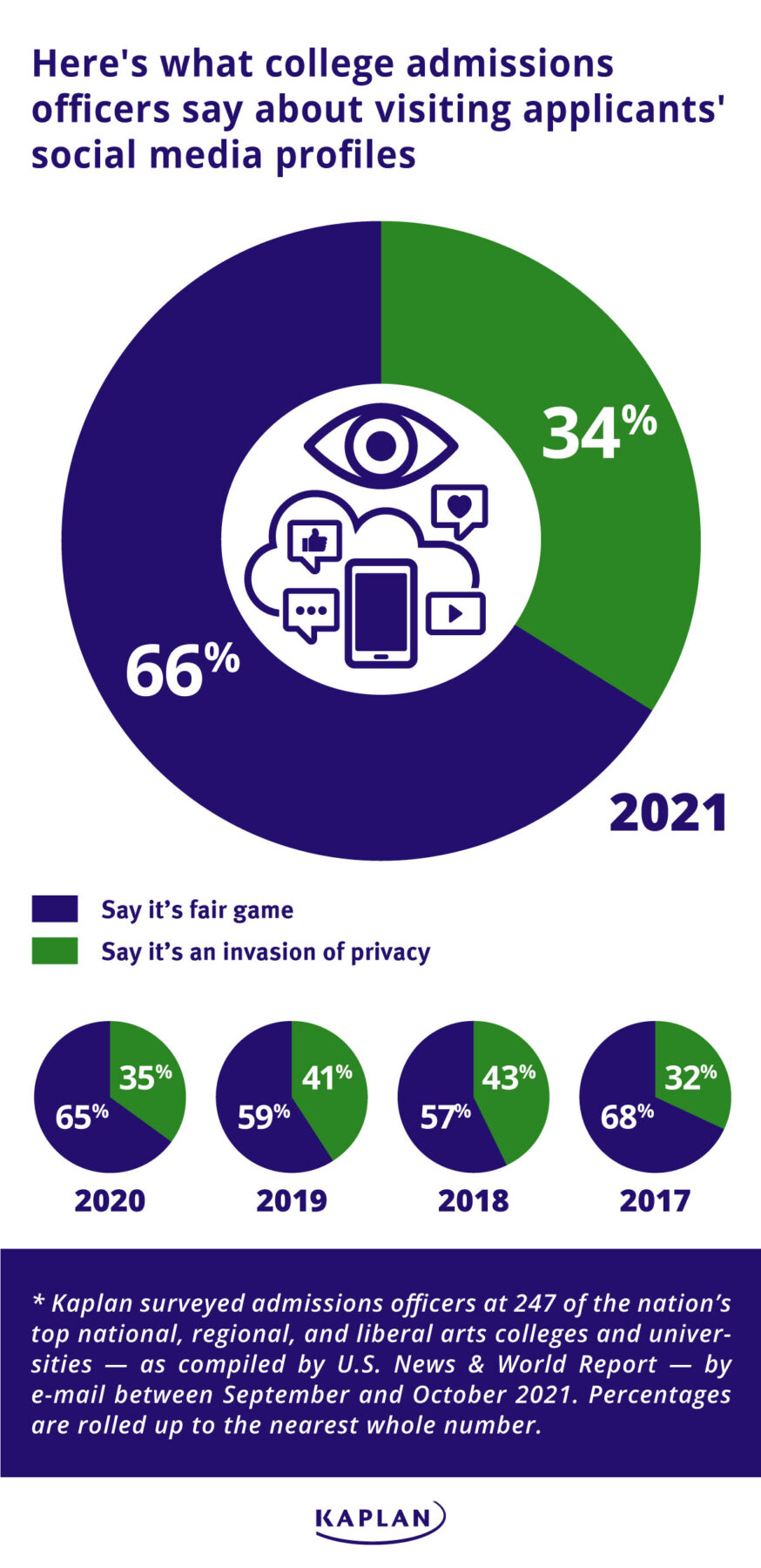
What does this have to do with your students? A new survey by Kaplan finds that 66 percent of college admissions officers think that applicants’ social media posts are “fair game” to help them determine who gets in.

Kaplan’s 2021 college admissions officers survey shows that a near record percentage of admissions officers think that applicants’ social media postings are “fair game” to help determine who gets in*. Of the hundreds of admissions officers surveyed, 66 percent (up 9 points since 2018) see no issue with social media being part of the admissions equation, a point of view that has gained support in recent years. In Kaplan’s 2020 survey, 65 percent reported they had a “fair game” view; in 2019, it was 59 percent, while the 2018 survey found it to only be 57 percent, and 68 percent in 2017, a high water mark. Taking the contrarian view, 34 percent of admissions officers consider viewing applicants’ social media “an invasion of privacy and shouldn’t be done.”

Among other findings:

  • The survey found that 27 percent of admissions officers visit applicants’ social media profiles to learn more about them⁠—significantly down from 36 percent in Kaplan’s 2020 survey**.
  • Of admissions officers who have checked out an applicant’s social media footprint, six percent say they do it “often,” a steep drop from the 17 percent who responded this way in Kaplan’s 2020 survey.
  • Of the admissions officers who say they check applicants’ social media, 38 percent say that what they found has had a positive impact on prospective students, down from 42 percent in 2020. On the flip side, 57 percent say that what they found had a negative impact, down slightly from the 58 percent who answered this way in 2020.

“Kaplan has been tracking the role of social media in the college admissions process since 2008 and it’s clear that a strong majority of admissions officers have arrived at being philosophically comfortable with the idea of visiting applicants’ social media profiles. Most will continue to say that while social media profiles shouldn’t be off limits, they are much more focused on evaluating prospective students on the traditional admissions factors like GPA, standardized test scores, letters of recommendation, admissions essays, and extracurriculars,” says Isaac Botier, executive director of college admissions programs, Kaplan.

“What also struck us was that a far lower percentage of admissions officers are actually visiting applicants’ social media profiles, compared to the past few years. We believe that given COVID-related issues, admissions officers decided to take a step back and give applicants the benefit of the doubt.”

Share this information with your students and let them know that post they make today could come back to haunt them later so they should really think about what they are posting online.

Five Things We Learned from the Class of 2022!

Congratulations! We all made it through another college application essay season.

As you begin to prepare the Class of 2023 for the application process, it’s natural to reflect back on the college essay season we’ve just finished. Last year was filled with big challenges.

Students faced uncertainty over school schedules and the continuous threat of COVID, many families dealt with the aftermath of wildfires or hurricanes, and far too many seniors felt they only got a partial high school experience during the lockdown.

It can be easy to let these challenges take up a great deal of our mental real estate, so let’s take a moment to intentionally make space for joy.

At Wow, we end every weekly writing coach meeting with this prompt: Tell me something good.

There are no rules; it can be about something big or small, silly, or funny. Doesn’t really matter. We just like to share positive things. David Bersell is taking a comic writing class. One of Susan Knoppow’s children’s poems is getting published this spring. Kim Lifton’s daughter got a raise–the second time in a year. I was able to reconnect with a cousin I hadn’t seen in quite some time.

We also always schedule time to talk about things that are going well on the work front: exciting brainstorms, personal statements coming to fruition, students who meet every deadline, and more. These little litanies of joy help all of our writing coaches maintain our own enthusiasm, and they remind us about what we love most about being college essay writing coaches: our students.

The Class of 2022 College Essays

As 2022 gets underway, we’d like to share some of our moments of joy that come from our students. Here are five fun things that my fellow writing coach David Bersell and I learned from our students this year:

  1. “A student is a member of the Lumbee Tribe. I had never heard of this particular Native Tribe, so I did a little Googling. It didn’t take long to become fascinated by the Lumbee Tribe’s history of inclusivity and fight for federal government recognition. My student’s stories of gregarious family gatherings and cultural traditions humanized and gave context to the facts I found online.” Joe Kane
  2. “I learned about how the online flight simming community uses YouTube videos and forums to share information. To me, mastering a flight simulator seems about as challenging as flying an actual plane.” David Bersell
  3. “Thanks to one student, I discovered the literary magazine Dishsoap Quarterly this summer. My student and several friends co-founded the magazine during lockdown, and they already have three issues out. I wish I had done things this cool when I was in high school.” Joe Kane
  4. “I learned about the online community of international gardeners. My favorite gardening lesson was how different soil recipes can help plants thrive–compost gives macronutrients, peat moss offers low compaction, perlite helps drainage, and Azomite rock dust supplies micronutrients.” David Bersell
  5. “One of my students wrote about a life realization she had after listening to Oprah’s podcast. It’s been a long time since Oprah has been on my radar. Of course, she has a podcast; I shouldn’t be surprised. Reading my student’s story gave me flashbacks to kindergarten and daytime TV at my babysitter’s house. It’s kind of comforting to know that some things don’t change.” Joe Kane

While students share fun facts and interesting hobbies, they also teach us how to be better essay coaches. Some students present a challenge that forces us to think on our feet. Others remind us why our tried-and-true coaching strategies work so well.

In our professional training program, the College Essay Experience, we take college counselors through the same essay writing process we use with our students. We sometimes hear the term “highflyer” to describe gifted and exceptional teens–the ones you might think need less help on the essays than other students. We know that’s not the case. And I had a student this season who is a great reminder to us all that gifted and exceptional teens also need help on essays.

My student was beyond gifted. She was brilliant, passionate, had an impressive resume, and was a great writer. Despite all her skills and achievements, she was terrified of writing her college essays. After we got through the first Common App essay, she was able to quickly write exceptional supplemental essays. But getting started was always a challenge. She needed my help. It didn’t matter how well she wrote or how gifted she was. We worked on several essays together and her self-doubt was an issue during every brainstorm.

This year we had quite a few students apply to business schools requiring essays that presented either hypothetical business plans or hypothetical solutions to economic problems. I’m not an economist, but I thought a few of the economic solutions students wrote about seemed dubious at best.

Part of me wanted to do exactly what we warn parents against: tweak the students’ ideas until we arrived at something that seemed wise from my adult perspective. I restrained that urge, however, because I knew that would be overstepping; I also knew that admissions wanted authentic stories from applicants who have minimal or no business expertise.

In 2021, we paid closer attention to students’ vacation/camp/work schedules than we had in the past. We wanted to improve how we plan and schedule to make it easier for the students and help us manage the process even more efficiently than before. We’re always looking for ways to keep improving things around here. It worked out great. We were more proactive and thoughtful about student commitment and energy levels.

“In a couple instances, I realized that students were ready and willing to work faster/harder, so I picked up the pace to accommodate them,” David said. “In other cases, I accepted that a student was busy and overwhelmed, and they could only accomplish so much each week. And finally, there were times when students were busy and tired, but that was not going to change any time soon, so I made choices to help them write effective essays as efficiently as possible.”

Coaching the Class of 2022 College Essays

As professionals who work with students applying to college, it’s our job (and yours) to help students effectively articulate their own ideas and stories, not tell them what to think or write about. No matter what David or I thought personally about any idea, we kept our opinions to ourselves, made sure the essays had solid themes, and let the students be in charge of their own essays.

By the time we reached the final drafts, the students had clearly expressed their ideas and carefully considered their arguments. We consider each of them successful essays.

What did you learn from your students this past season? We’d love to hear more.

Free Stuff for You and Your Families!

Download a free book for prosHow to Write an Effective College Application Essay, the Inside Scoop for Counselor

Sign up for a free monthly webinar — 1 p.m. ET on the second Wednesday of each month. Next up: Wednesday, March 9.

Let your students know we have a free class for them, too!

If you want to help students with the basics, encourage them to sign up for our monthly free student class on the second Wednesday of each month between February and September at 7 p.m. Eastern. Next up: Wednesday, March 9.

About the Author: Joe Kane

Joe Kane is a senior writing coach with Wow Writing Workshop. Outgoing, thoughtful, and imaginative, Joe loves hearing his students’ stories and helping them reflect on their life experiences in compelling college essays.

Perpetually optimistic, Joe is grateful for the things he has learned from working with Wow’s students about life in distant countries, VEX robotics competitions, cloning extinct species, and so much more! Joe joined Wow after working as a writer-in-residence for the nationally recognized InsideOut Literary Arts.

He now lives in Nashville, where he is the Program Director of The Porch’s youth programming arm, SLANT (Student Literary Artists of Nashville, TN). Joe’s poems and stories have found homes in a number of magazines, including RHINO, Elimae, theEEEL, Clapboard House, The Splinter Generation, Cricket Online Review, Psychic Meatloaf, Temenos, Right Hand Pointing, and Admit2. He holds a BA in English and an MA in Creative Writing from Central Michigan University.

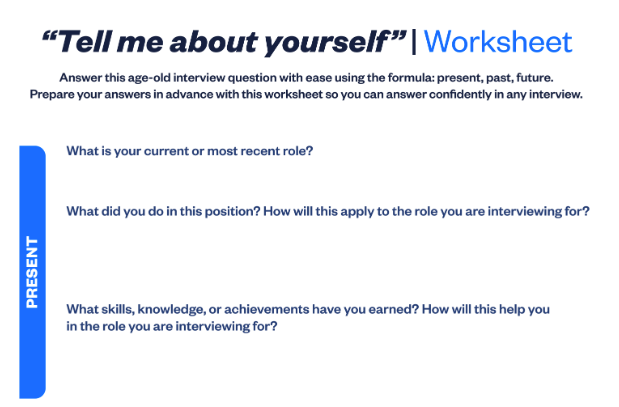
How to answer the “tell me about yourself” interview question

It’s the beginning of an interview and you’re prepared to answer questions about the job responsibilities and then you’re asked  “tell me about yourself.” This prompt can be difficult to answer if you aren’t ready for it. Luckily, there is a way to answer this common interview question with ease.

When encountering the “tell me about yourself” segment of the interview, you should use the past-present-future formula. Mention your background as it is relevant to the role, your current position and your plans for the future while summarizing your capabilities.

Understanding the position you are being interviewed for will help you tie your answer back to the role. Once you’ve grasped the requirements for the job you can choose to tell them details about your past, present and future that are relevant to the position.

There are three steps that can help you plan out your answer:

  • Explain how you got there (Past)
  • Start with your current or most recent position (Present)
  • Outline plans for the future (Future)

You can begin by telling them about your current or previous positions including the knowledge obtained and your day-to-day responsibilities. Then explain how your career path, education and other work experiences prepared you for the previously mentioned position and the position you are interviewing for. Finish your answer by detailing how working at their company would progress your career goals as well as what you can do for the company.

As you practice the interview process and answer the “tell me about yourself” prompt, remember to never express dissatisfaction with your current or previous job, summarize your resume, mention controversial topics or share too much information. Instead, you should tell a story, keep it brief and mention your strengths. The interview process can be overwhelming and nerve-wracking, however, being prepared can help ease these feelings. Remember to keep your answers professional, brief, relevant and to the point but don’t be afraid to show some personality. Guidelines like the past-present-future formula can help you ace the interview.

Free database of Colleges offering disability support services

CollegeWebLD is a comprehensive online resource for information about the disability support services at over 500 U.S. colleges and universities. Many students with learning differences who end up failing out of college within the first year do so because they did not choose a college that was a good fit for them.

The goal of this resource is to better the lives of students with learning differences by assisting them in finding a college where they can be happy and successful, and can become college graduates with meaningful, bright futures. Selecting the right college and starting with the right support are the keys to success. The website includes a College Success Profile tool for users to follow in the college planning process for students who learn differently. It is offered free for use by high school counselors, college counselors, transition coordinators, educational consultants, prospective students and parents, or anyone who needs to have a better understanding of the process of choosing colleges for students with learning differences.

Here is a link to the website: https://www.collegewebld.com/

National School Counseling Week

National School Counseling Week 2022 (#NSCW22) is Feb. 7-11, 2022, to focus public attention on the unique contribution of school counselors within U.S. school systems. National School Counseling Week, sponsored by ASCA, highlights the tremendous impact school counselors can have in helping students achieve school success and plan for a career. National School Counseling Week is always celebrated the first full week in February.

The 2022 theme is School Counseling: Better Together.

Photo Challenge

Celebrate school counseling by taking part in the 2022 National School Counseling Week photo challenge. Simply download each day’s sign, write in your response and then take a picture with it to post to your social media channels. Be sure to tag ASCA and #NSCW22. 

  • Monday, Feb. 7: School counselors and other school-based mental health professionals are better together because …
  • Tuesday, Feb. 8: School counselors and administrators are better together because…
  • Wednesday, Feb. 9: School counselors and teachers are better together because…
  • Thursday, Feb. 10: School counselors and the community are better together because…
  • Friday, Feb. 11: School counselors are better together because…

Downloads

Download templates and samples for press release, certificate of appreciation, proclamation and morning announcements. Also download a variety of National School Counseling Week logos; photo challenge signs; and images for Twitter, Facebook and other uses. 

Promotional Materials

Check out the selection of posters, stickers bookmarks and door hangers available from ASCA for purchase to help you promote school counseling.

A School Counselor Quiz for Educational Leaders is being developed. Would you like to participate?

Would you like to help develop a school counseling quiz for educational leaders (e.g., Principals). Submit a school counseling question that you believe Principals should know the answer to. Don’t forget to also include what you think the correct answer is. You can ask questions about any of the four components of a comprehensive school counseling program (e.g., define, manage, deliver, or assess), appropriate school counselor roles/responsibilities, use of data, accountability, ethical issues, leadership, advocacy, diversity, or whatever you like. You can also submit as many questions as you want! Know that your submission may be used for future research and/or publication. If you have any thoughts or inquiries, please contact Russ Sabella at rsabella@fgcu.edu.

Here is a link to the question submission page: https://docs.google.com/forms/d/e/1FAIpQLSfmT4wc-Wm-oUAoHVwFUsnVdbWriIci0srmRj9u3IgV4-Ge3g/viewform

10 Quick Tips for Remembering Students’ Names

Ever find yourself struggling to remember a students’ or other person’s name? We all do it but there are some tricks you can use to help you remember anyone’s name. Here are 10 tips from Counselor Clique to help you do that:

1. If your students wear IDs, subtly get a good glance at their name on their ID. 

2. Ask them how to spell their name for you (use this one in hopes that it’s not something super embarrassingly easy to spell).

3. Try to sneak a peak at their name on a worksheet if you’re in a classroom or catch them writing their name on a flipbook or an activity they’re doing in a small group of yours!

4. Ask them to remind you of their first OR last name (whichever one you think will trigger the other name for you). 

5. Study names in the yearbook or in your computer database system if it has pictures.

6. Review the class list/roster before you go into a classroom lesson. Names and faces (if you have pictures) will be fresh in your brain. 

7. Quiz yourself if you have bus or cafeteria duty. Stand outside of your office as students are walking in in the morning and see how many students you can name in your head. If you’re in a classroom teaching or observing, practice naming students in your head while they’re working on something.

8. Use their names as often as possible once you learn it. Repetition is key!

9. Endure and persist in a time where wearing masks and not being in school full-time is the new norm. This has got to be one of the hardest parts of forming relationships– definitely a barrier to learning names!

10. Just MAKE AN EFFORT! If you’re struggling, be honest that you’re still learning. Have a meaningful conversation with the student to trigger a memory of who they are to you!

Students notice if and when you care enough to (at least try) to remember their name. Once you start really committing student names to memory, you will gain so much momentum in your relationships at school!

Want to get additional information and resources from Counselor Clique? You can sign up for their e-mail list here: https://counselorclique.com/

Teen Driver Related Fatalities Continue to Rise

A recent study conducted by Bumper.com showed teen related driver fatalities were at a 12-year high in 2020. Some of the findings from their research showed:

  • Fatal accidents involving teen drivers hit new highs. NSC estimates motor-vehicle deaths in 2020 reached 42,060, up 8% from 39,107 in 2019 and the highest total since 2007. Bumper estimates the 2020 accidents involving young drivers (ages 15 to 20) killed 5,213 people, the most since 2009.
  • Teen drivers are about three times more likely to be involved in fatal accidents. Teenage drivers make up only 3.8% of the estimated 228 million licensed drivers in the United States, according to the latest government data, but on average from 2017-19 account for 12.4% of all fatalities.
  • Kentucky, Montana and Mississippi are deadliest for teen drivers. Measured by fatalities per 10,000 licensed teen drivers, states with the highest estimated rate in 2020 were: Kentucky (8.46), Montana (7.29), Mississippi (7.08), Arkansas (6.92) and New Mexico (6.77). States with the lowest predicted rates: Massachusetts (1.43), New Jersey (1.74), Hawaii (2.00), New York (2.09) and New Hampshire (2.14).
  • Several states see more than half of teen driving deaths during summer months. Between June and September, some states see more than half of the total year’s teen driver-related fatalities, based on 2017-19 averages. That list is led by Montana (53.9%), Maine (53.7%), North Dakota (51.4%) and Idaho (51.3%). States with the smallest percentage of teen driver-associated deaths in the summer are Florida (28.1%), Nevada (28.4%) and Arizona and Hawaii, with 29.6% each.
  • More than half of victims are under the age of 20. Historically, 56% of fatalities in accidents involving a teen driver are victims 20 years old or younger. Drivers are the most common victim (61%), followed by passengers (28%) and pedestrians (10%).
  • Speed, alcohol and distractions are the top causes. According to 2019 NHTSA data, 33% of teen-driving fatalities were associated with a driver speeding, compared to 26% of fatal accidents among all age groups. That’s higher than the 28% of drivers in teen driver accidents who had at least some alcohol in their system, compared to 33% for all age groups. Distracted driving, such as text messaging while at the wheel, accounts for 12% of teen fatalities, compared to 9% for all age groups. Accidents can happen for a variety of reasons, but it’s important to stay educated on the most common causes of car accidents to stay safe on roadways.

Here is a link to their complete findings which include the top 10 states and low 10 states for teen driving fatalities – https://www.bumper.com/analysis/teen-driving-accidents-fatalities/

How to Help Your Students Write Their Best College Application Essays

In one of her Friday Forums for educational professionals, Cyndy McDonald, a CEP who is well known as the founder of GuidedPath and one of the founders of HECA, interviewed Wow’s CEO Susan Knoppow.

Cyndy McDonald

With more than 30 years of experience in college admissions  under her belt, Cyndy recently launched a new venture as a career and business coach.

In the interview, Cyndy and Susan discussed best practices for college application essay coaching.

Read interview highlights below, including Susan’s top college essay coaching insights and tips. You can watch the interview here.

What can a writing coach do to best help students write good college application essays?

Susan talked about the best ways that writing coaches help their students during the writing process. She touched on a number of issues, including how to help students “keep their voice” while writing, why so-called bad writers can still write effective college essays and how to help students choose a topic.

Susan goes in depth about helping students write good college essays during the revision process. If your student or child asks you to read a draft of their application essay, you should! This is an honor, and it means that the student trusts you to read this very personal piece of writing. But, if you do so, remember that admissions officers aren’t reading students’ essays with a red pen in hand, so you shouldn’t either.

You are a college essay coach, not an editor with a red pen

As a professional, you are a coach, not an editor. This is Susan’s biggest piece of advice for professionals who read student essay drafts. Watch the recording, and hear Susan explain something you might not have heard before: The college essay does not have to be a beautiful piece of writing. Instead, it has a specific task—to communicate something meaningful about the applicant that admissions officers don’t already know from reading the rest of the application.

What does the essay teach you about the student?

If you’re reading a student’s essay, keep this in mind. Pay attention to whether or not the essay accomplishes its task, not whether the student uses commas correctly. And you don’t have to be an excellent writer yourself to do this. Instead, try to read like an admissions officer. This doesn’t mean rewriting sentences that you think sound awkward or telling the student that they should actually be writing about another topic.

The student voice is critical in any good college essay

Admissions officers know what the voice of a 17-year-old high school student sounds like; they can tell when an adult gets too involved or takes over the writing. What’s more, Susan addresses how the best topics are ones that highlight a trait that the student wants admissions officers to know about. Your job is to make sure that this trait comes across in the essay. Talk with the student about what works in the essay and whether it’s effective in its current form. And, as Susan says, “let go of the imperfect essay.”

The big takeaway …

Good application essays do not need to be works of art. Remember this, and both you and your students will be less stressed and more focused on what matters in the essay-writing process.

To watch a recording of Cyndy McDonald’s interview with Susan here.

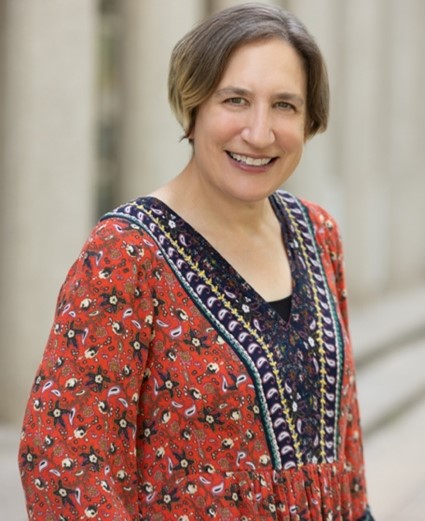
Susan Knoppow

ABOUT THE AUTHOR

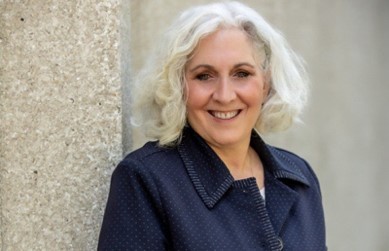
Kim Lifton, of Farmington Hills, MI, is President and Co-founder of Wow Writing Workshop, which teaches students and educational professionals a simple, step-by-step process for writing effective college essays, so students can stand out and tell their stories. Kim leads a team of writers and teachers who understand the writing process inside and out. Since 2009, Wow has been leading the college admissions industry with our unique approach to communicating messages effectively through application essays, including personal statements, activity and short answer essays and supplements. Kim is also a board member of MACAC. When she is not teaching students or training professionals, Kim likes to write her own stuff, do yoga at her synagogue, drink coffee, and swim laps (slowly but steadily) a few mornings a week at the high school she attended a very, very long time ago.

Kim Lifton

Our free gift to you!

And, if you’d like a free electronic copy of our book for counselors, How to Write an Effective College Application Essay, the Inside Scoop for Counselors, download it here.

Let your students know we have a free class for them, too!

If you want to help students with the basics, encourage them to sign up for our monthly free student class or Wednesdays at 7 p.m. Eastern.

Next up

Wednesday, Feb. 9, Wow Writing Workshop at 7 p.m. ET! You are welcome to sign up, too.

Learn more about Cyndy McDonald at CyndyMcDonald.com.

Newer Posts
Older Posts

Link for Counselors

Current Publication

View Current Publication

Advertisements

LINK Newsletter for Counselors

Sign up to receive our bi-weekly e-newsletter.