Twenty-five “megacities and high-growth hubs” accounted for
more than two-thirds of job growth in the past 10 years, and that trend
is expected to continue. Meanwhile, employment gains have been flat in
low-growth cities, and rural counties mostly have fewer jobs than they
did before the Great Recession.
Those divisions are poised to grow. Over the next decade, automation is more likely to displace workers in rural areas than those in urban areas with more diverse economies, such as Washington, D.C., and San Francisco.
Education Dive recently published a blog on 3 ways that colleges can prepare students for the coming workforce automation wave.
Adding new pathways from high school to the workforce:
The concept of lifelong learning is not new. The skills needed to thrive in today’s tech-based economy are continually shifting, requiring many workers to pursue additional education.
Even those who aren’t at risk will need new skills. McKinsey researchers estimate current technologies could take over about 30% of activities in 60% of jobs.
Colleges, however, have been slow to catch up. Only 22% of Americans surveyed in a recent Gallup poll say the nation’s colleges adequately prepare students for jobs involving technology.
Employers may be a natural fit to provide workers with this type of retraining, the researchers note. The Gallup poll backs that up: Americans ranked on-the-job training as their preferred mode of education to keep up with changes brought by artificial intelligence, second to campus-based programs at universities.
2. Scaling apprenticeship programs:
Nearly 15 million workers between the ages of 18 and 34 are at risk of losing their jobs to automation. That’s partly because they account for a large share of jobs in food service and retail, two sectors where a high degree of automation is expected.
Half of these young workers are in roles with high turnover, so
employers may not be willing to invest in their retraining, the report
notes. Alternative forms of postsecondary education, such as
apprenticeships, could be a solution.
Momentum has been growing behind expanding apprenticeships in the U.S., in part because the Trump administration has made them a priority. In June, 23 colleges received a total of $183 million from the U.S. Department of Labor to train more than 85,000 apprentices in health care, advanced manufacturing and information technology.
One of the biggest issues standing in the way of growing America’s apprenticeships is employers’ wariness of bringing someone on without relevant work experience because a bad hire can be costly.
One solution is firms that hire entry-level workers on a trial basis. Talent Path, for example, hires graduates pursuing technology jobs to work as consultants for companies, which can hire them after two years.
3. Bringing clarity to the credential marketplace:
As the need for skilled workers grows, so too does the marketplace for alternative credentials. Those options can give workers a way to reskill quickly, but there is a lack of standardized information about them.
That can make it hard for workers to understand which
credentials have value. In response, several efforts are underway to
bring clarity to the marketplace.
For one, Credential Engine, which maintains a digital database of credentials, is working
with several credential providers to help colleges and other education
providers use a common language to talk about their programs. A similar effort led by the U.S. Chamber of Commerce Foundation, called the T3 Innovation Network, is attempting to make it easier for employers to signal to colleges the skills they need.
Other groups are spearheading credentials specific to a region’s needs. The Capital CoLAB — which brings together colleges and employers in the Washington, D.C., metro area — recently launched a shared tech credential
offered by several institutions in the region, including Georgetown,
Johns Hopkins and Howard universities. Students who earn the credential
get priority in job interviews with participating companies.
Other companies are developing their own curricula, and in some cases are partnering with colleges to do so. Amazon has teamed up with several colleges to offer cloud computing curriculum. And Northeastern allows students to roll over credentials earned from IBM into certain master’s degrees.
As you help your students plan for that next step in life letting them know about changes in the marketplace such as the automation of the workplace can help them choose their best career paths going forward.
My first question to Rachel was “What do you wish you knew then that
you know now?” Rachel, after all, is officially a veteran of the college
admissions process. While she is busily adjusting to life after high
school graduation she is actually thinking much more about what her life
will be like in three months when she moves into her college dorm.
For Rachel it was a lengthy and sometimes stressful process. She
started visiting colleges in her sophomore year. She took the most
rigorous curriculum her high school offered, had stellar standardized
test scores, participated in a variety of clubs, held leadership roles,
got involved in community service, played an instrument, won awards,
immersed herself in a foreign culture during her summers; in short – she
did everything right.
Here are some snippets of my conversation with Rachel:
Lee – “What did you do right?”
Rachel– “I visited many colleges and applied to a good variety of schools – 3 safety, 1-2 target and 3-4 reach.”
Lee – “What did you wrong?”
Rachel – “I didn’t start essays or ask for letters of recommendation
early enough. It was hard to write essays in the fall and still keep up
with all the work during first semester. Some teachers had fulfilled
their quota of letters of recommendation before the end of junior year,
so waiting to ask as a senior was too late and I had to scramble.”
Lee – “Did you find any shortcuts or do you have any ideas to make the process run more smoothly for rising seniors?”
Rachel – “I was able to re-use several essays for schools a few times, although I did have to make significant adaptations.”
Lee – “Was it challenging at school with everyone asking where you’re applying?”
Rachel – “Yes, especially with juniors. They think they understand
everything about the application process and believe that holding many
leadership positions and getting straight A’s in AP classes guarantees
students a spot in the most prestigious schools. They don’t understand
that even for the most qualified students, the admissions process is
still incredibly random. Some students don’t understand when seniors
don’t get into top schools. I regret sharing my list of schools with all
of my friends and I eventually decided to put my acceptance/rejection
decisions on “lockdown” in April.”
Lee – “If you had high school to do all over again, what would you do differently?”
Rachel – “I don’t have many major regrets about high school, but I
wish I had been more involved in clubs freshman year and selected
activities that I knew I could continue for four years. I would also
focus more on a few select clubs and not join every honor society just
to be able to put it on an application. I always agreed with the “depth
not breadth” argument but my position was confirmed when I actually
started applying. As I began filling out applications, especially the
Common Application, I realized how few spots there actually were to put
extra-curricular activities, so being superficially involved in a ton of
activities truly doesn’t help at all.”
Lee – “What would you do differently in terms of preparation for the application process?”
Rachel – “I would research standardized tests more; I think students
focus more on the SAT and only take the ACT the one time in February or
March when the state pays for it; I wish I had taken the ACT again,
because I found the math section a better fit for my skills.”
Lee – “What was the biggest waste of time?”
Rachel – “Visiting some schools over the summer, some schools were
completely empty, so I didn’t get a good sense of the atmosphere; others
still had students. Families should check with admissions to see what
kind of campus life is going on during the summer.”
Bierer is an independent college adviser based in Charlotte. Send
questions to: lee@collegeadmissionsstrategies.com;
www.collegeadmissionsstrategies.com
Counselors are at the forefront of opening doors to opportunities for all students.
Counselors
are at the forefront of opening doors to opportunities for all
students. They collaborate “with stakeholders such as parents and
guardians, teachers, administrators and community leaders to create
learning environments that promote educational equity and success for
every student” (ASCA School Counselor Competencies).
It is crucial for educational leaders to recognize the impact and
service school counselors have in every school community as stakeholders
embrace engaging educational environments that support pathways to
sustainable and rewarding post-secondary opportunities. Pop Quiz!What do these skills have in common?
Analytical thinking and innovation
Complex problem-solving
Critical thinking and Analysis
This list comes from The World Economic Forum Future of Jobs Report.
These skills are in high demand by employers today. School counselors
recognize that labor market trends in local, national, and global
communities impact students. Counselors guide students toward viable
careers with these trends in mind. In order to adequately prepare our
students for sustainable careers and to ensure all students have access
to learn, school counselors are bringing opportunity to those who are
traditionally underrepresented in computer science (CS) classes and in
computing professions. Counselors recognize that technology is changing every
career. Engaging students and families in conversations about
sustainable careers means talking about the intersection of CS with
every vocation. Did
you know that the skills mentioned above are at the heart of
computational thinking in CS classes and also areas of interest for
school counselors’ student-focused ASCA Mindsets and Behaviors?
These skills transcend the computer screen! Teaching them to all
students integrates CS, school counseling goals, and life skills that
can and should begin in elementary school and follow students throughout
their academic career. This debunks the myth that a school counselor
must be tech-savvy to impart these skills to students. Your school
counselors are prepared and experienced in these concepts that will
broaden the horizons of your students.
One
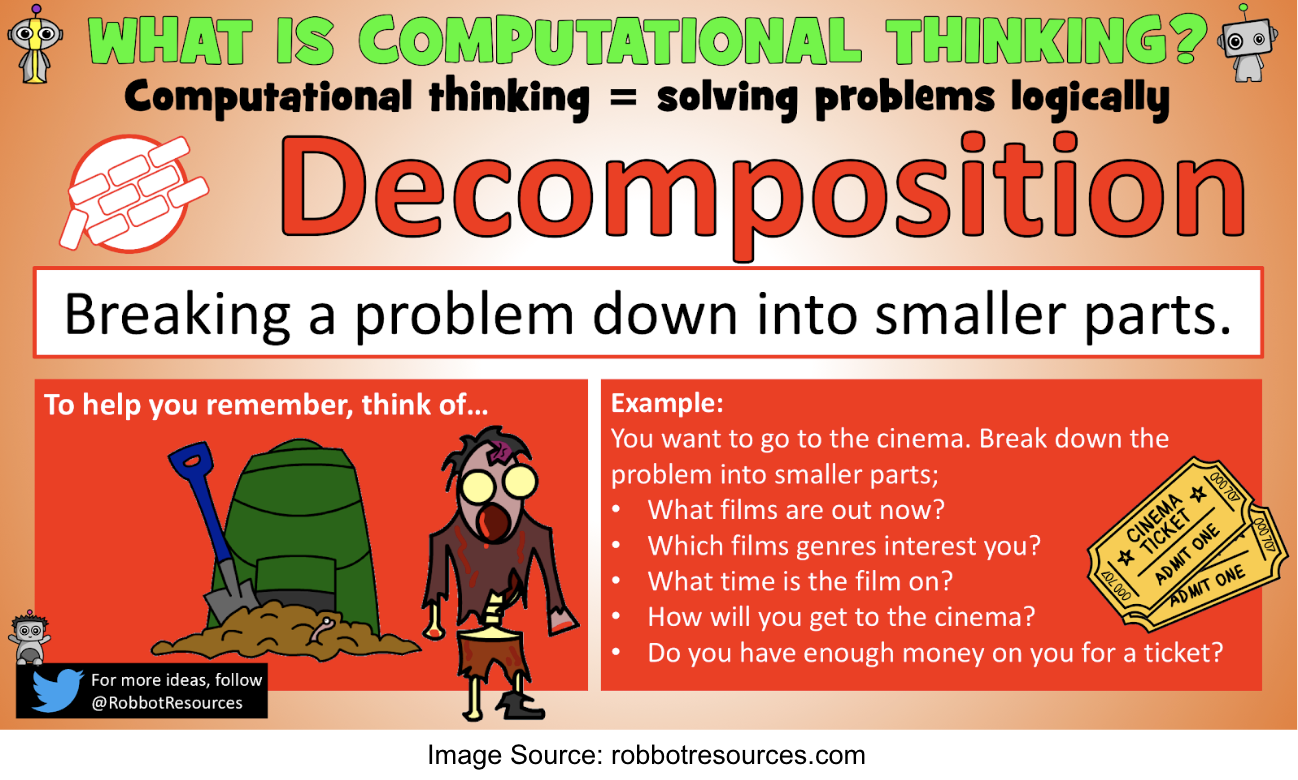
of the first components of computational thinking is decomposition.
What does this mean and how does it relate to school counselors? Every
day your school counselors are demonstrating this skill to students. The
concept of breaking down a problem into smaller parts is a crucial
component of a student’s ability to address an area of concern. As
counselors, this type of modification shows up in 504 planning and
I&RS committee meetings as a strategy we can use to help a student
grasp challenging content or behaviors. Modeling decomposition with
students allows for the acquisition of this skill which places them in a
position of advantage when obstacles arise whether it be on a school
project, a computer program, or a situation at home. For example, if a
student is having difficulty in a class, the counselor and student break
the problem down and view it from different angles. Is the student
studying regularly, taking advantage of extra help sessions, prepared
for class (both academically with supplies and ready to learn – not
hungry, tired), know where to find resources, etc.? Breaking down the
problem and considering a variety of possible contributing factors is
the essence of decomposition.
During
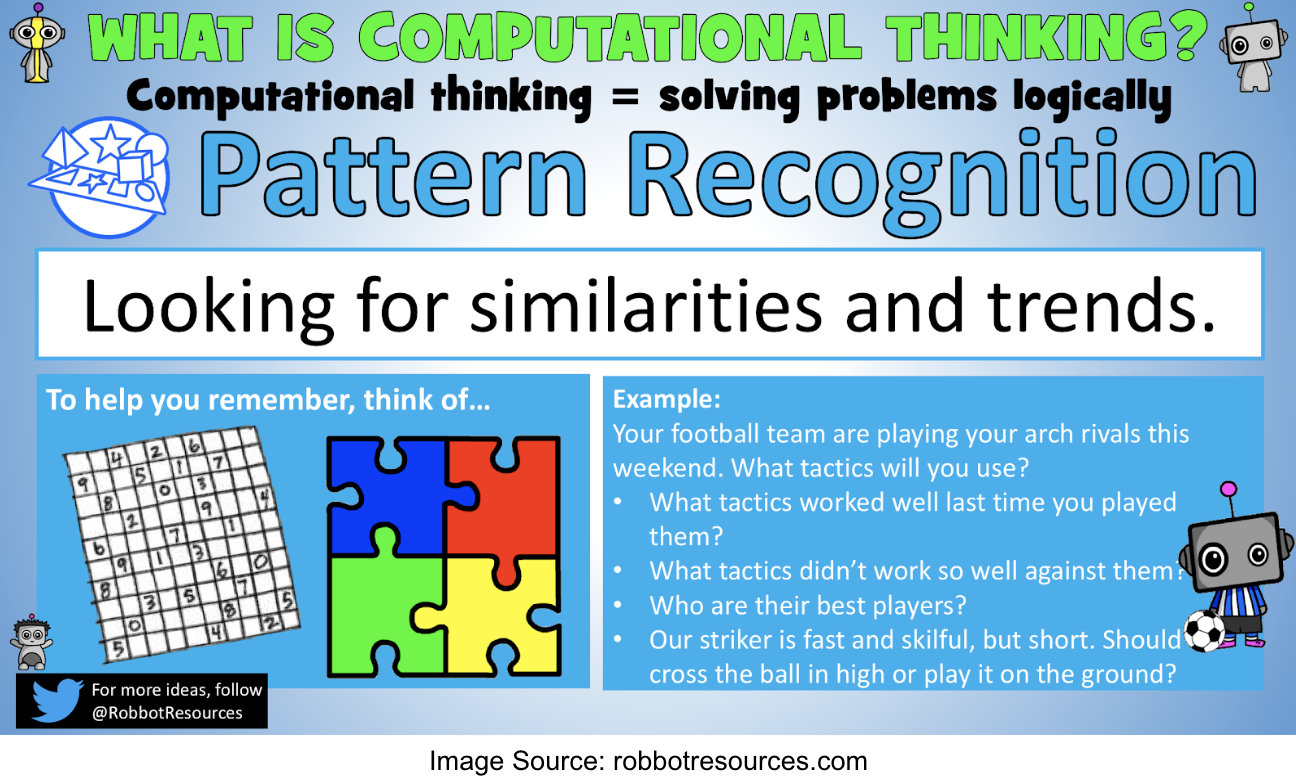
pattern recognition in computational thinking, students learn to
recognize trends and similarities. What worked successfully last time
they ran into this problem? What didn’t work? If students have run into
this problem before, what did they learn that worked well or didn’t
work that they can apply to this situation? In the scenario of a student
struggling in a class, the student and counselor might reflect on how
the student performed in this subject area the previous year. Is this
possibly a new area of study in which the student lacks enough
background experience? A counselor might meet with the students’ peers
in the class to learn about their study habits, resources they use, and
other strategies they employ. Identifying patterns of what has worked
and not worked in the past along with identifying patterns of behavior
in students who are doing well in the class provides a framework to
create a collaborative plan for the struggling student. It also models a
problem-solving strategy they can apply to other situations to support
more positive outcomes.
Abstraction
is about focusing on the most relevant aspects of a problem and not
getting distracted by the red herrings. Rarely do students come to a
school counselor with a clear, concise statement about the problem or
view of a situation. Often there is a great deal of extra information
that feels critical to the student. By taking a step back, counselors
can help students focus on what is truly relevant to the problem. This
challenge of sorting through details and distractions isn’t a problem
relegated to children; it’s a human problem! We all struggle with this
from time to time. Think of the last time you were late to work. You
might have run through a list of frustrations that led to you being
late, and some might have been legitimate problems to address (the alarm
didn’t go off) while others might be annoying situational frustrations
that may not relate to being late (Why does the dog always take so long
to go to the bathroom on cold mornings?). Being able to tease out what
is truly necessary to consider when solving a problem is not just a
computational thinking skill, but it is also a critical life skill!
School counselors view this as “stripping away the drama and pulling out
the facts.” The key is to identify which aspects are truly relevant to
solving the problem.
Computational
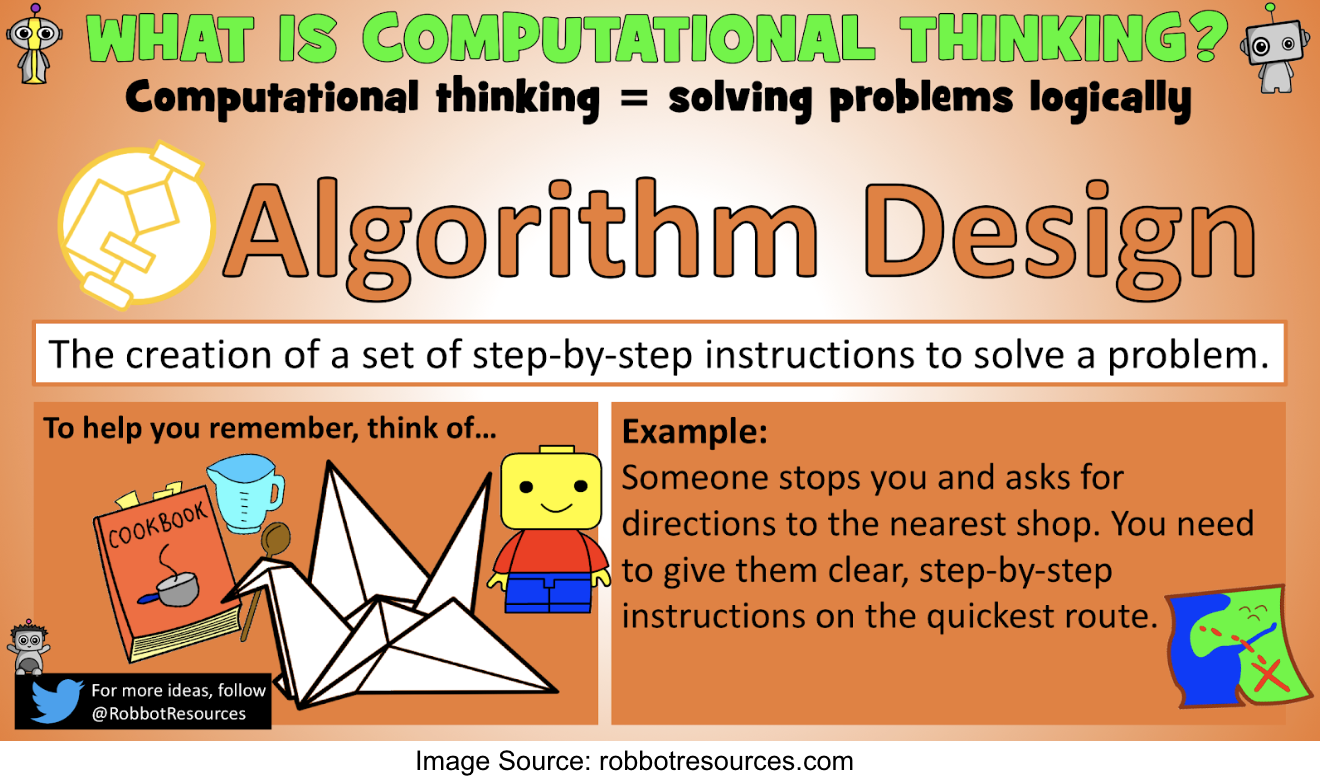
thinking also encompasses algorithm design, which is a step-by-step
process for solving problems. Think of an algorithm as being like a
recipe: very specific, measured ingredients combined in a clearly
defined order. When counselors work with students on challenges, they
develop a plan that involves a step-by-step process for addressing the
obstacle and “debugging” or anticipating challenges and problem-solving.
Within the creation of the plan, they need to provide for anticipated
roadblocks. How might that student address anticipated challenges? For
example, a counselor might verbally “walk through” the student’s process
of leaving period 1 class to arrive in period 2 class on time. Does the
student stay behind and chat with the teacher or peers? Does the
student circle back to the locker to pick up supplies or take a longer
than necessary route to the next class? Creating a step-by-step “recipe”
to get to class on time is a transferable skill for other life
challenges.
What are some next steps for collaborating with your school counselor, administration, and CS staff?
Did
you know that three out of five schools in the U.S. do not offer
computing courses that include programming or coding, yet we know that
computing jobs are the way of the future? “The U.S. Department of Labor
estimates that by 2020 there will be more than 1.4 million
computing-related job openings. At current rates, however, we can only
fill about 30% of those jobs with U.S. computing bachelor’s grads”(Source: https://www.ncwit.org/infographic/3435). This Computer Science Professional Development Guide
developed by Microsoft Edu and in collaboration with champions for
broadening participation in computing offers a step-by-step guide about
how education leaders can build teacher, school counselor, and
administrator capacity to support equitable computer science education. NCWIT Counselors for Computing
provides professional school counselors with information and resources
they can use to support ALL students as they explore CS education and
careers. The NCWIT Counselors for Computing “See Yourself in Computing”
virtual reality (VR) campaign motivates students to ask, “How can I get
started in CS?” Explore the free immersive content with your students
using your computer, tablet, or with a VR headset. School
counselors are champions for equity, advocating for a system that
supports all students’ in accessing learning opportunities to guide them
towards sustainable careers. They “demonstrate their belief that all
students have the ability to learn by advocating for an education system
that provides optimal learning environments for all students” (ASCA Ethical Standards for School Counselors).
Preparing ALL students for post-secondary plans requires all educators
to recognize and discuss how CS is woven through every career and how we
can spark interest in sustainable careers across K–12.
Angela Cleveland is the Program Director for NCWIT’s Counselors for Computing
which provides professional school counselors with information and
resources they can use to support all students as they explore CS
education and careers. Jennifer
Correnti is the Director of School Counseling at Harrison High School
and has been a counselor for 12 years. She serves as an NCWIT Counselor
for Computing consultant and encourages school counselors to embrace
their role as agents of change.
ust swipe and sign, right? Well, there’s a lot more to how credit
cards work than that, because with a credit card, you are essentially
borrowing money from a bank that you will pay back at the end of the
month.
How do I build credit?
If you’ve never had a credit
card before, you’ll need to build up your credit. How to establish
credit is somewhat of a Catch 22: You need a credit card to build
credit, but you can’t get one without good credit. Luckily, you have a
few options.
Sign up for a joint credit card account with an established credit user
Get a secured credit card (learn more about secured credit cards below)
Authorized user vs joint account holder
It’s important to note that there’s a big difference between an
authorized account user and a joint account holder. Joint credit card
account holders are like cosigners on loans. Both people can use the
account, both are responsible for the debt and repayment affects both
people’s credit history. By contrast, an authorized user is allowed to
use the account, but they are not responsible for the debt. As a result,
payments do not impact an authorized user’s credit history.
So,
while becoming an authorized user can help you get comfortable using
credit cards, it won’t help you build credit. If you ask a friend or
family member to add you as an authorized user, keep this in mind. You
can get some practice, but it won’t help you build credit.
If you’re learning to use credit, it’s best to pair an authorized user account with a secured credit card. This allows you to practice and learn from a seasoned credit user and build your credit.
How do credit cards work?
It’s important to think about what kind of card you need before applying for a new credit card. While you shouldn’t carry a balance from month to month, sometimes you can’t help it. If you plan on carrying a balance, make sure it is never above 20 percent of your credit limit. And only carry a balance on a credit card with a low interest rate. Also, make sure you are paying more than the minimum balance each month.
Credit cards come in two main
flavors: secured and unsecured. With secured credit cards, you give the
creditor a deposit for a specified amount. The creditor gives you a
credit limit equal to that amount. Even though you sent them money, this
is not a debit card situation. When you use the card, that amount isn’t
debited from the money you sent. You have to pay off your purchases
each month.
A secured card is great practice for someone who is
building credit. This includes those new to the credit card game or
individuals who have made bad credit decisions in the past. By using the
account and paying it off each month on time, the credit reporting
agencies will see that you are responsible with your credit account and
your credit score will start to build.
What is an unsecured credit card?
Once
you’ve built up your credit score, you can apply for an unsecured
credit card. These cards don’t require a deposit and the credit card
company will give you a credit limit based on your income as well as
your credit score. Most of the credit cards on the market or that you
see ads for are unsecured credit cards. They can offer rewards including
travel points or cash back.
If you are applying for an unsecured
credit card rewards card, it is important to pay off the balance each
month, otherwise the interest that you are paying carrying a balance
each month will negate all the rewards you are earning. Some rewards
cards also have annual fees attached to them, so make sure you are using
the card enough so that the fees are worth it.
Charge card vs credit card
Charge
cards are few and far between nowadays. American Express is the only
major issuer that distributes charge cards. The only real differences
with a charge card and a credit card are the terms. When you sign up for
a charge card, the main appeal is an implied lack of a spending limit.
While these cards often say no pre-set spending limit, your charges can
be limited based on your payment history, income and spending habits.
The
other main difference in a charge card is that you are supposed to pay
it off each month in full. This is actually the advice for credit cards
as well, but for charge cards, it’s always been more of a rule. But even
charge cards are starting to go the way of credit cards, as American
Express offers a “Pay Over Time” option for certain purchases.
Most
of the offers you will receive or apply for will be for credit cards
and not charge cards. If you aren’t sure, make sure to read the fine
print.
How do I use a credit card?
When using a credit
card for the first time, make sure to call the number on the sticker on
the front of the card and activate it. Also, make sure to set up an
online account with your credit card issuer. Even if you prefer to
receive paper statements, having an online account will allow you to
view updated information about your account instantly and make changes
if needed.
Decide how you plan on using your card: Are you going
to use it for everyday purchases everywhere, at just one place or type
of place? Once you decide, it’s time to make a purchase.
How do I make a purchase with a credit card?
When you get to the checkout, swipe the card or place the chip side into the slot if you have an EMV chip credit card.
Follow the prompts on the screen and sign if necessary. Nowadays, most purchases under $25 do not require a signature.
Make sure to remove your card when the transaction is completed.
You
don’t have to make a note of your spending on the card like you would
in an old checkbook, it’s important to be mindful of how much you are
spending on your card so you can anticipate the bill at the end of your
billing cycle.
How do I pay my credit card bill?
At the
end of your billing cycle, you will receive a bill from the credit card
company for the amount you put on the card. This is the amount you need
to pay back to the bank. By paying off your balance in full, you avoid
any interest charges.
However, if you spent more than you can
afford to pay off this month, you will carry a balance into the
following month. It’s important to pay off more than the minimum balance
if you can afford it to avoid paying months or even years of interest
fees.
Thanks to the Consumer Financial Protection Bureau,
it passed the Credit CARD Act in 2009 which required issuers to make
credit card billing statements easier to read. It also includes a
section as to how long it would take you to pay off your debt if you
only paid the minimum amount (and didn’t charge any more to the card).
If you can’t pay off your balance in one month, it’s important to make a
plan to pay it off over a few months’ time and not use the card for
much in the interim to avoid hefty fees.
How does credit card interest work?
When you can’t pay off your credit card bill each month, you are charged interest
on the amount you don’t pay off. The interest rate varies depending on
your credit score, whether you got a promotional rate and how often they
recalculate the rate if it is a variable card tied to an index. This is
your annual percentage rate, or APR.
How much you pay depends on
whether the issuer is calculating a daily rate or a monthly rate. If it
calculates monthly, then you would take the APR and divide by 12. To
figure out how much you will be paying in interest, take the balance
that you have leftover, and multiply it by that number. If it is
calculating daily, then you will need to instead divide the APR by 365
and then multiply by the number of days in your billing cycle (usually
30 days).
The interest will accrue as long as you carry a balance. Making minimum payments only increases the amount you pay on the money you originally borrowed. It’s important to pay off as much as you can each month.
Credit Card Security
When you use your credit card, it’s
important to keep your credit card information safe. Many people wonder
about the security of their credit card information this day and age.
Hacking credit cards is rampant, especially online. So how do you keep
your information secure?
One way that major credit card issuers
helped to make your credit cards safer was by implementing EMV
technology in credit cards, which stands for Europay, Mastercard and
Visa. Also known as chip-and-pin or chip-and-sign technology, the
computerized chip embedded in each card is much more difficult to gather
information from when skimming a credit card.
Another way to keep
your credit card information safe is to avoid saving your credit card
information with too many websites. The more sites that have your
information, the more vulnerable you are. Thankfully if your card is
compromised, you are only liable at most for $50. New technology has
also enabled credit card companies to freeze or even deny payments if
they suspect suspicious activity on the card outside of your normal
spending habits.
It’s important to keep track of your spending not just for budgeting, but also to avoid fraudulent attacks.
Many
students know that the path to college starts the minute they enter
high school, putting together the classes, grades, activities and test
scores that will get them into their dream college. But the path to affording
college should start just as early, with high school counselors playing
a vital in guiding families to take steps that could help them cut
costs.
The
rising cost of college makes it more important than ever to start
conversations early about paying for college. On average, a family will
pay $101,160 for four years at an in-state university and $203,600 for a
private college, according to CollegeData.com. And that’s just for one
child. Add in a second or third child and the cost can easily become a
family’s largest investment in their lifetime.
Counselors
can play a pivotal role in helping to bring those costs down for
families. Unfortunately, according to a survey conducted by the College
Board National Office for School Counselor Advocacy (NOSCA), many feel
unprepared to do so.
Bringing
in an expert early on to talk to students and their families about what
they can do to cut college costs is one way counselors can help. Those
programs can, and should, start as early as freshman year in high
school. Counselors also can talk to families about some simple steps
that can make a big difference for them down the road.
For
parents, early planning can lead to a larger financial aid package.
Since financial aid is based on a family’s Expected Family Contribution,
or EFC, a family that takes steps to lower their EFC long before the
time comes to fill out the FAFSA can reap big savings. For example, a
small business owners can lower their EFC by holding assets in their
business, rather than in personal accounts. An expert can offer other
suggestions a small business owner can take to lower their EFC
significantly by the time they have to fill out the FAFSA.
Counselors
can also encourage students to build a strategic list of schools that
looks beyond academics and school environment to include how the school
determines a family’s EFC. Some schools, for example, factor in home
equity when determining a student’s EFC, while others do not. With a
little research, students can learn which schools use a formula that
gives them the lowest EFC.
When
talking about scholarships, counselors can change the focus from
private scholarships to scholarship money given by the universities or
colleges a student is interested in attending. Applying to private
scholarships, which typically amount to awards of less than $2,000, may
not be the best strategy for time-strapped students. Instead, they might
want to focus on raising their test scores. Just raising an ACT test
score by two points can result in a school awarding as much as $10,000
more in scholarship money. Some schools are very transparent, noting
what GPAs and test scores trigger specific scholarship awards. Having a
number to shoot for may make it easier for students to work harder in a
class they’re struggling with or encourage them to retake the ACT of SAT
to raise their score.
When
it finally comes time to fill out the FAFSA, families can still take
steps to boost their financial aid package and receive it in a timely
fashion. Counselors can help by encouraging them to take these steps:
· Complete
and submit all the required forms on time. Some schools require forms
in addition to the FAFSA, such as the CSS Profile. Know ahead of time
what’s required and what the deadlines are.
· Use
the IRS data retrieval system to expedite the process and pay careful
attention to correct spelling and wording. Doing so can result in
students receiving their award letters sooner and avoid extra
verification by schools, which can lead to delays.
· If
applying to a state school, list it first on the FAFSA. This will let
students see state eligible grant money on award letters—something that
might not happen if they list the school second or third.
Finally,
students and their families should remember that no award is final. A
change in financial circumstance, such as a parent losing a job or
unexpected medical expenses, are both valid reasons to appeal. So, too,
is when one school offers a larger financial aid package than another
similarly-ranked school. Just remind families to first investigate
whether a school has a specific appeals process before proceeding with
an appeal. And encourage them to call in an expert if they’re unsure
about how to navigate the process.
In
the end, remind students that it’s not just about getting into that
dream school, it’s also about being able to afford it. Encouraging
families to start the college cost conversation early on can save a lot
of tears—and money—when senior year finally rolls around.
Jack
Schacht is the founder of My College Planning Team, a consortium of
academic consultants and financial aid specialists serving students and
families in the Chicago area. www.MyCollegePlanningTeam.com
Bullying has become a national epidemic and is happening daily to your students in schools, online and at home. Verywellfamily has put together a nice collection of resources on bullying.
Here are some direct links to the articles/resources they have put together:
Education Dive recently did a thorough evaluation of the Colleges that have closed since 2016. Click here to see the full list of nonprofit college closures since 2016.
The last few years have been tumultuous ones for colleges
and universities in the U.S. Increased regulation and reduced
enrollment continue to be among several factors contributing to the
closure or consolidation of thousands of colleges and campuses around
the country.
That consolidation also impacted the priorities of ones that remained open. Institutions are adding degrees and certificates in emerging tech fields such as artificial intelligence and cybersecurity, and dropping low-enrollment programs including some in the liberal arts. They’re also looking online, where they can reach more students with targeted subject matter.
That activity is ongoing and more is forecasted in the years ahead.
Small liberal arts colleges fight to stay open
Undergraduate enrollment is on the decline, reducing the
tuition revenue many small colleges rely on for lack of a sizable
endowment. Experts say
the drop-off is due in part to a strong economy and projections of a
cyclical decline among the college-age demographic. To help attract more
students, colleges are offering them a bigger break on tuition.
A 2016 report
from Ernst & Young affiliate the Parthenon Group found 800 colleges
vulnerable to “critical strategic challenges” due to their small size,
compared to a much smaller share of colleges with enrollments over
1,000. The report lists several risk factors for small colleges amid the
current environment of consolidation in higher ed. Those include:
enrolling fewer than 1,000 students; the absence of online programs;
tuition increases greater than 8% and discounts higher than 35%; and
depending on tuition for more than 85% of revenue.
In a review of more than 75 New England colleges
enrolling more than 100 students and that had annual expenses of less
than $100 million in 2012 and 2016, The Boston Globe found
tuition accounted for 70% or more of revenue at 63 institutions.
Harvard University, by comparison, got 21% of its revenue from tuition
in 2017. Small liberal arts colleges have played an important role in
the region’s economy and history, The Globe notes, which is partly why
their closures tend to make headlines.
Tight budgets and small endowments factored into announcements
by several New England colleges in recent months that they, too, would
close. The 2018 closure of Mount Ida College, located near Boston, made
headlines yet again this spring when a federal judge dismissed a lawsuit
by students alleging officials knew the college was in financial
trouble and didn’t inform students of the situation until it abruptly
shuttered in May following a failed merger attempt. The judge said the
claims didn’t stand up to state law and that paying tuition in exchange
for education “does not create a contract” between the institutions and students.
Not all colleges faced with the likelihood of closing end up doing so, however. Iowa Wesleyan University raised enough money
from alumni and the community to stay open for the spring 2019 semester
after officials said it might close due to financial difficulties amid
enrollment declines.
Major private liberal arts college closures and consolidation, 2016-present
Just as small colleges are undergoing major
consolidation, so too are some larger university systems. Among the most
high profile is the set of mergers underway within the University of
Wisconsin System, which will consolidate 13 two-year colleges into seven
four-year colleges. It’s the system’s biggest change since it formed in
1971, according to the Wisconsin State-Journal.
The University of Georgia System has been consolidating campuses for several years in a move to reduce operating costs and improve student outcomes. A trio of community colleges in Alabama, too, is consolidating into a single institution with a new name: Coastal Alabama Community College. Connecticut’s community colleges are also eyeing an administrative consolidation.
Slightly fewer than half of college mergers between 2010 and 2017 — roughly 40 across nine or more states — involved at least one public college,
according to The Pew Charitable Trusts’ Stateline publication. Colleges
face several challenges to successful mergers, however, including the
potential for cultural mismatches, higher tuition from reduced local
competition and challenges reconciling salaries of two-year college
employees with the often-higher rates commanded by those at four-year
institutions, Stateline reported.
Consolidation of individual colleges or entire systems is
most successful when it’s part of a strategic plan and not a last-ditch
effort to save an institution, according to a 2017 report
from the research arm of the Teachers Insurance and Annuity Association
of America. The report notes potential short-term costs include
updating campus buildings, marketing the change and lost efficiencies
despite the move to scale, and that gains pay out over the long term.
Major public college closures and consolidation, 2016-present
Institution
State
Year
Deal
Dive Insight
Alabama Southern Community College
AL
2016
Merged (Faulkner State and Jefferson Davis community colleges)
The for-profit sector has been in a downward spiral since
2016, when the Obama administration increased its oversight and
stripped federal recognition of the accreditor responsible for two large
chains — ITT and Corinthian Colleges
— whose collapses drew attention to issues of misrepresentation and
poor student outcomes within the sector. That accreditor, ACICS, oversaw
about 250 colleges in 2016, a figure that has since shrunk by roughly
two-thirds with 61 closing and more than 100 finding new accreditors,
according to a July 2018 report by the Center for American Progress.
More than 100 for-profit and career colleges closed
between the 2016-17 and 2017-18 academic years alone, while 20 nonprofit
colleges shuttered during that period, according to data from the National Center for Education Statistics.
And although the number of credentials issued increased 1.2% from
2012-13 to 2016-17, for-profits offered nearly 30% fewer than
nonprofits.
The closures that have characterized the sector reared up again in late 2018 and early 2019 with the shuttering of for-profit colleges owned by three college operators: Education Corporation of America, Vatterott Educational Centers and the Dream Center. Combined, tens of thousands of students were affected. The closures’ quick succession drew renewed attention to concerns over how the department and accreditors monitor struggling colleges, and what safeguards protect students when they shut their doors.
Efforts by the U.S. Department of Education under Betsy DeVos to roll back or weaken some of the regulations governing the sector are underway, most recently with its move to permanently reinstate federal recognition of ACICS after DeVos temporarily restored it last year. That could breathe new life
into several ACICS institutions that were unable to find new
accreditors. DeVos’s Ed Department has also pledged to overhaul two key
Obama-era regulations concerning for-profit colleges — borrower defense
to repayment and gainful employment — though it missed a key deadline for doing so. It is now in the process of writing new rules for accreditation.
For-profit colleges have been taking advantage of lax
oversight from the Ed Department to shed the sector’s tainted reputation
and targeted regulation.
The biggest move yet involved the for-profit Kaplan University, whose acquisition by Purdue University was finalized in 2018 to form the framework of the nonprofit’s online education platform. And Grand Canyon University last year won approval
to change status from a for-profit to a nonprofit institution, though
it will operate under a for-profit parent that handles support services
such as technology, marketing and financial aid. Critics say such moves allow for-profits to operate as nonprofits.
Other for-profit college operators are changing tack, dropping their colleges and picking up companies that can round out
an educational services portfolio. Among them are Zovio, formerly
Bridgepoint Education and parent of Ashford University, as well as
Adtalem Global Education, which sold off DeVry University last year as it doubles down on professional education.
Several House Democrats, who won a majority in the 2018 midterm elections, have pledged to step up oversight
of the Ed Department’s de-regulatory efforts. Industry observers expect
more movement among for-profits through 2020, including nonprofit
conversions and acquisitions.
In addition to general awards based on location, discipline, merit, and financial need, many scholarships exist that specifically help minority students achieve their dreams of attending college. In addition to those highlighted below, students should conduct additional research to find funding opportunities that meet their needs.
Scholarships specifically available for students of Arab, Middle Eastern & North African descent:
AAWBC Scholarship The Arab American Women’s Business Council provides $1,000 scholarships to Arab American females pursuing business or related studies at the undergraduate level. Applications are due October 12.
American Federation of Ramallah Palestine Scholarship The AFRP offers this scholarship, which varies in amounts, to Palestinian and Palestinian American students who demonstrate financial need. Applications are due May 1.
Arab-American Scholarship The Network of Arab-American Professionals offers students $1,000 if they maintain a 3.0 GPA or higher and are of Arab heritage. Applications are due January 18.
Dr. Adawia Alousi Scholarship This award of up to $10,000 exists for Muslim women studying STEM topics, with special consideration given to immigrants and refugees. Applications are due in the spring.
Ibn Battuta Scholarship for Peace & Diplomacy The Qalam Center offers this scholarship for individuals to take part in a language intensive courses designed to teach them Arabic. The $4,200 semester-long scholarship covers all tuition and housing. Six deadlines exist throughout the year.
Ibn Sina Endowed Scholarship Wayne State University provides this award to Arab American students enrolled in the School of Medicine. The amount varies each year and students are automatically entered into consideration when submitting their admissions application.
Jack G. Shaheen Mass Communications Scholarship The American-Arab Anti-Discrimination Committee offers this $2,500 scholarship to American citizens of Arab descent who are working towards a mass communications degree. Applications are due June 8.
Khalaf Family Scholarship The Center for Arab American Philanthropy oversees this award, which provides $2,500 to students of Arab American heritage are are studying engineering. Applications are due in the spring.
Lebanese American Heritage Center Scholarship This award, offered by the LAHC, provides funding to high school, undergraduate, and graduate students, with individual awards varying by amount. Applications are due by March 26.
Russell J. Ebeid Scholarship for Arab American Students The Center for Arab American Philanthropy awards $5,000 to students pursuing bachelor’s degrees in engineering or business studies at Kettering University. Applications are due February 17.
Scholarships available for Black/African American students:
Acel Moore Scholarship for Community Journalism
The National Association of Black
Journalists provides this $3,000 scholarship to undergraduate and
graduate journalism majors. Applications are due April 16.
Agnes Jones Jackson Scholarship
Administered by the NAACP, this $2,000
scholarship exists for members who demonstrate financial need and
maintain GPAs of 2.5 or higher. Applications are due in the spring.
Blacks At Microsoft Scholarships
Microsoft provides two renewable $5,000
scholarships per year to African American, African, and Ethiopian
learners who plan to study a STEM or business topic. Applications are
due March 8.
David Porter Need-Based Diversity Scholarship
IES Abroad offers a $5,000 award to
African American students who want to study abroad but lack the funds to
do so. Applications are due May 1 and November 1.
Dr. Nancy Foster Scholarship
This award, which gives preference to
female minority students, is administered by the National Oceanic and
Atmospheric Administration and provides up to $42,000 annually.
Applications are due December 17.
George Washington Carver Scholarship
This academic fund supplies up to
$10,000 to African American students enrolling in an approved subject at
an HBCU. Applications are due in the spring.
Hercules Scholarship
The Tom Joyner Foundation provides
these awards to African American male high school graduates beginning
their first year of studies at an HBCU. Scholarships offer a full ride,
with applications due in the spring.
NABA Scholarships
The National Association of Black
Accountants provides 50 annual scholarships of up to $5,000 to African
American learners working towards an accounting degree. Applications are
due December 15.
NBMBAA Graduate Merit Scholarship
The National Black MBA Association
offers up to $10,000 per year to learners accepted to the University of
Alabama’s MBA program. Applications are due January 31.
Scholarships available for Native Americans/Alaska natives:
American Indian College Fund Full Circle Scholarship
Ford provides these scholarships to
students with tribal affiliation who plan to enroll full-time in a
diploma, associate, bachelor’s, or graduate degree. Amounts vary and
applications are due May 31.
American Indian Undergraduate Scholarship
The American Indian Education Fund
provides this renewable $2,000 scholarship to individuals who can
provide proof of tribal enrollment alongside ACT and GPA scores.
Applications are due April 4.
DAR American Indian Scholarship
The Daughters of the American
Revolution offers this $4,000 award to Native Americans with 3.25 or
higher GPAs and demonstrable financial need. Applications are due
February 15.
Health Professions Scholarship
The Indian Health Service makes
available this scholarship to American Indian and Alaska Native students
who plan to study a medicine-related topic at the bachelor’s level.
Award amounts vary and applications are due May 15.
The Native American Scholarship
The Continental Society Daughters of
Indian Wars provides a $5,000 annual scholarship to enrolled tribal
members who plan to work in a nation or tribe to provide education or
social services. Applications are due June 15.
Science Post Graduate Scholarship
The American Indian Graduate Center
offers up to $20,000 to undergraduate and $30,000 to graduate students
completing STEM degrees who are enrolled in a federally recognized
tribe. Applications are due June 1.
Truman D. Picard Scholarship
The Intertribal Timber Council offers
this award to Native American students pursuing a degree in natural
resources or a related topic. Learners may receive up to $2,500, with
applications due March 15.
Udall Undergraduate Scholarship
The Udall Foundation provides up to 50
scholarships of $7,000 each to Native American sophomores and juniors
who have a demonstrated history of public service, leadership, and
championing the interests and rights of American Indian nations.
Applications are due March 4.
Wells Fargo Scholarship for Undergraduates
This $5,000 award exists for full-time
students of American Indian or Alaska Native heritage who maintain GPAs
of 2.7 or higher. Applications are due May 1.
Scholarships available for Hispanic/Latino students:
Alliance/Merck Ciencia Hispanic Scholars Program
The National Alliance for Hispanic
Health oversees this $2,000 award to Hispanic learners pursuing a
bachelor’s degree in a subject related to technology. Applications must
be in by spring.
ALPFA Scholarship
The Association of Latino Professionals
for America offers scholarships to undergraduate and graduate learners
working towards degrees in topics ranging from accounting and computer
systems to engineering and education. Amounts vary, but applications are
due June 8.
AMS Minority Scholarship
The American Meteorological Society
offers this award to Hispanic students working towards a degree in
meteorological studies. Awards are for $6,000 over two years.
Applications must be sent by February 8.
Aurelio “Larry” Jazo Migrant Scholarship
The Geneseo Migrant Center provides
$1,000 to undergraduate students who were employed as migrant
farmworkers and recently migrated to Illinois. Applications are due
February 1.
HENAAC Scholarship
This award of up to $10,000, provided
via Great Minds in STEM, exists for Hispanic STEM undergraduate students
attending college on a full-time basis. Applications are due April 30.
The Hispanic Nurses Scholarship
The National Association of Hispanic
Nurses, in partnership with the United Health Foundation, offers
Hispanic nurses in training a renewable $5,000 award for undergraduate
studies. Applications are due April 3.
Hispanic Scholarship Fund Scholarship
HSF awards scholarships of up to $5,000
to individuals of Hispanic heritage who are pursuing undergraduate and
graduate degrees. They must meet GPA requirements and send applications
by April 2.
LULAC National Scholarship
This $2,000 award exists to help
empower Latino learners working toward an undergraduate business degree.
Applications are due in the spring.
Opportunity Scholarship
TheDream.US provides scholarships for
DREAMers/DACA recipients to attend college. The award covers up to
$80,000 in expenses. Applications are due in the spring.
SHPE Scholarship
The Society of Hispanic Professional
Engineers provided more than $250,000 in scholarships during the most
recent round of awards and hopes to increase that number for next year.
Applicants must be of Hispanic heritage and submit applications by June
15.
Scholarships available for Asian/Pacific Islander students:
Anna Chennault Scholarship
The Asian American Journalists
Association provides $5,000 scholarships to students of Asian
American/Pacific Islander heritage. Applications are due by April 22.
Asian & Pacific Islander American Scholarship
This award exists for individuals
living at or below the poverty line who are first generation college
students. Applications are due January 10, with those selected receiving
varying amounts.
Banatao Family Filipino American Education Scholarship
This scholarship provides up to $20,000
over four years to incoming students pursuing degrees in STEM topics.
They must live in California and submit applications by February 26.
Central California Asian Pacific Women General Scholarship
This award exists for Asian Pacific
women from Fresno County, California who study at the undergraduate or
graduate level. Applications are due April 30 and award amounts vary.
Chi Am Scholarship
The Chi Am Circle Club provides this
award to high school seniors of Asian descent who live in California.
Awards range from $1,000 to $5,000 and applications are due March 9.
Lapiz Family Scholarship
The Asian Pacific Fund administers this
$2,000 renewable scholarship made available to undergraduate learners
who are farm workers or the children of farm workers. Applications are
due April 26.
Matt Fong Asian Americans in Public Finance Scholarship
Incoming sophomores, juniors, or
seniors studying accounting, political science, public policy, or
business can apply to this non-renewable award of $5,000. Applications
are due April 1.
The Tang Scholarship
Provided via the Silicon Valley
Community Foundation, this award exists for LGBTQ learners with at least
25 percent Asian/Pacific Islander heritage. Scholarship amounts vary
and applications are due April 30.
UH-OHA Ho’ona’auao Higher Education Scholarship
The University of Hawaii offers this
scholarship to Native Hawaiians who are the first in their family to
attend college. Undergraduates receive $1,000 and graduate students
receive $3,000. Scholarship applications are due with general admissions
applications.
USPAACC Scholarship
The U.S. Pan Asian American Chamber of
Commerce provides 15-20 scholarships per year of up to $5,000.
Applicants must write an essay, provide proof of financial need, and ask
for letters of recommendation. Applications are due March 29.
Early in my career as an investment banker to colleges and universities, I sat in on meetings with CFOs and Treasurers of hundreds of institutions. I learned tuition rates are not based on the services provided to students, nor the affordability for students or parents. In large, senior management simply analyzed their peer groups, and based future tuition rates on whether they wanted to be more or less expensive relative to their peers. And most of the time, they chose to be more expensive than their peers. So it’s no wonder college costs have outpaced inflation for decades and students are saddled with unnecessarily large debt balances.
The consequences of this debt on the students after graduation last for decades as graduates may be pressured to take on ill-suited jobs. They could also delay life goals such as buying a home, saving for retirement, and/or having a family. Parents can not only save money for college, but also lower the cost of college itself. Here are some ways to cut the cost of college so that doesn’t happen:
1) Understand that everyone pays a different price.
One of the biggest misconceptions about paying for college is the idea of a fixed tuition. While tuition prices are fixed, the effective cost of college after tuition discounting through grants, scholarships and loans varies dramatically from student to student, and even between students who have similar financial resources as well as test scores. More so, tuition discounting increases over time. At the end of the day, a lot of schools have slots to fill and it’s not just “A” students getting the grants and scholarships.
2) Maximize your savings.
Setting aside money in a 529 plan to get tax advantages is important. Under the new Tax Cuts and Jobs Act (TCJA), many states allow these accounts to be used for private schools as well. Thirty-four states offer a deduction and growth in these accounts is tax-free. But be careful about your state rules, as about 10 states require you to be the “owner” of the account to get a deduction on contributions. If a parent saved $50,000 into a 529 at birth, the family would have $10,000 more in the account by age 18 than if they put that money into a taxable brokerage account (assuming a 6% rate of return, a 25% marginal rate and 15% capital gains rate).
Some states even allow a one-day deduction loophole, wherein you could theoretically put aside money into a 529 on day one, receive a deduction on day 2 and then pay for college expenses out of that account on day 3. Another strategy would be to open a 529 before you even have kids with yourself as the beneficiary. You could change the beneficiary to the child when he or she is born to maximize compounding.
Another effective way to save for college is to fund Roth IRAs for children when they have “earned income” from summer jobs or work in the family business. Distributions from Roth IRAs for higher education are not subject to a 10% penalty under 59.5. Moreover, distributions for non higher education expenses are taken out principal-first and not earnings-first, so those might escape the 10% penalty.
3) Know your effective family contribution (EFC) before you step foot onto any campus.
We recommend that parents estimate their EFC years before they go through the college application process. EFC is a dollar figure that represents what a household should pay in college expenses over one year. Having a sense of EFC early on (i.e. freshman year of high school or even in middle school) can dispel some of the mystery of whether a family will qualify for need-based financial aid. This early analysis can help guide which strategies are best to save them money on the cost of college.
The EFC attaches certain percentages to parent-student income and assets to arrive at a specific number. If this number is above the cost of attendance (COA) for a particular school, the difference translates to need as well as eligibility for financial aid up to that need amount. The higher the cost of the school, the higher the need.
There are two categories of EFC calculations:
1) the FAFSA EFC, which is mainly for public universities and
2) the CSS/Profile EFC, which is mainly used by private universities.
Both have some significant differences with the Profile EFC; most schools have their own variation on the calculation. For example, if you’re house-rich, but investment account-poor, you’ll likely qualify for more aid under the FAFSA than the CSS/Profile. Another difference is that the CSS Profile looks at the assets of the student’s siblings, while the FAFSA does not. Our suggestion is to calculate them both on EFC calculator on the College Board’s website or work your financial advisor to estimate your EFC.
Parents should know their financial aid strategy will be different, depending on whether based on their EFC they’ll likely be getting:
need-based aid (low and middle income students) — Need-based aid students should focus on the percentage of financial aid the school typically offers, the percentage of students percentage of students that get their full need met, and the average financial aid amount.
merit aid (high income students) — Affluent families seeking merit aid should focus on the average merit scholarship, the percentage of students receive who receive merit aid, and the requirements to keep the merit aid.
both need and merit aid — Between the College Board site and collegedata.com, parents can find out the information they need to find the most generous schools for their situation.
4) Everyone should fill out the FAFSA, carefully.
The most frequent mistake we see is families not filling out the FAFSA, because they don’t think they will qualify for financial aid. It helps determine whether they qualify for need-based as well as merit aid. And while financial aid isn’t necessarily first-come, first-serve, the sooner you apply, the more time you’ll have to analyze the various financial aid offers and potentially appeal for additional aid.
Admittedly, the FAFSA can be confusing, but mistakes can cost you thousands of dollars, so filling it out correctly is imperative. Even seemingly simple questions, like questions on household size, can be entered incorrectly and cost families money. For example, an unborn child, or an uncle or grandparent living in the home can increase the household size and qualify your family for more financial aid.
Other common errors we see are families failing to exclude home equity as an asset, divorced parents putting both of their assets and income instead of just the custodial parent, mistakenly including retirement accounts (IRAs, 401K, Roth IRAs, etc.) as investments, and including the value of a small business when they have fewer than 100 employees. Also, 529’s should not be listed as a parental asset, not that of the child.
As parents move into the base year for applying for financial aid for the first time, i.e. the prior-prior calendar year of your child’s freshman year enrollment, there are a few financial transactions parents should probably avoid. We’ve seen IRA rollovers or Roth IRA conversions mistakenly be counted as income in the FAFSA, so it’s probably best just to avoid them altogether during this period. As well, any sort of IRA distribution should be reconsidered, given it would count as additional income under the FAFSA formula.
5) Carefully consider CSS/Profile Strategies.
For CSS/Profile schools that include home equity in their EFC calculation, special attention should be paid to the home valuation. Using an appraisal value could unnecessarily lower your chances for financial aid, so we suggest using the federal housing index, typically far less than market value. If you have a lot of equity in your home, consider focusing on just FAFSA schools.
6) Put in the prep work, plus other extracurriculars.
Higher test scores can translate into savings on the cost of college. It’s obvious advice, but SAT review courses work and there even free ones online. Students should take the SAT more than once since college admissions committees take the highest score into account.
Most people know AP courses can count as college credit and save on the cost of college, but another option is CLEP testing. These courses allow students to test out of certain subjects for college credit.
And, while SAT scores and grades dramatically impact the net cost of college, packaging a student correctly can also save on the cost of college. Significant community service, multiple on-campus visits, and/or leadership positions in clubs that match areas of study can make prospective students more attractive to admission directors as they look to build a diverse, well-rounded student body.
7) Focus on greater sources of college aid.
Annually, the federal government, schools and private scholarship distributes $125 billion in student aid. But private scholarships account for only 13% of aid given and most of these scholarships are $1,000 or less. We guide parents into focusing most of their time and energy on identifying the right schools for their children to apply to and receiving aid from the colleges themselves. Focusing primarily on private scholarships can take away from valuable time in the critical decision period where financial aid offers need to be evaluated, and potentially appealed in the spring.
If you do have time to apply for private scholarships, we recommend focusing on local scholarships, many of which are not posted on the large scholarship databases. However, if you do garner a private scholarship, recognize it might end up being offset by a decrease in aid from the school itself. Even worse, the school might decrease the grant portion of its financial aid package and not the loan portion. If this happens, we recommend writing to them directly and requesting to reduce the loan portion of their financial aid package and not the grant portion. A private scholarship doesn’t hurt an high income student, since it won’t replace merit aid from the school.
8) Research the graduate rates and the potential return on investment of prospective colleges and universities to save you thousands dollars.
Parents should research the four year graduation rates when creating a universe of schools to apply to. There are significant differences in graduation rates among similar schools. One sure way to add 25% to the total cost of college is for a student to graduate in five years instead of four years. In our view, low graduation rates are more of an institutional issue than as a result of laziness.
Parents and students can analyze their potential return on college investment by looking at expected financial outcomes of the schools they’re looking at. Parents should know the value of a degree and major, and what internship and job placement opportunities are available for graduates. Research shows brand names are often overrated and overpaid. There are vast differences in quality among departments, even at brand name schools. A Stanford study looked at the ineffectiveness of rankings on success and this article further explores how to dig deeper than just the rankings.
We recommend looking at schools that go out of their way to secure high-paying jobs after graduation. There are several resources online for parents, such as Payscale.com, that can show return on investment by major (educatetocareer.org and collegescorecard.ed.gov are also helpful).
9) Apply to schools that compete against each other.
As students and parents narrow the universe of schools to apply to, we recommend they garner a sense of how financial aid is offered at prospective schools, and how generous those gifts are (i.e. % of student need met, average need-based grant, and % of students offered aid). We recommend looking into which schools compete for the same students and consider applying to a handful of them to potentially leverage offers against each other later in the process.
10) Use net price calculators (NPC) to see which schools will give them the most aid.
All schools that participate in federal aid programs are required to have net price calculators on their websites. Parents can use these calculators to get a better sense of how much how much aid a school will offer — well in advance of application deadlines. Some calculators will ask detailed financial questions, while others will ask just a few questions. While we recommend that parents calculate their estimated EFC as early as middle school, you won’t be able to use NPCs effective until around sophomore year since NPC need student academic info.
Our experience shows the more detailed the calculator, the more accurate it is. Parents can also change variables, like SAT scores, in the calculators to see how much, if any, the net price of the school changes. Then, one could potentially quantify how much that expensive SAT prep course could save you in financial aid in the longer run. Additionally, families with large home equity relative to their total net worth should run the calculators with and without home equity to get a sense of which schools will penalize them the most and which ones won’t for having such a valuable home.
11) Budget for your retirement, not just your child’s college years.
We see it again and again: parents struggle to stay on track for their own retirement after putting their kids through college. The biggest issues arise when kids get to choose whatever school they want to go to, regardless of cost and/or the expected career economic payoff after graduation.
We recommend parents work with their financial planner or CPA to run projections, taking into account their income, expenses, assets, debts and an expected college budget to see if they are on track for retirement and paying for college. If the margin of error to accomplish both retirement and paying for college is too thin, then they should lower the budget for college and look primarily at colleges within that budget. When faced between an expected shortfall and funding an expensive college education for their kids and funding retirement, many parents choose funding college at the expense of their retirement. We think this is a huge mistake, since running out of money in retirement is worse than not being able to attend a student’s dream college. We highly encourage parents to say no to dream colleges out of their budget and not succumb to pressure from their 17-year-old child — if it means jeopardizing their own financial stability.
12) Recognize repositioning assets to maximize financial aid is probably a terrible idea.
We see many “financial advisors” advocating for dramatic asset repositioning, often times to the detriment of parents’ financial well-being. Yes, you can potentially lower your EFC by converting your brokerage assets to annuities or cash value insurance life insurance, but you’ll like pay more in fees than receive in college savings by doing so. Even worse, you could spend all those fees and effort in making those changes, but it could backfire if your child ends up going to an out of state public school that won’t give aid to out of state students or a private school that only gives loans.
There are certain cases where asset positioning might work. However, we recommend deliberate discovery on what the EFC change would be, and even run the changes through net price calculators on a few school. One of the surest asset strategies is to improve financial aid eligibility down the road by maximizing contributions to retirement plans and IRAs, since this money doesn’t apply towards the FAFSA calculation. (Here’s an article of ours on pro-active financial aid maximization strategies, including moving money out of the child’s name, paying off credit card debt, and spending the student’s fund balances first).
13) Leverage financial aid offers to save money.
When financial aid letters come in, most families either accept them and move forward, or decline them to choose a different school. This is a big mistake. In our experience, schools often low-ball parents with their initial offers. We recommend researching what the average need-based and non need-based awards are, and compare your own award against the average. Contrast the school’s average test scores against the student’s test scores. If the award is less than the average, we suggest the student directly appeal the offer in writing (not the parent). Moreover, if the offer is in line with the averages, but student’s test scores are higher than the the average, the student should appeal in this situation as well. Most people see test scores as tools to getting admitted to college, but they can be tools to save money as well.
If you have offers from colleges the target school competes with or have had a change in financial circumstances since the FAFSA was filed, we recommend you also include that information in the appeal letter. A detailed letter about a serious medical issue, a job loss, or other major change in financial circumstances could persuade the school to offer more aid.
For families that can’t pay full price for college, we recommend students avoid early decision all together and consider early action instead. For students that have applied via early decision, your chances of negotiating a better offer are probably low.
14) Choose wisely on loan decisions.
The stakes are high when it comes to taking on debt. There’s over $1.5 trillion of outstanding student loan debt. Every $50,000 of student loan debt translates to approximately a $550 payment per month for a decade after graduation. If students save and invest that money instead, they’d have about one million dollars by the time they retire (assuming an investment return of 7.5%). We recommend that families stay away from parent plus loans, which have high interest rates and upfront fees. As a rule of thumb, students should take on no more debt than their expected first year starting income in the major at the college they choose. For most parents, we advocate not taking on more student loan debt than their gross income if they are more than 10 years away from retirement. If they are five years away from retirement, they should probably limit student debt to no more than half their gross income.
The best type of loans to take on are the subsidized loan, which don’t accrue interest while the student is in school. For affluent parents that are footing the bill for college, we recommend taking on these loans, investing the proceeds and then paying the loans off upon graduation.
David Flores Wilson, CFP®, CFA is a New York City-based Certified College Financial Consultant & Wealth Advisor at Watts Capital. He can be reached at dwilson@planningtowealth.com.
A new study sheds light on how the complicated design of student-aid programs affects borrowing decisions
As the student-loan debt bubble grows, lawmakers and consumer
advocates are pushing for better counseling to help students make
better-informed borrowing decisions.
Researchers from the University of Illinois at Urbana-Champaign and
the University of Maryland examined how students make decisions
regarding the size of their potential loan.
The researchers
performed a field experiment with students attending a large, anonymous
community college. All students at the school were offered the maximum
amount of eligible federal-loan aid.
The financial-aid office then identified students who had not made a loan choice by August — these students were randomly sorted into different groups, and each group received different information regarding student loans.
On the other hand, for some students who didn’t ever choose a
financial-aid package because of the overwhelming choices that were
available, their inaction could end up being beneficial, because it
could help them avoid debt.
Students who received more
information on what past students had borrowed became overwhelmed by too
many options, the researchers said. Students who were unfamiliar with
the borrowing process and students who had worse grades were more prone
to such information overload.
Here’s what they found:
•
Of the students sorted into the control group that received no email
communication, 14% took out a loan, and 12% borrowed the maximum amount.
•
Other students, meanwhile, received emails citing either the
unconditional ($800) or conditional ($3,000) average annual amount that
past students had borrowed — these amounts both being lower than the
maximum that students were offered in loans. They were 11% less likely
to take out any loans at all after getting that information.
• A third group of students was sent an email simply stating that a student could borrow an amount other than what they were offered. This information was shown to have no effect on how likely they were to borrow. “Simply providing information may not be sufficient to improve student outcomes,” the researchers wrote.
This study aligns with existing research pointing to how important it is to be careful when designing student-loan packages.
A study distributed last November found that students are far more inclined to opt for the student-loan repayment plan they are offered by default, even if it’s not the plan best suited to their financial situation.