Menu Sidebar
Menu

10 Amazon Gift Card Winners – LINK for Counselors Survey

Recently we commissioned Paramount Research to conduct a study for us on our Spring 2022 issue. Counselors that took the survey were entered into a drawing for 1 of 10 $10 Amazon Gift Cards. Paramount chose the 10 lucky winners randomly. Here are the Counselors who were selected as winners:

Candace Reedckreed@canfieldschools.net
Hillary Bushhbush@rsu16.org
Tracye Martintmartin@troupisd.org
Heather Nocerohnocero@cvcougars.org
John Quantjohnquant@regentsacademy.com
paula duncanpduncan@cpsbla.us
Alicia Kuehnakuehn@jeffcoschools.us
Celestina Ucabchernandez-ucab@swisd.net
Stephanie Laustelau@d219.org
Lorretta Evanslorretta.evans@tangischools.org

Phi Theta Kappa Transfer Honor Roll

Phi Theta Kappa annually looks at all four-year colleges to see which ones welcome transfer students and publishes a list of schools that provide great pathways for students to transfer. The Transfer Honor Roll Program identifies colleges and universities that understand the unique needs of community college transfer students and applauds the dynamic pathways these colleges have created to continue fostering student success at the four-year college. The 6 areas they evaluate are:

  • Transfer Data
  • Admissions
  • Cost of Attendance
  • Campus Life
  • Recruitment Practices
  • Peer Reviews

Here is the complete list of the schools that made the 2022 Transfer Honor Roll:

Adelphi University

Albion College

Alma College

Anna Maria College

Antioch University – Santa Barbara

Antioch University – Seattle

Appalachian State University

Arizona State University

Athens State University

Augsburg University

Baldwin Wallace University

Barton College

Bay Path University

Belhaven University

Bellevue University

Binghamton University

Blackburn College

Blue Mountain College

Bluffton University

Bryant University

Buena Vista University

Carroll College

Carson-Newman University

Carthage College

Chatham University

Clarke University

College for Creative Studies

Columbia College (SC)

Concordia University-St. Paul

Cornell College

Cumberland University

Dallas Baptist University

Delaware Valley University

DePaul University

Drake University

Duquesne University

East Texas Baptist University

Eastern Illinois University

Eastern Oregon University

Eckerd College

Elizabethtown College

Elmhurst University

Elmira College

Florida International University

Florida Southern College

Freed-Hardeman University

Friends University

Georgetown University SCS

Georgian Court University

Gonzaga University

Grand View University

Greenville University

Hamline University

Hiram College

Hood College

Illinois College

Illinois Institute of Technology

Illinois State University

Iowa State University

Kansas State University

Kean University

King’s College

Kutztown University

Lake Forest College

LIM College

Lincoln Memorial University

Lindenwood University

Lipscomb University

Long Island University Post

Loyola Marymount University

Loyola University Chicago

Loyola University Maryland

Loyola University New Orleans

Marian University

Marquette University

Maryville College

McMurry University

Merrimack College

Metropolitan State University of Denver

Millikin University

Mississippi State University

Monmouth College

Mount Mercy University

Mount St. Joseph University

Neumann University

New College of Florida

New York Institute of Technology

Newberry College

Newman University

Niagara University

North Carolina Wesleyan College

North Central College

Northeastern State University

Northern Arizona University

Northern Michigan University

Northland College

Notre Dame of Maryland University

Oakland University

Oglethorpe University

Ohio Dominican University

Ohio University

Pacific University

Palo Alto University

Prescott College

Radford University

Randolph-Macon College

Rensselaer Polytechnic Institute

Rider University

Roger Williams University

Rollins College

Rowan University

Russell Sage College

Rutgers University Newark

Saint Joseph’s University

Saint Peter’s University

Shepherd University

Simpson College

Southern Illinois University Edwardsville

Southern Wesleyan University

Spring Hill College

Springfield College

St. Cloud State University

St. John Fisher College

Stephens College

Stevenson University

Stockton University

Suffolk University

SUNY Cortland

SUNY Geneseo

SUNY Polytechnic Institute

Texas A&M University Corpus Christi

Texas Lutheran University

Texas Tech University

Texas Wesleyan University

The College of Saint Rose

University of Texas at Arlington

Trevecca Nazarene University

Union Institute & University

University of Colorado Boulder

University of Colorado Denver

University of Evansville

University of Illinois Urbana-Champaign

University of Iowa

University of Kansas

University of Louisville

University of Massachusetts Lowell

University of Mississippi

University of New Haven

University of North Texas

University of Northern Iowa

University of San Francisco

University of Southern Mississippi

University of Tampa

University of the Incarnate Word

University of Wisconsin Milwaukee

Ursuline College

Utica College

Valparaiso University

Walsh College

Wayne State University

Webster University

Wells College

Western Governors University

Western Kentucky University

Whitworth University

Wichita State University

Wilkes University

Wilmington College

Wilmington University

Wisconsin Lutheran College

York College of Pennsylvania

For more information on the program visit: https://www.ptk.org/recruiters/university-transfer-recruiters/transfer-honor-roll/

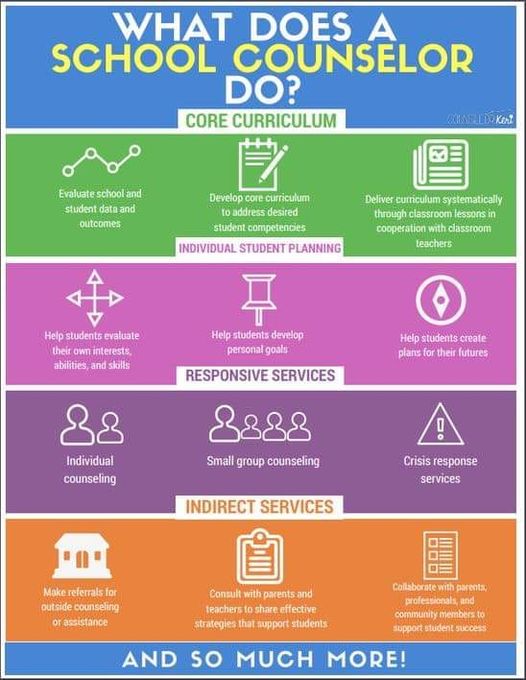
What Does a School Counselor Do? (Infographic)

Saw this posted in the High School Counselor Resources Group on Facebook and wanted to share for those that may not have seen it.

Follow up to post: Note in many schools curriculum is not a role of a school counselor, but rather an administrator or curriculum coordinator. Here are the guidelines set forth by the American School Counselor Association: https://schoolcounselor.org/About-School-Counseling/School-Counselor-Roles-Ratios

Survey Says!: Spring 2022 Paramount Research LINK for Counselors Profile Report

We recently hired Paramount Research to conduct a survey of our audience to determine how they use LINK for Counselors magazine. 343 Counselors took the survey. Thanks for all that participated. Here are a snapshot of those results:

Which ONE of the following best describes your School/Company?

63% are in a Public High School

25% are in a Private High School

7% are Independent Counselors

1% are at a College/University

4% are Other types of Counselors (Mental Health, Social Work, Middle School, etc.)

How many students do you personally work with?

Most respondents (61%) personally work with more than 200 students. One in six (17%)
indicated between 101 and 200 students. Another one in ten (10%) indicated between 51 and
100 students. Estimated Mean is 248 Students per Counselor.

Are you a member of NACAC?

More than six in ten of the Link for Counselors subscribers (62%) are not NACAC member

Considering all the times you pick it up, about how much time, in total, do you spend reading or looking through a typical issue of LINK for Counselors?

The typical respondent spends nearly three quarters of an hour (44 minutes) reading or looking
through each issue of LINK for Counselors. More than one in ten (12%) spend one hour or more
with each issue. Four in ten (39%) indicated between 30 and 59 minutes.

How many people, other than yourself, usually read or look through your issue of LINK for Counselors?

More than four in ten respondents (43%) share each issue of LINK for Counselors with an
average of one or more additional readers. More than one in ten (13%) indicated they share each
issue with three or more additional readers. Another one in six (14%) indicated two additional
readers.

Which version of LINK for Counselors do you typically read?

More than half of the respondents (54%) typically read the online/digital version of
LINK for Counselors. Another one in four (24%) prefer the print version. 22% read both versions.

What action(s) have you taken during the past year as a result of advertisements and/or articles in LINK for Counselors.

Nearly all the respondents (94%) indicated they have taken action as a result of advertisements
and/or articles in LINK for Counselors. More than half (52%) have visited an advertiser’s/
school’s website. Four in ten (43%) discussed an advertiser or article with another counselor.
Another two in ten (20%) have recommended an advertiser/school to a student.

Do you receive LINK for Counselors E-newsletter?

The vast majority of respondents (84%) receive the LINK for Counselors E-newsletter.

Have you visited Linkforcounselors.com in the past 3 months?

More than four in ten respondents (41%) have visited the LINK for Counselors website within
the past 3 months.

How to tell if a college is “good”

When students ask us to compile a list of recommended colleges, they are often thinking of rank and reputation. But, as we well know, rankings in magazines are usually just a popularity contest, and sometimes are not always even true. Ranking can also make admission rates vary; colleges have learned to manipulate rankings without fundamentally changing anything about their schools.

At the same time, many truly good colleges are overlooked. Can we correct this?

Using additional measures can provide real, significant information about an institution’s quality of a college:

  1. What is its retention rate? What percentage of first-year students return to this campus for their second year?
  2. What is its 4-year graduation rate? 6-year graduation rate?
  3. The school may offer the major a student wants, but how many courses are there? Are there opportunities for undergraduates?  
  4. What is the average class size? And what is the overall student-faculty ratio? This does not mean the student-teacher ratio. There is a difference.

All of the answers may be found in the data for each school. The key is to locating this data. We cannot assume that students will able to find answers on their own, so others need to be prepared to help them by doing the research.

The answers lie in each school’s Common Data Set. For new counselors, the CDS is a document of about 33 pages compiled each year by the school’s office of institutional research. It is a collaborative effort, but schools are not required to answer. It is uniform, meaning that the same information is asked in the same order. But it offers a wealth of statistics: who is reporting the information, if the school offers undergraduate degrees only or both undergraduate and graduate degrees, how many applications are filed each year, how many are chosen, and how many have enrolled. Does the school offer a waiting list? All enrolled students are listed: how many men, how many women, how many of each race. It tells how many teachers there are, what their highest degree is, and what race they are. You can see the sticker price (that is, tuition charged before scholarships are taken into consideration), the cost of housing and dining, and any fees charged.

Schools know not every person wants every bit of information, so they often give a page of “fast facts” about themselves. But there should also be a link to the current Common Data Set; most schools give the last few years’ results. This way, you can see in what ways the school has expanded or not. So the first thing is to look at a school’s website and see if the CDS is offered. You may need to go to the school’s “search” function and simply ask for the CDS.

But if there are just “Fast Facts” you can try another way. Google the name of the school AND the phrase “Common Data Set.” Either it will come up, if it exists, or not. You may be led to a “CDS” produced by another source, with some of the data available. Or you may be asked to fill out a data request form. Or you may be told to request information from a certain person on campus. This requires a time investment, and may not provide the information you seek.

When you ask for a school’s CDS, why are you offered all kinds of information except the CDS? Is the school trying to make things easier for me – or is this an attempt not to reveal something?

Take a look at the first thing suggested: what percentage of first-year students return to this school for a second year? 97% is excellent – 65% says something else. There can be many reasons for students’ not returning, including health and finances. But you need to ask for an explanation.

The second thing is the 6-year graduation rate. The CDS gives this as an indication of student success. A 6-year rate is usually given rather than 4, as many things can interfere with student progress: work opportunities, internships, illness, family reasons, switching majors, or holding down a job while balancing school responsibilities. If, for example, every member of a cohort that began college in the fall of 2018 graduated by the spring of 2022, that would be a rate of 100%. No school has that. But 91% is pretty good. 42% is not. What if you can’t find the graduation rate? It’s there: colleges know this information. You will need to ask.

If students want a certain major, you know which schools to suggest. But how many courses does the school offer in this area? What is their average size? Are there scholarships available? Does the school help students get internships? Is there a space in the department for students to gather? How many graduate each year with this major? Where are last year’s graduates? From five years ago? In other words, is there support for this major? Schools will be very eager to provide information about successful graduates.

And, significantly, who teaches the courses? Who teaches the introductory courses and who teaches more advanced classes? This is the final, and possibly the most significant, question you can ask about this school. It is normal for a university (which has a grad school) to have some advanced students teaching intro courses.

But it is not normal is to have 40%, 50%, 60% or more of the teaching staff working as part-time, contingent faculty. This shows that skimping on salaries is more important to this school than the educational process. Counselors should care if colleges have huge numbers of contingent faculty. They should see as red flags repeated, chronic labor issues on a campus. An unhappy teaching force may reflect working conditions that will definitely affect our students’ learning conditions.

Train your students to ask very pointed questions. When colleges send admissions reps to high schools to recruit applicants they answer most students’ questions. But they don’t address the working conditions of faculty – and in fact, they are usually unaware of them. Sometimes, and often at smaller schools, faculty and administration do work together for the benefit of the students; but those are the exceptions. At large universities, despite all the administrative personnel, students are on their own.

Colleges may be charging high tuition, but shortchanging students. If they continue to persist in treating huge numbers of their teachers poorly, we can expect a continuing decline in higher education. More teachers will leave the profession, fewer students will aspire to become teachers, and classes will get even larger. Only those who can afford it will even go to college or graduate school. Adjuncts will quit in disgust, courses will have no teachers, and colleges will have to retrench or close down. Students may pursue degrees, but not real education.

Those of us who were nurtured by caring teachers, who inspired us with their passion for learning, and those of us who still care about students, are filled with dread. Today’s students must be very careful, and ask uncomfortable questions.                    

Dr. Jane S. Gabin was senior assistant director of undergraduate admissions at UNC-Chapel Hill for 10 years, and then worked as a college counselor in New York City, most recently at the United Nations International School. Currently she operates Collegiate Consulting, an independent educational counseling firm, in Chapel Hill, NC.               

How To Write A College Deferral Letter for a Gap Year

Are any of your students considering a Gap Year before attending College? Many Colleges will defer admission for a full year. How does a student defer College for a year? Every College is different (so it is important to check with the College to find out its specific policy), but it typically involves putting down a deposit AND formally requesting a deferral.

It is also important that your student write a deferral letter. What does this letter look like? Julia Rogers, owner of Enroute Consulting and an expert on Gap Years provided an example in her recent blog post on the subject.

Here is an example of a great deferral letter written by an EnRoute student several years ago and edited for relevance this year:

John Smith
Director of Admissions
Aplus College
451 School Drive
Boston, MA 12345

Dear Mr. Smith,

I am writing to request a one-year deferral of my admission to Aplus College. I was accepted into the Aplus College Class of 2026. After reading about, hearing about, and attending a virtual tour of Aplus, I’m extremely excited to attend. I love its small size, intellectual and alternative atmosphere, great student support, and enthusiastic professors. I am sure it’s the college for me. My life, thus far, has been preparing me for both higher education and life outside of academia. I have never doubted that college would be for me, and have been looking forward to the college experience for years. Now, however, I feel truly that a gap year between high school and Aplus is what’s best for my personal development.

From late June to early August this summer, I will live at home on the weekends and spend my weeks living as a backcountry trail crew member. My crew will restore trails on public lands in northern Vermont with the Green Mountain Club.  This is an exciting adventure of living in the woods for the first time, working and living extremely collaboratively and learning about stewardship of public lands.  This work will generate some money to facilitate the next stages of my gap year.

Following my trail crew work, I will spend the fall on a leadership and outdoor education course with Woodlands Outdoor School. I will spend 80 days with my group navigating the terrain of the American Southwest while honing skills in orienteering and various outdoor pursuits. I am excited for the physical challenge of this experience and the personal development Woodlands will provide.

After the New Year, I hope to travel to in Costa Rica with the language immersion program, SICR. At SICR I will study Spanish and intern with a conservation organization. In addition to learning about international conservation efforts, I will get to integrate with another culture. This will nurture my interests in sustainable practices and cross-cultural exploration. In the event I’m not able to travel internationally, I plan to take online Spanish courses and find a virtual intercambio partner to practice language with.

In another year, I expect to be a more mature and engaged member of the Aplus community. I sincerely hope you will grant my deferral request and welcome me as a member of the Class of 2027.

Sincerely,

Jake Williams

Here is a link to Julia’s complete blog post: https://enroutegapyear.com/heres-how-to-write-your-college-deferral-letter-in-2022/?fbclid=IwAR1G5vbGuUAudeAJiVjdmi1X9HhdL3tbGqqg6xN-Flj9ILM3UJR18S6JfXs

These Colleges are Still Actively Recruiting Students for the Fall 2022 Semester

NACAC’s annual College Openings Update: Options for Qualified Students is a voluntary listing of NACAC member postsecondary institutions that are still accepting applications from prospective freshman and/or transfer students for the upcoming fall term. Now in its 34th year, the College Openings Update is designed as a tool for counselors, parents and others assisting students who have not yet completed the college admission process. The list of colleges is updated daily, so please check back periodically to see additional colleges still accepting applications. Each College is still accepting applications for the Fall 2022 semester and has a contact name and URL to check out their website. Here is a link: https://www.nacacnet.org/news–publications/Research/openings/?fbclid=IwAR1GcmTXwkD1-ApSPoeukR5ddBYUB4pMlkybn9IN0OiSuBkBr01FaGFDuuY

Income-Share Agreements(ISAs) – Be Wary of Recommending These to Your Students – A Cautionary Tale

Some schools are now offering Income-Share Agreements (commonly called ISAs) as a new alternative to traditional student loans to help students fund their college educations. These are agreements where the student agrees to pay a portion of their post-grad salary towards paying back any amount of money given towards the students tuition and other college costs. Although ISA providers have advertised their products as an alternative to loans, the Consumer Financial Protection Bureau, or CFPB, a federal regulatory agency, has said that ISAs are indeed student loans. An income share agreement is a student loan in which you receive money to fund your education or training. In return, you promise to pay the ISA provider a fixed percentage of your income for a set amount of time after you finish school. You may repay more or less than the amount you received, depending on your agreement’s terms.

A recent Yahoo story shed light on some of the downside of taking an ISA to fund your students college education. When mom-of-three Patricia Feldman decided on helping fund her son’s engineering degree at Purdue University, she didn’t expect him to graduate owing nearly $100,000 to a loan servicer in addition to several federal student loans.

Purdue’s Back a Boiler program, launched in 2016, offers ISAs to students seeking alternatives to traditional federal and private student loans. Feldman’s son took out a $10,373 ISA for the 2018-19 academic year, and a $29,491 ISA for the 2019-2020 year, according to documentation seen by Yahoo Finance.

That $39,864 loan ballooned to $99,660.50 as of January 2022. You can read the full story here: https://finance.yahoo.com/news/purdue-income-share-agreement-scrutiny-student-loan-153057798.html

If your students are considering this type of funding you may want to send them this story and remind them of the old adage “nothing is for free” and “if it sounds too good to be true it probably is”.

For Parents Only – Tips for you for Campus Visits

If this spring break is going to be your first stroll on a college campus since your own graduation day, here are four tips to avoid some rookie-parent campus visit mistakes.

Remember, this is about your kids, not you. Your priorities for safety, class size, spacious dormitories and nutritious food may not be exactly aligned with those of your child.

Tip #1: Keep quiet. As hard as that may be, the less you say, the more your child is likely to create their own impressions, ask their own questions, and make their own judgments. This trip is not about you reliving your college experience, it’s about identifying colleges that represent a great fit for your child. Empower your student to take control of the visit.

Tip #2: Encourage your child to be proactive.  Gently suggest that your child ask questions during the Information Session and Tour. Additionally, encourage them to initiate conversations with current students in the dining hall or in the Student Center. I always recommend that my students walk up to a group of students and ask them for five minutes of their time. There is no question this is a tough task for many high school students, but the return on the investment is well worth the effort. College students love to talk about their school; the good, the bad and the ugly. Your student will receive some honest feedback on what current students like and what they don’t like about their school. If the chat reveals that everyone is in the midst of transfer applications because the academics have been disappointing; well then, you’ve learned an awful lot that you would never have heard from anyone in the admissions office.

Remember that you need to take all the information you receive with a grain of salt. It is the admissions office’s mission is to make you want to apply; consequently, they are only going to share their accolades and their strengths and yes, the tour guides are really college cheerleaders in disguise.

Tip # 3: Get lost. Get off the beaten path. Try and visit a dorm room that wasn’t on the tour. Say “hi” to students passing by to see how friendly the campus is. Ask for directions. Check out different facilities on campus: the theatre, recreation center, science laboratories, dining halls, etc.

Don’t forget to tour the surrounding area. How far do you need to travel for that late-night pizza or that missing shower cap? What’s within walking distance and how accessible are movie theatres, restaurants, and cultural opportunities?

Tip # 4: Have everybody jot down their thoughts. This task is especially helpful if you plan to see multiple colleges over several days. It’s very hard to remember which one had the gorgeous fountains or the brand new dorms. But, even more importantly, ask your child to record their impressions of how well they think they’d fit in at each school, both academically and socially. Can they visualize themselves on that campus? That’s key.

Lee Bierer is an independent college consultant and founder of Bierer College Consulting based in Charlotte. Send questions to: leesbierer@gmail.com and visit www.leebierer.com. 

NACAC Conference 2022 – Registration is Open

Registration is now open for NACAC Conference 2022 which will take place September 22-24 in Houston. Join thousands of college admission professionals for three days of empowering programming, networking, and learning.

In addition to the in-person conference, NACAC will offer a concurrent virtual conference experience. You can find more information on the conference website and choose the option that’s best for you.

NACAC’s conference is the premier annual event for college admission professionals and we hope you will join us either in-person or virtually this September. Register between now and July 13 to take advantage of Early Bird rates.

Register or get more information here: https://www.nacacconference.org/registration/registration-rates/?utm_source=reg_open&utm_medium=email&utm_campaign=conference_2022

Newer Posts
Older Posts

Link for Counselors

Current Publication

View Current Publication

Advertisements

LINK Newsletter for Counselors

Sign up to receive our bi-weekly e-newsletter.