Menu Sidebar
Menu

Letters of Recommendation: What Every College Bound Student Should Know

Letters of recommendation are important because they put a college applicant’s transcript into a meaningful context. College admissions professionals often cite grades and academic rigor as the best predictors of academic success on the college level. But these two predictors do not tell the whole story. Grades and courses do not provide information about a student’s strengths, challenges, personality, character and work ethic—all of which are significant indicators of a student’s ability to be academically successful and contribute to the campus community. Letters of recommendation provide this valuable, contextual information.

Who writes the letters of recommendation?

There are three types of letters of recommendation: the school counselor letter, the teacher letter and the “other recommender” letter. Typically, colleges require a letter of recommendation from two teachers as well as the applicant’s school counselor. However, it is important to read the instructions on each college’s website to understand the exact requirements. Some colleges require fewer letters of recommendation and some colleges allow an “other recommender” letter for applicants who feel that an endorsement from a community member such as clergy, an employer or a coach would add value to their application.

What is the difference between a “teacher letter” and a “counselor letter”?

Teacher letters help admissions counselors determine if a student is an academic fit for their institution. Teachers may choose to comment on a student’s intellectual curiosity, work ethic, ability to work as part of a group, improvement over the course of the year or how a student handles challenging topics in the subject area. Teachers have a unique relationship to the student which will allow them to comment on a student’s organizational, public speaking and writing skills. Teachers often give examples of how a student approached a specific project and how they interacted with other classmates.

The school counselor letter of recommendation helps admissions officers understand a student’s character and personality. School counselor letters may also address inconsistencies on a student’s transcript. Transcripts that have inconsistent grades or a semester or year of low grades can only be accurately interpreted with more information. Admissions officers will often look for an explanation in a student’s school counselor’s letter of recommendation. A well written school counselor letter will explain to admissions officers how an applicant is likely to make a positive contribution to the campus community.

Which teachers should a student ask for letters of recommendation?

  • A student’s favorite teacher is not always the right choice for the teacher letter.
  • Ask teachers from junior and senior year. Students develop rapidly over the high school years. Colleges want to know about the student who will join their campus, not the student as he or she was two or three years ago. How a student performs in class junior and senior years will give admissions officers a more accurate picture of how he/she will perform in college than academic performance from freshman and sophomore years.
  • Ask academic (not elective) subject teachers. Colleges want to hear about a student’s performance in math, English, science, history and foreign language much more than art, music and woodshop. However, if a student is planning to pursue a major in an elective subject, such as culinary arts, art, theater or music, it is appropriate to submit one of the two teacher letters from the relevant elective teacher.
  • Students planning to pursue a major in a STEM field should ask at least one science or math teacher for a letter of recommendation.
  • In most cases, I recommend a student vary his or her letters. For example, don’t ask two English teachers for letters of recommendation. Letters from teachers of differing academic subjects are less likely to be repetitive in their content and observations and will generally add more valuable insight to the application.
  • Ask teachers that are known to be skilled writers. Although college admissions counselors are not “grading” students on the style of the teacher’s letter, poor writing may distract from the content.
  • It is not necessary to ask for a letter from a teacher in whose course a student has earned an “A”. Sometimes, a teacher whose course a student struggled with can provide the most insightful and helpful information to admissions counselors. A letter describing a student’s willingness to face a challenge, seek out extra help or overcome a barrier to success may reflect much better on that student than a letter describing success in a class in which the student breezed through.

When should students ask their teachers and school counselor for a letter of recommendation?

Ask for recommendation letters during the spring of junior year or beginning of senior year (for senior year teachers.) It is important to be near the top of a teacher’s list because some teachers put a cap on the number of letters they are willing to write. This is especially true of the more popular teachers or teachers of the academic classes perceived to be more rigorous than others. Additionally, a letter that is written when the teacher is fresh, not after he/she has grown weary of writing letters for students will likely be more comprehensive. Students should realize that it takes time for teachers to prepare a letter. Asking at the last minute reflects poorly on the student and may impact the quality or timeliness of the letter.

How should I ask for a letter of recommendation?

Whenever possible, students should ask for a letter in person. The teacher will be spending their personal time outside the classroom to prepare the best possible letter. It is not thoughtful to send an email. It is not appropriate for a parent to request the letter on behalf of the student. While schools remain closed due to COVID-19, a video chat may be an appropriate substitute for an in person request. Once a teacher has agreed to write a letter for a student, the student should ask the teacher if there is any information that would be helpful to provide. Some teachers ask students for a resume, transcript and/or “brag sheet” where the student answers questions about their strengths, interests and goals. Be ready to provide any or all of these if requested.

What should students do if they would like their teacher or school counselor to write something specific in their recommendation letters?

There are instances when a student would like to request that something specific be included in the letter of recommendation. For example, perhaps a student excelled at a specific project in class or was consistently helpful to other students. Or, in the case of the school counselor letter, perhaps a student missed a lot of school and the absences affected his/her grades. Students should discuss these scenarios with their teachers and school counselor and decide if it is best for the applicant to address them in the “additional information” section of the Common Application or if it is best for the recommendation letter to address them. A word of caution: When someone else writes about you, you lose control over the message. It may provide greater clarity if the student addresses these matters directly rather than rely on either a teacher or school counselor to do so.

How are letters of recommendation sent to colleges?

Letters are sent to colleges electronically. However, the process does vary between high schools so a student’s school counselor is the best source of information for the process of getting letters to the colleges. In general, for colleges using the Common Application, teachers and school counselors upload their letters directly to the Common Application website. If a high school uses the college planning program Naviance, the letters of recommendation are uploaded to Naviance. For colleges who do not use the Common Application, follow the directions on the college’s website for sending letters of recommendation.

Should students waive their right to see their letters of recommendation?

Under the Family Educational Rights and Privacy Act of 1974, students who are age 18 and over have the right to request access to their letters of recommendation after they have received an acceptance letter and chosen to attend a particular college. A student’s college application will ask whether they want to waive this right. It is beneficial to the student to waive the right. Doing so assures the admissions officer reviewing the application that the recommender was candid and honest because he/she knew that the student would not see the letter. Admissions counselors may discount the importance of a letter which they know to have been reported back to the student.

How should students follow up with their teachers and school counselor after the letters are written?

Students should always send a thank you card to their recommenders. Additionally, as acceptances start rolling in, students should let their recommenders know where they were accepted and what their college plans are. Teachers and school counselors work hard on these letters. They deserve and will appreciate a “thank you” and they will enjoy the opportunity to share in the student’s progress towards college.


Image of Michelle McAnaney, founder of The College Spy.

Michelle McAnaney is the founder of The College Spy, a full service independent educational consulting firm that assists students and families across the US and internationally with the college selection and application process. Prior to founding The College Spy, Michelle was a guidance counselor and educator for more than 15 years, including serving as the Director of Guidance at two high schools, an adjunct college professor and a GED tutor. Michelle holds a master’s degree in school counseling and a bachelor’s degree in human development. She completed UC Irvine’s certificate program in educational consulting and is a MBTI (Myers-Briggs Type Indicator) Certified Practitioner and a NLP (Neuro-Linguistic Programming) Master Practitioner. Michelle visits over 40 colleges each year so that she has first-hand knowledge of the colleges and universities her clients will be considering. You can find her on Facebook, Twitter, Instagram, LinkedIn and on The College Spy Podcast.

Winners of $10 Amazon Gift Card – Participants in Paramount Research Study

We recently surveyed Counselors that had participated in a survey related to readership of the print and digital versions of the Spring 2020 issue of LINK for Counselors. As an incentive to participate, we offered all entrants a chance to be chosen as a winner of one of ten $10 gift cards that would be randomly drawn.

Here are the winners that have been notified and sent their cards:

Mrs. Corrie Klinefelter, Cactus Shadows High School

Mr. Kristi Cooper-Denton – Edgewood Jr/Sr High School

Mrs. Pat Cunneen – Benet Academy

Ms. Daysi Colom – Belleville High School

Mr. Jed Geary – Eagle Hill School

Jennifer Brown – Bullock Creek High School

Rachel Henderson – Oswego High School

Maria Correa

Ms. Kim Jackson-Allen – Windsor Forest High School

Ms. Laura Willard – The Woodlands High School

Congratulations again to all these Counselors and thanks again to all who participated in the survey.

Are Your Students’ College Essays About Great Storytelling?

An independent educational consultant recently asked me this question: “Is the essay about great storytelling?”
 
Day after day, we get emails and calls like this one from counselors, teachers and educational consultants with questions and challenges. We’re always happy to answer.

This time, my answer was “Nope.” That’s a myth.
 
We say this all the time: At its core, the college essay is all about reflection –  NOT great storytelling, and not great writing. We say it because it’s true.
 
Some people believe the essay should be beautiful. Perfect. Like a piece of art. A story written with dynamic words, fancy sentences, flawless grammar and spelling.
 
But that’s a myth, too.
 
Because college admissions counselors who read application essays are not looking for great. Not before COVID-19, and not after. They want an essay that answers their prompt and will help them get to know the applicant beyond the application package. They want to hear what the student has to say, understand how that student thinks, NOT what the student thinks they want to hear.

As we move into application season in the most unsettling time in our history, it’s important to remember that great writers sometimes write great essays, but only if they show reflection. Just as many not-so-great writers crank out meaningful stories that get noticed inside the admissions office.

Questions? We’ve got answers.

MONTHLY FREE WEBINARS FOR STUDENTS AND PROS
 

Pro Chats: Every month we record a new College Essay Pro Chat. Check out the recording, or sign up for next month’s webinar. Wow CEO Susan Knoppow answers questions live for 30 minutes.

Free Student Classes: If you’re a school counselor who wants to help students with the basics, encourage them to sign up for my next free student class, or listen to the recording. You are welcome to sign up, too.

Stay healthy. We’re sending warm and calming thoughts to all of you.

Kim Lifton is President and Co-founder of Wow Writing Workshop a premier college application essay coaching and professional training company, offering private, virtual writing coaching services to professionals and students throughout the world.  Since 2009, Wow has been leading the college admissions industry with our unique approach to communicating messages effectively through application essays, including personal statements, activity and short answer essays and supplements.  Kim leads a team of writers and teachers who understand the writing process inside and out. Kim blogs regularly about the college essay’s role in the admission process for multiple industry publications and websites. In 2019, she was named a LinkedIn Top Voice in Education.

You Don’t Have to Be an Expert to Help Families Afford College

Now more than ever, middle class families need help figuring out how they can afford college. With many families having to do more with less, knowing the ins and out of the financial aid system can be key to helping them cut college costs.

A high school counselor may be the first person families turn to for help. But a survey by the College Board National Office for School Counselor Advocacy (NOSCA) noted that this is an area where most counselors feel they lack expertise—with good reason. Rules are frequently changing, and the way aid is calculated varies from school to school.

While financial aid is a complicated process, there are a few simple steps counselors can encourage families to take to put college within their financial reach.

Focus on School Over Private Scholarships

Private scholarships tend to be smaller, typically less than $2000. If students have limited time, it’s best to focus on working toward the large scholarships offered by colleges and universities. Part of that means crafting a list of schools that looks beyond the advertised price tag. Sometimes private or out-of-state schools are cheaper than state schools when you factor in the scholarship money a student qualifies for. Encourage families to do some research before they commit to a list or eliminate schools based on advertised tuition.

Retake the ACT or SAT

Maybe a student has a score they’re happy with that will get them into their dream school. Great! But can they afford that school? Scoring just two points higher on a test may be all they need to do to earn $10,000 more in scholarships. Some schools list the scores students’ need to earn rewards right on their web sites. Families can see for themselves how a modest increase can make a huge difference.

Consider the EFC

The Expected Family Contribution (EFC) varies from school to school, which impacts a family’s potential financial aid. That’s because not all schools use the same formula. Some colleges, for example, may count home equity, while others may not. Encourage families to investigate how schools compute their EFC to eliminate surprises down the road.

Plan Ahead for the FAFSA

The most important steps families can take in filling out the FAFSA happen before they ever sit down to complete the form. There are strategies families can take years before their student’s junior year in high school that can help them reduce their EFC. Consulting with a local financial aid expert may help them reduce their EFC and increase their eligibility for aid.

Follow Directions

Some schools require students to complete a CSS Profile in addition to the FAFSA. Others may require filing through the Institutional Documentation Service (IDOC). Encourage families to stay on top of this and make sure they complete the forms correctly and in a timely manner. Failing to do so could result in them losing out on thousands of dollars.

Update the FAFSA If Circumstances Change

Especially during the COVID-19 pandemic, it’s possible a family’s financial or health circumstances could change once they complete the FAFSA. Make sure families are aware that they can update their information if a parent loses a job or the family incurs unexpected medical expenses.

List a State School First

It may sound crazy, but if a family doesn’t list a state school first on their FAFSA, they may miss out on state aid. Families should list a state school first to make sure they see state eligible grant money on award letters.

Be Savvy About Small Businesses

If a family owns a small business, encourage them to consult an expert about how to manage their assets. A simple step like keeping most of their assets in their business rather than a private account can make a huge difference in terms of financial aid awards.

Use the IRS Data Retrieval System

Families need to use precise spelling and wording for this system to work accurately, but that’s a small price to pay for the benefits they’ll receive. Families who use this system will receive their award letters sooner and will be less likely to need verification from schools.

Remember, Nothing Is Final

Financial aid awards can be negotiated. Receiving a better offer from a similar school, or a change in financial or health status in the family are all valid reasons to appeal a financial aid award. Encourage families to look into a school’s process for appeal and have them go through the proper channels to make a request before eliminating a school a student wants to attend.

Call in the Experts

Many high schools bring in experts to host free financial aid workshops for students and their families. This can be a great tool to fill in the knowledge gaps for college-bound students and their families. If you choose experts who also offer private consultations on a sliding scale, parents will have an affordable place to turn when they need some extra help.

A few smart tips can go a long way to helping families make college more affordable. College counselors don’t have to have all the answers, but they can certainly point students and their families in the right direction.

Shane Cole is an advisor for My College Planning Team (www.mycollegeplanningteam.com) in the Chicago area.  He is also a counselor at Addison Trail High School. He has helped families from diverse economic backgrounds successfully navigate the college application, financial aid and scholarship processes.

Seniors Coping with the Covid Quarantine

There is no doubt that this is the saddest senior class of all time, and rightfully so. They have missed out on opportunities they have waited for for 13 years. When I talk to high school seniors they talk about how they feel robbed of experiences and opportunities. Many of them are sad and depressed. Many are anxious about college because they do not feel ready for this transition. 

Finding joy in times like this can be a challenge, so here are 3 Tips to Finding Joy in the NOW. 

  1. Realize that all your feelings right now are valid.

You have had a very unexpected kink thrown in your plans. You have had experiences you have dreamed about stripped from you. You are sad, mad and maybe even depressed and it is okay to feel that emotion. In fact, you need to feel that emotion and understand that it is okay for you to feel this way. When you feel the negative emotion do not push it away, but rather embrace it. 

  1. Focus daily on what you are grateful for. 

Regardless of your personal situation, there is so much to be thankful for. Are you healthy? Do you have someone that supports you? Is there food in your refrigerator? Will you get a high school diploma? Are you still alive? Are you still able to get a college education? No matter how small, make the choice to focus on the good. Look for the good in nature. Notice that nature has continued to thrive despite our lives being put on halt. 

  1. Take the time you have now to create. 

You have months of downtime right now. What can you create? Think about the skills you have and how you can use them to create something epic! Do you want to start a podcast or a blog? Maybe create a non-profit? Learn another language? Take this time to create something incredible. Is there something that you have always wanted to do, but have never had the time? Find the joy in creating new things. 

If you have lived to be 18 years old, then you have done hard things. This is just one more hard thing to add to your resume. I believe that no matter what you are going through in your life right now that you are going to come out stronger on the other side. I want to encourage each and every student and parent to embrace this time we have together. Take the time to love and understand each other on a deeper level and find joy even in the hard times.

JoBeth Evans has five years of experience teaching high school, and has been teaching public speaking at the University of Arkansas for five years. She holds a bachelor’s degree from the University of Arkansas and a master’s degree from Arkansas Tech University. She is a nationally certified life coach with a total of three different coaching-related certificates. In her work as a life coach, she helps teen girls make the transition from high school to college. In addition, JoBeth is a speaker and writer who works to equip young women for the major life transition of entering college. She can be reached at jobethevans@outlook.com.

Test Optional – What Does It Really Mean?

Test-optional may sound enticing to some students – but skipping the ACT or SAT is not the easy out from testing that it may appear to be; there are serious ramifications. With the knowledge that we have about the implications of new college admissions policies, we must guide students so that they make appropriate decisions and bring the best possible balance to their college applications, with or without testing. This webinar will add to your counseling toolkit and help you answer your students’ most pressing and pertinent questions about test optional:

…What does test-optional really mean?
…Who benefits the most from test optional?
…Who should apply without scores to a test-optional university?
…When is the best time to take the SAT or ACT?
…How can students remain productive during the coronavirus pandemic?

Here is a link to the recent webinar from Score at the Top which answers these and many other questions: https://www.youtube.com/watch?v=25G93wC1MYc&feature=youtu.be

Have any questions about this webinar or the information it contains? You can e-mail them at Questions@ScoreAtTheTop.com visit their website at www.ScoreAtTheTop.com

The effect of coronavirus outbreak over student loans

The current COVID-19 virus outbreak may create a temporary financial problem for federal student loan borrowers. Borrowers who make payments hourly, or are unable to telework may face such a challenge sooner than other borrowers. The damage caused by the coronavirus outbreak is making our lives vulnerable to financial issues. So it’s important to be on your toes and prepare to face such financial difficulties as an outcome of the pandemic.

Due to the loss of jobs and falling income levels, borrowers may find it difficult to make monthly federal student loan payments. A borrower may understand the options available to him/her and should prepare early to get some well-needed relief immediately. This way the borrower of a student loan may also avoid delinquency and default of a federal student loan and the long-term outcome of them.

There are 4 income-driven repayment plans for federal student loans

  • PAYE – Pay As You Earn
  • REPAYE – Revised Pay As You Earn 
  • IBR – Income-Based Repayment
  • ICR – Income-Contingent Repayment

The U.S. Department of Education has recently declared that most federal student loan borrowers may get an opportunity to suspend their payments for approx two months. This option is announced due to the national emergency caused by the massive coronavirus outbreak. 

From March 13 to Sept. 30, during that time, no interest will be charged on the loans.

As per Forbes – “More than ever, student loan borrowers are searching for ways to lower their monthly student loan payments. The CARES Act, which is the new $2 trillion stimulus bill to help those impacted by a coronavirus, directly helps borrowers with student loans and provide financial relief. Let’s clearly understand what is included (and not included) so you can make an informed decision about your student loans.”

The CARES Act will allow all the borrowers to stop paying federal student loans from March 13 through September 30, 2020. Mark Kantrowitz, Publisher and VP of Research for Savingforcollege.com, strongly believed that “interest rates on federal student loans will drop by 0.75% to 1.0% in 2020-2021. If your wages are still being garnished, contact your human resources department, as they were supposed to stop doing this.” 

You should call the Education Department’s Default Resolution Group at 1-800-621-3115 for assistance.

Secretary of Education Betsy DeVos initiated an automatic suspension of payments for any student loan borrower “who is more than 31 days delinquent as of March 13, or who becomes more than 31 days delinquent”.

So, let us see the effects of The CARES act 2020 on borrowers    

a) Suspension of payment or interest on federal student loan

From March 13 through September 30, 2020, the interest rate on federal student loans will be fixed at 0% and all payments are suspended. You don’t need to apply for that. Your federal student loan servicer will do all the needful without any delay. You don’t have to contact him either.

If you made any payment towards your federal student loan after March 13, you may ask for a refund to the student loan servicer. However, if you are financially strong to carry on with the payments on your student loans, any payments you make after March 13 will be treated as payment to the principal. This way your loan will be paid off faster.      

b) Interest and payments are suspended for federal student loan only

Only federal student loans will be eligible for the suspension of payments. Some federal student loans are owned by private lenders. Normally student loans under the Federal Family Education Loan (FFEL) Program fell into this category. 

The FFEL lender might suspend interest and payments if they want to. You may contact your servicer to check if this option is available to you.

The CARES Act does not entertain private student loans owned by banks, credit unions, schools, or other commercial companies. But some of the many private student loan lenders may implement extended forbearance options. You may contact the lender to get more information on this subject. 

If your lender does not allow suspension of student loan interest and payment, and you can’t afford your payment at all, you may opt for a debt settlement program. You may choose any of the best debt settlement companies in the USA, but make sure you read reviews online.   

c) Feds won’t charge you for suspending student loan payments

The federal government does not charge any fee to suspend your payments. If someone asks for money, it is a student loan debt relief scam and you should file a complaint to the FTC’s complaint assistant. 

The federal student loan servicer will suspend all interest and payments on your loan and send you a written notification about the suspension between March 13 and September 30, 2020. You might be getting the notice by mid of April. Make sure to update your contact information and check your mail or email regularly. You can call your servicer or call at 1-800-4-FED-AID to get all the information.              

d) The suspension does not affect your credit

You won’t get a negative credit reporting if you put your student loan into a deferment or forbearance. The CARES Act instructs credit reporting agencies and loan servicing companies to report the suspended payments for the next 6 months as a normal, on-time payment for each month.

e) Tax-Free employer contributions for student loans

If your employer makes all the student loan payments as an employee benefit, you might get extra benefits for that under the CARES Act. 

Your employer may pay up to $5,250 of your student loans tax-free this year. Apart from that, the CARES Act also prevents the involuntary collection of student loan debts during these 6 months. That means you’ll get tax refunds and Social Security benefits, with no garnishment of wages. 

Endnote

You might find financial difficulties being a student loan borrower, due to the pandemic. The CARES Act does not provide for any student loan forgiveness. 

But still, do not hesitate to contact your loan servicer and look out for other options. You may use online forms on your servicer’s website or call the servicer for direct assistance.

$2,000 Quarterly Porch Skilled Trade & Technology Scholarships Available for Your Students

Growing demand and lack of qualified workers in skilled trades and technology means it’s a great time to go back to school and enter these lucrative and fast-growing industries. To help keep up with demand and assist the next generation of professionals, Porch will award a $2,000 scholarship four times a year to eligible students.

Entries are now being accepted for the Winter scholarship, which runs from April 17-July 17, 2020.

Review the terms and conditions and the Porch privacy policy for more details. FAQs Are you eligible?

  • You must be 18 years or over and currently be enrolled as a high school senior, or in a community college, undergraduate, graduate, technical college, or vocational program, or be planning to enroll in a high school, community college, undergraduate, graduate, technical college, or vocational program during the 2019-2020 academic program in the United States.
  • You must have a minimum 3.4 GPA.
  • You must be pursuing a degree that enables you or others in your community to learn a new trade, develop skills and technology, or start a small business related to home services offered by Porch.

How are winners selected?

Winners will be drawn at random from all eligible entries shortly after the application deadline has ended.How and when do I find out if I won?

Winners will be contacted by email within a reasonable time after the application deadline has ended.Can I submit more than one entry?

Each scholarship is limited to one entry per person.

About Porch

Seattle-based Porch is a home services platform that simplifies home management for homeowners and renters across the nation. We make moving easy, complete one-off improvement projects, take care of common home maintenance and repair tasks, and more. Porch also provides these services to customers of world-class partners such as Walmart and Keller Williams. Visit porch.com to learn more.

Follow us on Facebook, Pinterest, Twitter, and YouTube to keep up with the latest Porch news and updates. Still have questions? Email scholarships@porch.com.

Recommendations For College – Six Tips You Can Give Your Students to Help Them Get Great Letters from Their Teachers

One of the most important elements of the college application is the recommendation of a teacher. College admissions offices take these letters very seriously, and it is critical that your students do their best to secure the best letters of recommendation possible.

The most important step in requesting letters of recommendation is that your students ask the right teachers.  Admissions representatives want to hear insights about what type of student they are and how they are going to contribute to the academic community at their college.  They want to know if your student participates in class, completes their assignments and takes a leadership role in group projects.  But they also want to know if they go above and beyond the basics of being a good student.

What makes a good recommendation for college?

Below are some of the insights that colleges are often looking for.  Your students should think about how they perform in each of their classes and if any of their teachers would be able to describe them as one of these students.

The Intellectually Curious:  Colleges often say they are looking for students who are “intellectually curious”.  What does that mean?  Well, do they ask insightful questions?  Do they not only participate in class discussions, but provide insights that encourage their peers to think of things in a new way.  Do they research a topic beyond what is covered in class and the textbook?

The Helper:  Are they the type of student that helps others in the class?  Some students learn materials better if they teach others.

The Leader, but not the Dominator:  It is great to show that they have leadership skills by taking charge of a group project, but it is important to make sure they don’t take it over.  A true leader is able to bring out the best in everyone in the group, so that everyone contributes to the project in a constructive way.

The Most Improved:  Most students feel that if they have struggled in a class, then they should definitely not ask that teacher for a letter of recommendation, but this could not be further from the truth.  If they have had to work twice as hard as everyone else to succeed in a course, then this could be a great letter of recommendation.

The Motivated to Succeed:  Are they the type of student who asks for help?  Do they often strike up a conversation with their teachers outside of class?  Do they ask for feedback before a paper is due so they can turn in the best work possible?

Some students assume that there is nothing they can do to ensure that the letters are glowing testimonials. While they can’t really expect to sit in the room looking over the shoulder of their teacher as he writes the letter, there are many things they can do to increase the likelihood that the teacher writes a strong letter that will impress admissions officers everywhere.

Watch this video on letters of recommendation.

Here is a step-by-step guide for making sure your students letters of recommendation (LORs) are the best they can be.

1. Get Organized

The students should talk to you or another Counselor to find out how the school handles teacher recommendations. At some schools, the guidance office will submit the teacher recommendations from the students file to colleges directly, along with their transcripts and the school report. At other schools, teachers are requested to send LORs directly to the colleges. Some schools manage recommendations electronically through software packages like Naviance, while others are using functions on the Common Application. The point is that students must know the procedures at your school before they even get started. And they need to follow those procedures, so as to make the lives of their teachers and counselors as easy as possible. With some teachers writing dozens of letters each year, the more they can make things easy for the teacher writing their letter, the diligence and kindness will be reflected in their evaluation.

2. Decide Which Teachers Should Write their LORs

teacher recommendation for college

A good LOR tells a good story about the applicant. The story reflects the strengths—and perhaps a few weaknesses—of the candidate. A good letter contains some details, some examples, some bits of information that bring the candidate to life for the reader. And a good letter might also provide information about the student’s intellectual growth and development over time. Therefore they need to choose a teacher who knows them well to write their letter.

They also need to make sure that they choose at least one teacher in a core academic discipline. They are applying to college, not to a resort or a team or to a service club. Admissions officers want to know about their performance in and contributions to the classroom. If they like, they can add a second or third LOR from a band director, a coach, or the head of their youth group. These letters can help round them out as a person. But at least one LOR should be from an English, math, social studies, science, or foreign language teacher.

Finally, don’t assume that they should choose the teacher in whose class they are performing the best. Nor should it necessarily be the teacher of their favorite subject. As noted earlier, they need to identify the teacher who knows their work, who can tell some good stories, and who can highlight their positive personal qualities.

3. Establish a Relationship with Their Teachers

Well before they decide which teacher will write their LOR, they need to consider that a teacher will not know them very well unless they make an effort to get to know the teacher. They need to participate in class, ask questions, work hard. They should go above and beyond what is required, to demonstrate their interest, their fortitude, their proficiency. They should show up before or after school to ask questions, shoot the breeze, or comment about the course content. It is important to express interest not only in the class, but in the teacher. Obviously, they will get along better with some teachers than with others. So they should focus their efforts on developing relationships with the teachers with whom they share some connection, some affinity.

4. Consider the Timing of Their Request for a Letter of Recommendation

Teachers are busy people. Don’t wait until the last moment to request an LOR. They should avoid asking after their midterm or final exam—when their teacher is still grading stacks of papers. They should never assume that teachers will write letters during school vacations (students don’t want to work during vacations, and their teachers don’t, either). They need to look at their own deadlines for their college applications, and consider requesting the LOR at least a couple of months before the deadline. It is imperative that they be considerate and respectful.

5. Pop the Question

letter of recommendation for college admission

When they meet with their teacher to request an LOR, they will likely be nervous. They should try not to worry. Teachers field these requests all the time, and they expect to be asked. They should consider making their request after school or during a teacher’s off period. They should never make the request via email or over the telephone. They should always do it in person: it makes a better impression.

Their question can go something like this: “Ms. Baker, out of all my high school classes, I have enjoyed yours the most. I feel that I’ve learned a lot from you. You’re a great teacher, and I enjoy the material we are learning. I also think you bring out the best in me. I would like to ask whether you would be willing to write a strong letter of recommendation for me as I apply to colleges this year. Of all my teachers, I think you know me best, and I’d be pleased if you would write my recommendation.”

They should be complimentary of the teacher, but they also want to convey a sense of pride in the work they have done in the class. Brown-nosing won’t work. But if they have built a good relationship with this teacher, he or she will be delighted to give them an enthusiastic “yes,” if they craft their request in this way.

6. Provide Their Teacher with Adequate Information

After their teacher answers an enthusiastic “yes!” to their request, they should present him with a slim folder with everything the teacher needs to fulfill the request. The folder will contain a variety of documents (see below) that will help him in writing a detailed letter filled with anecdotes about their skills and abilities. Presenting this folder immediately will convey how seriously they take the teacher—and the recommendation.
The folder should contain:

  • Resume
  • Personal statement, assuming they have completed it
  • A short “statement of purpose” that outlines the sort of college they hope to attend and why they think that sort of college would be best for them. Write one or two solid paragraphs. Make sure to focus on the academic issues related to their college choice, so that the teacher can provide specific information to support their application.
  • A full list of the colleges to which they are applying, including addresses, with application deadlines clearly stated. If they are applying to particular departments, scholarships, or other special programs, make sure to clarify that information for the teacher.
  • The recommendation form or forms the teacher will need to complete (note this might be the form your high school uses, or it could be the form from the application platform they will be using, such as the Common App). Or they might include the form from each individual college to which they are applying.
  • If the letter is to be turned in to the school guidance office, include an envelope in which the completed letter can be sent to the guidance office.
  • If the teacher has to send the letter directly to the college, include stamped, addressed envelopes for each college to which they are applying (make sure to clip these to the appropriate blank forms, to make it easy for the teacher to do the collating).
  • Contact information, including phone number, home address, and email address, in case the writer has any questions.
  • A short note of personal thanks to express their appreciation.

FAQs about Letters of Recommendation for College

How many college recommendation letters do I need?

As in so many things in life, the priority here is on quality, not quantity. Generally most colleges want one counselor recommendation and one teacher recommendation. I advise my students to obtain two solid recommendations from teachers. One should be from a teacher in a core subject (math, English, science, social studies, or foreign language).

The second can be from another core teacher, or from an elective teacher who knows you well or in an area that the student hopes to pursue in college (a budding actor needs a letter from the drama teacher, for example). In some cases, a third letter from a coach, a youth group leader, or some other adult who plays a significant role in the student’s life may be included. Admissions officers spend a total of about seven minutes reviewing an applicant’s file. A pile of letters that say essentially the same thing will be more of a hindrance than a help.

My dad knows Senator Longbottom from my state. Should I get him to write me a recommendation for college?

Not unless Senator Longbottom knows you really well and can say something new, different, or eye-opening for the admissions committee that is not otherwise in your application. Gratuitous letters from bigwigs will not impress anyone. The admissions officers want to know first and foremost about your life in the classroom. Senator Longbottom is unlikely to have much to add on that score (unless he was your civics teacher before got himself elected!).

Can I request a letter of recommendation for college via email?

No. Many high schools now have automated systems for requesting letters of recommendation. These are fine for processing and for making the lives of teachers and counselors easier. If your school uses such a system, you need to adapt your request to accommodate an electronic delivery system. But you should NOT request the recommendation this way. Make your request in person, then follow it up with the electronic request. A face-to-face request shows maturity and respect. An emailed request is wimpy.

What if my teacher turns down my request for a letter of recommendation?

It happens very occasionally. Usually this happens only when a student does not carefully consider whom to ask in the first place. Reasons for rejection vary. Some teachers are too busy. Some teachers will not write letters for students they don’t know well. And some teachers are brutally honest: they will not write a letter unless they can write a strong, supportive one. You have little choice to respect the teacher’s decision and seek one from another. Don’t despair, however; a teacher who turns you down would be unlikely to have written a good recommendation, anyway. Better to opt for your second choice than to get a letter that is weak or (worse) negative.

Should I waive my right to see a recommendation? Should it be strictly confidential?

get letter of recommendation from a teacher

A confidential letter is best. Some teachers will provide you with a copy, anyway. But it is better for the admissions officer to believe that the teacher is not sharing his or her comments with you directly. The teacher, too, should feel comfortable about being honest in the recommendation. Often the strongest letters are actually ones that include a couple of insights into the student’s relative weaknesses; these insights can help highlight a teacher’s strengths (plus, a letter that goes on and on with nothing but superlatives really doesn’t say much of anything). If you have chosen your recommender carefully, you need not fret that the letter will say something bad about you. So waive your right to see it, and give that letter an extra measure of weight in the eyes of the admissions officer who reads it.

How can I build a better relationship with my teachers before I ask them for a letter of recommendation for college?

Thought it may seem somewhat surprising, teachers are human. They like it when students show an interest in them, and in what they are teaching. So engage with your teacher as a human, and as an instructor. Ask questions in class. Come after school or before school with a question (even if you know the answer—sometimes it helps just to get the teacher talking!). Express your thanks. On a day when you feel class was particularly good or the teacher was in fine form, tell her so. If you enjoyed a particular project or assignment, say so as you hand it in (don’t wait to complain about the grade after it is returned). You want to be an eager, conscientious student.

But you don’t to be a tiresome brownnoser. If you find that you are forcing yourself to like the teacher or the subject matter, consider asking a different teacher to write your recommendation. Not only are teachers human, they are also able to smell a sycophantic toady a mile away.

How can I thank the writers of my letters of recommendation for college?

As a former teacher, I’m tempted to say that you should buy them expensive gifts: Rolex watches come to mind. But the best form of gratitude is to act grateful. Write a thank you note (not an email—a handwritten note on a nice card) after you have confirmed that the colleges have received their letters. Make sure to let your recommenders know where you are accepted: run by their office between classes and share your good news, and say thanks for the recommendation. Write another nice note at the end of the year, just before graduation, to let them know how much you appreciate their help in getting you through high school and into college.

And, if you really want to make a teacher’s day, week, month, or year, send him a note or two from college. Let them know how you’re doing. Share some good news. Relate what you are learning in college to something you learned in their classroom. Nothing warms a jaded teacher’s heart like a genuine note of thanks from a former student.


About Mark Montgomery

College Admissions Expert Mark Montgomery

Mark is the Founder and CEO of Great College Advice, a national college admissions consulting firm. As a career educator, he has served as a college administrator, professor of international relations at the University of Denver and the Hong Kong University of Science & Technology, program consultant at Yale and the University of Kansas, government instructor at Harvard and Tufts, high school teacher of French, and a Fulbright teacher of English in France. He has personally helped hundreds of students from around the world map their college journeys.

Mark speaks on college preparation, selection, and admission to students and parents around the world, and his views have been published in major newspapers and journals


Facebook for great college advice

Want to stay informed about college admission trends? Want to ask questions of experts who can give you some Great College Advice? Join the Great College Advice Facebook group using this link.

What Does “Test Optional” Mean Anyway?

COVID-19 has wreaked havoc on the college admissions calendar. High school juniors would normally be taking the SAT or ACT this spring and, if not satisfied with their scores, retaking the tests during the summer or fall of their senior year. However, the SAT and ACT were canceled this spring and it is not clear if summer testing will be possible. Many colleges have responded to the canceled test dates by adopting test optional admissions policies, assuring high school juniors that they can apply even if they do not have test scores or do not feel that they were able to achieve test scores that adequately demonstrate their abilities.

The role of standardized tests in the admissions process has confused parents and students even before the pandemic, with most people overestimating their importance at most colleges. Now, with more colleges allowing applicants to apply without test scores, it is even harder to decipher how test scores (or the lack thereof) will impact an applicant’s admissions chances. I have been “spying” on this subject for several years and offer the following explanation of test optional policies.

What does test optional, test flexible and test blind mean?

In lieu of requiring the SAT or ACT, colleges have three choices. They can be test optional, flexible or blind.

  • Test optional colleges allow the applicant to apply with or without test scores.
  • Test flexible colleges require some form of testing but it doesn’t have to be the SAT or ACT. Some colleges allow applicants to submit AP test scores, IB exam scores or SAT Subject test scores instead.
  • Test blind colleges are not interested in evaluating standardized test scores. If students submit them, they will not be considered as part of their application.

It is very important to read the application requirements carefully. Some colleges are test optional for most majors, but not all. For example, some test optional colleges require students who intend to study engineering, nursing or education to submit tests scores. Other colleges require students who do not submit standardized test scores to provide alternative evidence of their abilities such as a paper, portfolio or additional letters of recommendation.

Are test optional admissions policies new?

No. The first college to adopt a test optional policy was Bowdoin College (a small, liberal arts college in Maine) in 1969. Bates College (also in Maine) followed suit in 1984. Worcester Polytechnic Institute (Massachusetts) was the first science and technology university to implement test optional in 2007. The University of Chicago (Illinois) was the first highly selective research university to embrace test optional policies in 2018. By the beginning of 2020, over 1000 colleges were test optional. A full list of test optional colleges and universities can be found at fairtest.org.

Why have so many colleges stopped requiring the SAT or ACT?

Colleges that do not require the SAT or ACT have found that these tests are not necessary to predict which applicants are going to thrive academically on campus. Admissions professionals at test optional colleges generally view academic rigor and grades as the best indicators of success at the college level. In other words, they look at what classes applicants took in high school and how they did in them. Admissions professionals at test optional colleges are able to select students using these alternative indicators of success.

Many colleges have stopped requiring the SAT or ACT in an effort to increase diversity on their campuses. It has been shown statistically that white and wealthy students score higher on the SAT and ACT than minorities and low-income students. Colleges who want to increase educational access to Black, Hispanic, first-generation and low-income students may remove the requirement of SAT or ACT test scores to attract more applications from these demographics.

Colleges also choose test optional admissions policies to improve their selectivity relative to other colleges in the statistics published by U.S. News and World Report and other college guides. Colleges that are test optional appear more selective in the rankings in two ways. First, by allowing students to apply test optional, colleges increase the number of applications they receive. The more applications received, the more students the college must reject, the lower their admission rate and the higher they place in the rankings. Additionally, colleges report their middle 50% test scores to U.S. News and World Report and other publications. Students who choose to take advantage of a test optional policy by not submitting test scores are presumably students who had lower scores. Since those lower scores are not shared with the college, the college is unable to report them, skewing their middle 50% of test scores higher than it would be if all scores were received and reported.

Why is the COVID-19 pandemic causing more colleges go test optional?

Since mid-March, many colleges have announced that they are implementing test optional policies including Tufts University, Tulane University, Oregon State University, Rhodes College, Vassar College and the entire University of California System. Some colleges have announced that they will only be test optional for this coming year. Others have committed to a test optional policy for multiple years, as a trial or have permanently changed their admissions requirements. Colleges are making these changes because they are concerned that the pandemic will result in a low number of applications. Students who have not been able to test would not be able to apply if the tests are required. Other students may have lower scores than they would have if there had not been a pandemic (due to testing under stress, not being able to take advantage of tutoring and test prep courses and not being able to test more than once) and those students may self-select out of the admissions pool because they do not believe their scores would be high enough to warrant an acceptance. Additionally, colleges are in competition with one another for students. As the wave of colleges moving to test optional expands, other colleges are under increasing pressure to do the same in order to maximize their chances of receiving applications from as many qualified students as possible.

Are applicants, in effect, excused from taking these tests without any penalty?

No. All high school juniors should, to the best of their ability considering the limitations and stress imposed by the pandemic, plan to study for and take the SAT or ACT when they become available.

Here are the reasons why:

  • A score that matches or exceeds the grades and rigor demonstrated by a student’s transcript will enhance their chances of getting accepted to the colleges on their list.
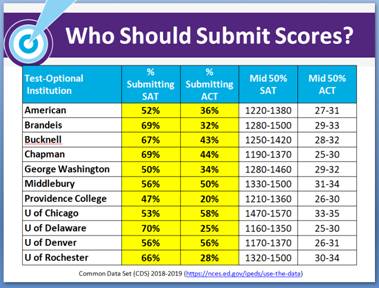
  • If students do not submit test scores, colleges will likely assume their scores are on the lower end of or below their published middle 50% score.
  • Some colleges use SAT or ACT scores to determine merit aid. Students do not want to miss the chance to receive a discount on tuition.

How do students determine if they should submit their scores at a test optional college?

Students should submit their SAT or ACT scores if the scores reflect their academic abilities. It is also helpful to know the middle 50% of scores at the schools on their college lists. Knowing how their scores compare to matriculated students at a particular college can help determine if students are more competitive applicant with or without their test scores. Students can find this information on the common data set, published by most colleges.

Many students suffer from “test score anxiety.” These students make the mistake of believing their test scores are not competitive when they are fine scores for the colleges on their list. Students who are unsure whether to submit their test scores can call the admissions offices of the colleges on their list. Admissions counselors will be more than happy to advise you on this and other aspects of their admissions process.

Will students be accepted at colleges if they don’t submit SAT or ACT scores?

They might. While admissions counselors may assume that the absence of a test score indicates a score that the applicant did not believe was competitive, the other parts of the application may be strong enough to warrant an acceptance. It always helps to have a hook, something that makes a student more attractive to a college than the general applicant pool. Examples of hooks are being a legacy, athlete, musician or full-pay student. Also, consider other strategies to enhance the likelihood of acceptance including applying early decision (if available) and affirmatively demonstrating interest in the college in a manner that will likely be tracked by the admissions office (e.g. participating in a phone interview with alumni or admissions staff, following the college on social media, etc.).

The trends and rules that normally govern college admissions are going to be very different in the upcoming admissions cycle. Given the pandemic and economic fallout, many students are likely to choose more affordable college options that are closer to home, leaving some colleges scrambling to fill their classes and others scrambling to award the amount of financial aid students are going to need. The recent move to test optional policies by many colleges and universities is likely just one of many changes we will see in admissions in the near future.


Photo of Michelle McAnaney, founder to

Michelle McAnaney is the founder of The College Spy, a full service independent educational consulting firm that assists students and families across the US and internationally with the college selection and application process. Prior to founding The College Spy, Michelle was a guidance counselor and educator for more than 15 years, including serving as the Director of Guidance at two high schools, an adjunct college professor and a GED tutor. Michelle holds a master’s degree in school counseling and a bachelor’s degree in human development. She recently completed UC Irvine’s certificate program in educational consulting and is a MBTI (Myers-Briggs Type Indicator) Certified Practitioner and a NLP (Neuro-Linguistic Programming) Master Practitioner. Michelle visits over 40 colleges each year so that she has first-hand knowledge of the colleges and universities her clients will be considering. You can find her on Facebook, Twitter, Instagram, LinkedIn and on The College Spy Podcast.

Newer Posts
Older Posts

Link for Counselors

Current Publication

View Current Publication

Advertisements

LINK Newsletter for Counselors

Sign up to receive our bi-weekly e-newsletter.