Menu Sidebar
Menu

Do Any of Your Students Have a Disability? Below are some Ideas to Help Them Settle into College.

Section 504 for College Students

http://www.smartkidswithld.org/getting-help/college-bound/section-504-for-college-students/

Things to Consider during Transition for High School Students with IEP/504 Plans

  1. Plan to apply for accommodations in college.
    1. Recognize that increased academic demands will require more academic support.
    1. Services received in high school will not automatically follow students to college.
    1. Not all accommodations granted in high school are considered reasonable in college.
    1. Students can choose not to use college accommodations; it is better to have them and not use them, than to not have them and seek them after falling behind.
  • Locate the documentation of your disability from high school to ensure that you have appropriate and updated documentation for the application process.
    • Most documents should typically be dated within three (3) years of starting college.
    • Documentation that is not current but otherwise meets College guidelines may qualify the student for one semester of provisional accommodations while the student seeks re-evaluation.
    • Parents may have to seek out and pay an outside provider for private testing.
    • It is recommended that students have information as up-to-date as possible that reflects the most recent services they were provided.
  • Find out as much as possible about the disability support services office at the colleges(s) of the student’s choice.
    • Take advantage of college tours, college presentations, etc. to find out as much information as possible about the application process and the services offered.
    • Use the college’s website to gather information about the application process, especially deadlines and documentation guidelines.
  • Complete the intake process as early as possible to ensure accommodations are in place on the first day of classes.
    • June/July for fall semester; November/December for spring semester; March/April for summer semester.
    • Students who start strong are more likely to persist in college. Having and using accommodations can contribute to college persistence.
  • Expect the first year in college to be different than high school.
    • Course grades are based more on performance and achievement as compared to the flexibility of some high school grades utilizing effort and participation.
  • Academic demands will be higher in college courses. If your college offers it, the Introduction to College/Introduction to University Life, College Success Skills type course will be helpful as it covers topics such as study skills and time management.
  • Students will be considered adults and will have adult decisions to make about class schedules, course selection, managing time, etc., and can expect adult consequences as well.
  • Prepare for an increased level of self-advocacy.
    • Learn how to communicate information about disability/diagnosis, strengths/weaknesses and functional limitations.
    • Inform the college disabilities counselor immediately if barriers/concerns arise about your accommodations.
  • Consider starting slow in the first semester/year of college.
    • Aim for a successful first semester to grow into the new environment and new role as an adult.
    • Embrace the idea that getting good grades is more important than finishing fast. For some students, taking four courses instead of five may be a way to increase chances for academic success during the first semester.
    • Resist comparisons with friends/other graduates. Remember that everyone learns differently and at a different pace!
  • Remember that a student’s progress and success in college is the student’s responsibility!
    • Under FERPA (Family Educational Rights and Privacy Act), once a student reaches the age of 18 or enters post-secondary education (i.e., college) at any age, parents no longer have the right to access the student’s records or intervene on the student’s behalf with college faculty/staff, except when given permission by the student.

College staff are awaiting the opportunity to work with students as they learn how to function independently in the college environment to achieve success!

By Kenneth McGhee, Director DC Tuition Assistance Grant Program (DCTAG) Kenneth.mcghee@dc.gov
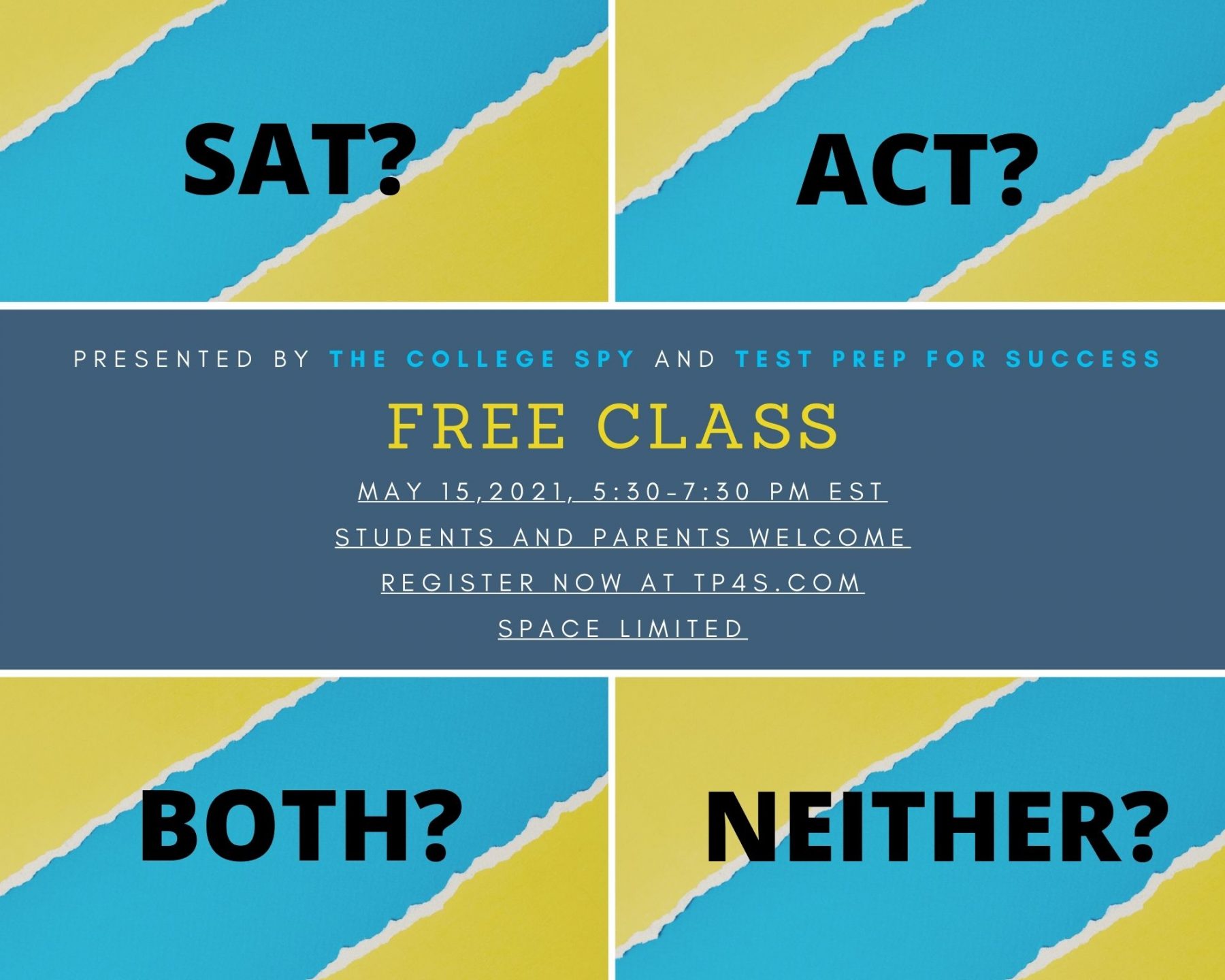
SAT/ACT Introduction Class: Learn about the differences between the SAT & ACT

Do you know the differences between the SAT and ACT and whether students should take both or not take the tests this year given the test optional trend? A free class will be offered on May 15th at 5:30-7:30 PM Eastern Time. The class is intended for parents, students and educators. 

In this class you will learn what to expect on the SAT and ACT tests, such as what topics will be covered, how much time will be given, how many questions will be asked, what the directions will be, and how the tests will be scored. The discussion will also cover overall test-taking strategies such as pacing, guessing, and coping with test anxiety.  The discussion will also include how testing fits into the greater landscape of college admissions, including the movement toward test-optional colleges.  If you are unsure as to whether you should take the SAT, ACT, both, or neither, you should definitely take this class. 

Register free here: https://tp4s.com/product/introduction-act-sat-intro/

The speakers will be Heather Krey, director of Test Prep for Success & Michelle McAnaney, owner of the College Spy

Does Crime Pay? The Varsity Blues College Admissions Scandal Says No

From the producer who brought us viral sensations like “Tiger King” and “Fyre,” director Chris Smith has turned his cinematic lens to the 2019 college admissions scandal in the new Netflix docu-drama “Operation Varsity Blues.” In between the melodrama and cliched reenactment of recorded phone conversations, however, are a few points worth discussing in the context of today’s college admissions landscape.

Authenticity Matters

While peeling back the layers of what made the Varsity Blues admissions scandal so sensational to the American public – images of rich elites going to prison, the galling entitlement exhibited by the parents, the complicity of coaches in cheating their institutions – one core element felt the most egregious: the dishonesty. Pretend to play water polo to be processed as a recruited athlete? No problem. Fake a learning disability to get more time on the SAT? Why not? What Rick Singer offered to parents and students was a game of fraud, which these families agreed to because they believed that it was the only way to gain admission to the college of their choice. And it is this flawed perspective still driving many families today, albeit on a much smaller scale, that we IECs who work in college counseling need to confront head on and actively combat.

In my work as an IEC, an Independent Educational Consultant, I’m lucky enough to work with wonderful students whose personalities run the gamut from nerdy robotics savants to head-in-the-clouds poets to nurturing outdoor leaders. My students are amazing! But they are all still susceptible to the pull of presenting a “beautified” version of themselves to colleges. Perhaps this is the zeitgeist of the Instagram-filtered times that we live in: self-presentation is increasingly manicured and manipulated, inflated and illusory – so much so that, in the extreme examples of the Varsity Blues scandal, students and parents found themselves unmoored from reality and ethics, crossing the line from “Instagram touch up” to outright fabrication.

But here is a reality check for families and students: college admissions readers are inured to this fakery. These experienced readers can smell the inflated resume and self-aggrandizement from a mile away, and it’s not appealing. Authenticity matters in college admissions, in everything from the essays to the activities list, not just because presenting yourself authentically is the moral thing to do, but also because it’s more effective. Win-Win.

Misrepresenting yourself in a college application does not “pay.” This is the message that high school guidance counselors, IECs, career coaches, test prep tutors, and all of us in the college counseling world should band together to promote!

Turn Down the Hype

Some of the most tragic elements of the Netflix documentary were the brief snapshots of high school students discussing the anxiety they feel about the college application process. That anxiety is real and pervasive, and educators need to work harder to counteract the toxic messaging that equates a college acceptance with a student’s worth. It is this fear that drives students (and parents) to take the unethical steps that were on full display in the Varsity Blues scandal. We, as counselors, must educate families about the need for honesty, for authentic representation, and discuss with more frequency how this authenticity will not only lead to better “results” (i.e. a more honest, compelling essay will be received better than a transparently padded personal hagiography), but this authenticity will also lead to less anxiety and improved mental health for our students.

There is something fundamentally freeing when you can say with conviction: “I did my best. This essay represents my hard work, my honest reflections, my curious observations about the world. And if colleges don’t accept me on the basis of that writing, well, at least I know I didn’t hold anything back.” It is liberating to experience this mindset shift, and it’s an experience that I hope more students will embrace.

To me, that is the best way to defeat the Rick Singers and the fraudsters of the elite education industry: by being authentic, by leaning in to your own unique identity, and thereby transcending the temptation of a society that suggests you need to misrepresent yourself to succeed.

Rachel Coleman is an IEC (independent education consultant) at collegeessayeditor.com and an active member of HECA (Higher Education Consultants Association) who received her certificate in College Counseling from UCLA in 2016 and her B.A. in Comparative Literature from Stanford University in 2014. The best part of her job is working with students on their writing and empowering them to be effective communicators.

Common questions asked on a job interview

As your students begin interviewing for internships and ultimately jobs they are sure to be asked many questions during their interviews. What are some of the typical questions they should prepare for? Here are some examples they can use to prepare:

Common interview questions include:

  • Can you walk us through your resume?
  • Can you tell us a little about yourself?
  • Why do you want to work for (insert firm)?
  • What have you done that has prepared you for this position?
  • Why should we hire you over someone else?
  • Where do you see your career in five years?
  • What do you like to do in your free time?
  • Can you tell us about a time you made a mistake?
  • How do you handle stress and working under pressure?
  • What are your strengths?
  • Talk about a time you worked in a group and encountered a conflict.

Practice all types of questions

There are different categories of questions that will be asked during an interview. Depending on the position, business, or industry, an interview may consist of more questions of a specific type than another.

The categories of interview questions that can be asked include:

Fit: Fit questions are asked to find out just that. Are you a good fit for the position, team, and company?

Behavioral: These are asked to gauge how you HAVE acted in certain situations or how you WOULD act in certain situations.

Technical: Questions of this type revolve around technical knowledge and capabilities related to the position.

  • Examples can include questions on how the financial statements tie together, how to value a company, how to perform a discounted cash flow, etc. Technical questions are notoriously tough.

Case Study: Case study interview questions involve questions asked after a case is laid out in front of you verbally or through a written document. The interviewers will ask you questions related to the case and this will test your analytical and problem-solving abilities.

Firm/Industry Specific: Interviewers will ask questions specifically about the firm or the industry it is in. This tests what you know about the company and industry and also gives a gauge to the interviewers about how strongly you want the position. If you wanted it bad enough, you would do your research.

Current Events: These questions test how in touch you are with what is going on in the news and if you actually understand what is going on.

  • Interviewers will ask a basic question and drill deeper with follow-up questions on the underlying concept the news event is on.

Looking for more information about what to expect in the interview and the entire interview process? Here is a link to a guide put together by Bizness Professionals that should be of interest: How to Prepare, Practice and Study for an Interview: The Ultimate Guide

Varsity Blues scandal – two years later

On March 17th Netflix released  Operation Varsity Blues: The College Admissions Scandal, a documentary about the bribery scandal from 2019.

It’s a powerful film that shows the ugly underbelly of what happened to the college admissions process. It features reporters, independent educational consultants and the sailing coach from Stanford who pleaded guilty. Since William “Rick ” Singer, the kingpin coordinator of the bribery scandal agreed to plead guilty and share information with law enforcement officials, the documentary has the original taped conversations between Singer and his unknowing clients.

The Netflix film takes a deep dive into the 2019 college admissions scandal, dubbed “Operation Varsity Blues,” involving a criminal conspiracy to influence undergraduate admissions decisions at several prestigious American universities. The scandal led to more than 50 high-profile arrest, including actresses Lori Loughlin and Felicity Huffman. The conspiracy was arranged by Singer, who claimed to be an educational consultant and used millions of dollars from wealthy parents of college applicants to fraudulently inflate entrance exam test scores as well as bribe college coaches and administrators.

The Independent Educational Consultants Association (IECA), of which I’m a professional member, has been the leading voice in putting students first in the college admissions journey. commends its members for their continued commitment to the highest standards in ethical college advising, while at the same time calling for greater transparency in the college application process.

According to IECA, while the Varsity Blues scandal exposed the specific efforts of wealthy, privileged parents to ensure their children’s admission into the national’s top colleges, it brought to light broader problems in the college application process:

  •             Access to college advising in high school is unequal across the country, and particularly strained in urban and rural public high schools, where the average student-to-counselor ratio is 455:1 and more than 700:1 in some areas. This leaves school counselors overburdened and students under-resourced.
  •              Colleges have become increasingly opaque in their admission criteria.
  •              College acceptance rates continue to decline, partly due to the increase in applications, leading to heightened anxiety levels among students and parents
  •               Sophisticated modeling means computers play an outsized role in college admissions, minimizing the personal stories of students and admissions counselors

Lessons Learned, according to IECA

What have we learned over the last two years?

  • there is an unjustified need that many families feel to attend a “name-brand” college
  • there continues to be an unhealthy over-involvement of parents in the process
  • there is a lack of clarity about how admissions offices decide who gets in, who gets wait-listed and who gets rejected

What changes have been implemented?

  • This scandal has led to reforms in some admissions offices, including some colleges that now require more information and a closer scrutiny of athletic recruits
  • There have also been reforms in athletic recruitment to guarantee a student admitted as an athlete deserves that designation.

What additional changes are needed?

  • The focus must shift from thinking “it’s all about getting into the most exclusive school that will take me” to “finding the college that best fits my learning, social financial and community needs.”
  • Colleges need to assure that multiple individuals are needed to sign-off on a special circustance admission.
  • Colleges need to better explain how their admission process works and the type of students would be most successful at their school.
  • Students and parents must look toward best fit rather than biggest name – it’s about getting OUT successfully, not about getting in!

Lee Bierer is an independent college adviser based in Charlotte. Send questions to: lee@collegeadmissionsstrategies.comwww.collegeadmissionsstrategies.com

PS – TUNE IN TO HEAR MORE ABOUT THIS TOPIC.

I’M A GUEST ON NPR AFFILIATE WFAE (90.7 – WWW.WFAE.ORG) CHARLOTTE TALKS WITH MIKE COLLINS, ON THURSDAY MARCH 18TH (9-10AM) WHERE I’LL BE JOINED BY LIZ WILLEN OF THE HECHINGER REPORT TO DISCUSS EDUCATION EQUITY AND HOW COLLEGE ADMISSIONS HAVE BEEN IMPACTED BY THE OPERATION VARSITY BLUES SCANDAL AS WELL AS COVID. 

If you can’t tune in live, it is rebroadcast every evening at 9pm and you can always go to www.wfae.org  and listen on their archives.

Insight into the U.S. News Best College Rankings

Many of your students use the U.S. News & World Reports Best College Rankings each year to decide which Colleges to apply to. How are these rankings determined and what criteria goes into creating them?

Summer Discovery and U.S. News & World Report will host a webinar that answers these questions.

U.S. News Education Managing Editor Anita Narayan will guide students and parents in a discussion about the college rankings and how they can inform a student’s college choice.
What You’ll Learn:

  • What factors are used in the U.S. News Best College rankings
  • Why U.S. News started ranking colleges and developing “Best” lists
  • How prospective students and parents can use the rankings to help narrow college lists 
  • Firsthand advice about the college selection process
  • How pre-college summer programs can help guide your college selection process

The event will take place on Wednesday, April 7, 2021,  3:00 PM EST | 12:00 PM PST so mark your calendars now.

Here is a link to register for this free webinar – https://register.gotowebinar.com/register/2302586669245106960?source=LINK

12 Tips for Parents and Their Teenage Drivers

Put down the phone  —  Up to 11 percent of drivers age 19 and younger who were involved in fatal accidents were distracted. Talking and texting while driving substantially increases the risk of injuries and fatalities.

Reduce speed  —  Teens often drive over the speed limit or too fast for weather or road conditions, which can be caused by their impulsiveness or poor judgment. Over one-third of male drivers between the ages of 15-20 were speeding immediately before their fatal accident.

Don’t mix drinking with driving  —  Thankfully young drivers are less likely than adults to drive after they have consumed alcohol. However, when they do drink and drive, their risk of a crash is much higher because the effects of alcohol combined with their inexperienced driving skills is a recipe for disaster.

Be prepared  —  Make sure your teen is prepared for an emergency. Pack an emergency kit that includes items such as a flashlight, jumper cables, a first aid kit, water, and non-perishable snacks.

Limit driving at night  —  There is a reason GDL programs restrict teen driving at night. During 2017, 17 percent of teenage fatalities on the road occurred during the hours of 9 pm and midnight, and nearly a quarter occurred between midnight and 6 am.

Be mindful of weather conditions  —  Teen drivers are inexperienced at handling roads impacted by weather conditions. It is imperative to teach them how to drive in poor weather confidently. You might want to look into a driving school that can help them with safety and car control techniques, such as what to do if they are hydroplaning. It is better to get this practice with an experienced driver in the car before going out on their own.

Limit the number of passengers  —  Each passenger adds to the risk of a fatal crash. With three or more passengers, the risk climbs to four times as much compared to the driver being alone. Numerous studies reveal that teens who have passengers in their vehicles are much more likely to partake in risky driving and become distracted. These factors will multiply the dangers.

Select the right vehicle  —  It’s tempting to buy an inexpensive older car for your teen or to provide them with a hand-me-down that has seen its fair share of miles. From a financial standpoint, this might initially make sense. However, these cars are not likely to have advanced safety features like electronic stability control or side-curtain airbags. Keep your teen safer by selecting the right vehicle after doing your research.

Put rules in place  —  Your teen will need to abide by California driving laws and the restrictions of the GDL program, but you should also but your own rules in place. Spell out the penalties if they break the rules and put everything in a contract. If necessary, take their keys away.

Minimize the distractions  —  Drivers on the road today face more distractions than any drivers that have come before. This can make driving challenging for beginners. Older generations may have only needed to worry about changing the radio station or talking with passengers, while today’s teen drivers are also tempted by distractions on their phone, touchscreen and GPS controls in the console, and even DVDs and video games being played by passengers. Teens need to know that their safety and the safety of those around them relies on being a focused driver.

Click your seat belt  —  The NHTSA reports that 60 percent of fatalities of people under the age of 20 from car accidents were unrestrained at the time of their accident. Wearing a seatbelt is a simple way to reduce injuries and fatalities should an accident occur.

Be prepared  —  Like all other drivers, your teen’s driving career will be filled with the unexpected. The best thing you can do is to ensure they are prepared for these events. Make sure they know what to do if their car breaks down or they are in an accident. Pack their vehicle with an emergency supply kit and even an atlas in case they cannot access the GPS on their phone.

In 2017 alone, 2,364 teenagers in America between 16 and 19 years of age were killed in car crashes, while approximately 3,000 were treated in emergency rooms for injuries caused by car accidents. This averages to about six teens between the ages of 16-19 dying every day as a result of motor vehicle crashes in addition to hundreds of daily injuries.

People ages 15-19 accounted for 6.5 percent of the United States population in 2017. However, this same age group caused $13.1 billion or nearly 8 percent of the total cost of motor vehicle injuries in the same year due to fatal and non-fatal accidents. 

Arash Law has put together the Ultimate Teen Driving Safety Guide. Here is a link: https://arashlaw.com/the-ultimate-teen-driving-safety-guide/

Let’s Talk About the New Common App Prompt?

What do you think about the new prompt on the Common App?

Reflect on something that someone has done for you that has made you happy or thankful in a surprising way. How has this gratitude affected or motivated you?

We’ve been getting lots of inquiries about the new prompt – and having great conversations.

I was talking recently with an admissions director at one of the Ivies, who called the multi-pronged prompt a trap. “It will be hard to answer the whole question authentically.”

A senior admissions rep at a prestigious public university told me she loved the prompt because it was so positive. “But I want to read about the student, not someone else or someone who did something for them.”

And a counselor enrolled in our current College Essay Experience training program described this prompt as an invitation to write about Grandma. “It’s problematic. And because of how it’s worded, there are too many things students are supposed to do in one essay.”

What do we think?  We’re still figuring that out.

But, to be honest, I don’t think it matters much what we think of any prompt.

Colleges don’t care which prompt a student selects on the Common App. But they do want them to pick a prompt that speaks to them, not one that speaks to me, or to any other adult who loves them. Our job, and yours, is simply to help students understand what the prompts mean and let them choose the prompt that they like (without any judgement over their choice).

Here’s our take on Common App Prompt #4:

This prompt is more complex than some of the others. On the surface, it seems to be asking about a time you felt gratitude. But it’s not quite so simple. This prompt is both reflective and very specific. The key words here are reflect, surprising, gratitude, affected and motivated.

Prompt 4 invites you to reflect on someone else’s kindness, but the story you tell should not be primarily about the other person’s act.  It should be about how this experience affected you. What did you do as a result?

And the prompt doesn’t ask you to share just any act of kindness. Readers want to know about something someone did for you that made you happy or thankful in a surprising way. Maybe the other person surprised you with their kindness, or maybe you were surprised that you felt so grateful or happy. Or maybe the surprise came through in some other way. 

If you can identify a specific story that focuses on you, showcases a characteristic or trait that demonstrates who you are, fits these criteria, and also explains how your gratitude affected or motivated you to do something, this prompt might be for you.  

I hope this gives you some insight. What are your thoughts about this prompt? We’d love to hear them!

Kim Lifton is President and Co-founder of Wow Writing Workshop, which teaches students and educational professionals a simple, step-by-step process for writing effective college essays so students can stand out and tell their stories. Since 2009, Wow has been leading the college admissions industry with our unique approach to communicating messages effectively through application essays, including personal statements, activity and short answer essays and supplements.  We teach students – and we train professionals. Kim leads a team of writers and teachers who understand the writing process inside and out. She can be reached at Kim@wowwritingworkshop.com

Join us next month, April 14, for a free chat about How to run a group workshop.


Sign up for our monthly Pro Chat: How to Run a Group Workshop, with Wow CEO Susan Knoppow on Wednesday, April 14, at 1:00 p.m. Eastern. And if you can’t join us live, sign up anyway; we’ll send you the recording.

Let your students know we have a free class for them, too!

If you wants to help students with the basics, encourage them to sign up for our monthly free student class, or listen to the recording. Next up: Wednesday, April 14, Wow Writing Workshop at 7 p.m. ET! You are welcome to sign up, too.

LINK for Counselors 2021/2022 media kit was just released

LINK for Counselors is distributed free to Counselors. We never charge you for any of our content. This is made possible by our advertisers who invest in their advertising to let you know about their school or specific product that may be of interest to you. It has worked for many of them who tell us they get great feedback from Counselors through our Signet Research and Paramount Research studies that are conducted each year.

There are many options available including print advertising, e-newsletter advertising, banner advertising on linkforcounselors.com, sponsorship of our college night handouts and targeted e-blasts.

If you have any Colleges you work with that might be interested in reaching Counselors throughout the country please share this link with them. Our new media kit outlines our print and digital opportunities. Here is a link to it – https://www.linkforcounselors.com/wp-content/uploads/2021/03/2021-2021-LINK-for-Counselors-Media-Kit.pdf

Financial Aid Award Letters – 8 Things to Consider

1. Expected Family Contribution (EFC)

After successfully completing the Free Application for Federal Student Aid (FAFSA), you will be provided a Student Aid Report (SAR). On the SAR is a number called the Expected Family Contribution (EFC). 

The EFC is the number that determines your eligibility for Federal Student Aid (FSA) from your FAFSA results and many private scholarship organizations also use it to assist in making award decisions. Your EFC will be the same at all the colleges that offer you financial aid.

2. Federal Pell Grant

This is an award of federal funds based on your EFC. It is a grant and grants do not have to be repaid. The Pell Grant offered will be the same at all colleges that offer you financial aid.  Not all students will qualify for a Federal Pell Grant.

3. Federal Supplemental Educational Opportunity Grant (SEOG)

By completing the FAFSA you will also be considered for SEOG funding; This grant is given to students with the greatest financial need. To receive this grant, you must be eligible for the Federal Pell Grant. It does not have to be repaid.  Applying for financial aid early is recommended to give your application the most consideration. Funding is limited.

4.  Loans – all loans must be repaid. This is the case for Federal and private student loans.

Some colleges heavily rely upon parents borrowing from the Parent PLUS loan and private student loans. This may be the case regardless of a student’s strong academic background. 

5. Institutional Scholarships

A college may offer you a scholarship from institutional funds, which are funds that the college/university controls. Scholarships do not have to be repaid. Institutional Scholarships are not offered by all colleges. Some colleges will only offer most students Federal Student Aid (FSA) based upon your FAFSA results.  

6. Federal Work Study

Federal Work Study (FWS) allows students to work up to 20 hours a week mainly on campus with some limited off campus options. Each school has a different amount of money available for eligible students.

7. Outside Scholarships

Depending upon the timing of your award offer, scholarships you earned from outside sources may not be listed on the college’s award letter. Outside scholarships can impact the college’s current scholarship offer.

8. Requesting More Financial Aid  

Some colleges may be able to award you additional financial aid based upon your specific situation, but it should not be assumed that all schools have the funding to meet your request. Ask the college which office handles scholarships and inquire at those offices. Examples of college offices that may be involved are the Admissions Office, the Financial Aid Office, and the academic department for your major field of study.

By Kenneth McGhee, Director DC Tuition Assistance Grant Program (DCTAG) Kenneth.mcghee@dc.gov

Newer Posts
Older Posts

Link for Counselors

Current Publication

View Current Publication

Advertisements

LINK Newsletter for Counselors

Sign up to receive our bi-weekly e-newsletter.