Menu Sidebar
Menu

What if instead of taking the SAT or ACT test your students could play an interactive video game?

If it’s up to one company it could happen! A newly published piece by Bloomberg Business News about Rebecca Kantar, explains how the paradigm shift away from the traditional screening methods of candidates using outdated multiple-choice standardized tests, to a revolutionary and much more comprehensive game-based simulation testing scenario which more accurately assesses one’s critical-thinking ability is vitally important.

Kantar is the founder of Imbellus Inc., a startup in Los Angeles that aims to reinvent testing and, in the process, challenge the received wisdom about what students are expected to learn. The digital assessments Imbellus has developed resemble video games. Placing users in a simulated natural environment, they present test takers with a series of tasks, all the while capturing the decision-making process used to complete them. And because each simulation delivers a unique user experience, they’re intended to be cheatproof.

“The nature of human intelligence required in even the most elite jobs is very different than what it was 30 years ago. If you look at any job across the spectrum, whether it’s a blue-collar job or a white-collar job, the thinking skills involved are getting harder, not easier,”

Here is a link to the article : https://www.bloomberg.com/news/features/2019-03-19/a-harvard-dropout-s-plan-to-fix-college-admissions-with-video-games

I got into 39 colleges without cheating: What applying to schools looks like in 2019

Jordan Nixon has received 39 college acceptance letters so far, all without celebrity parents or $500,000 bribes. It just took years of planning, a private college adviser, 50-plus applications and the unwavering support of family.

“I don’t have money like the celebrity parents,” said Angelia Nixon, mother of the 17-year-old senior near Atlanta. “There were no bribes going into this.”

As the nation’s largest-ever college admissions scandal surfaces this week, with celebrity parents and rich CEOs accused of cheating to get their children into prestigious schools, the Nixons are navigating college admissions like the rest of us. But they’ve found extraordinary success, discovering how the journey to college remains daunting – yet possible – in 2019.

For the Nixons, the multi-year process entailed early college visits, regular check-ins with her adviser, ACT and SAT prep, careful budgeting and essay after essay after essay. The result? Schools from across the nation welcoming Jordan and $1.6 million in scholarship offers.

Jordan has always been a “high achiever,” her mom says. She won elementary school spelling bees as a child and her poetry ran in Highlights for Children. The mom knew if she invested in her daughter’s process early, she’d see results. 

The college tours began during Jordan’s sophomore year. Angelia Nixon talked to admissions advisers and filled out info cards. They made a broad list of schools. Jordan set sights on a major – international business.

The private college adviser began her junior year. That’s when things really picked up.

Jordan worked with Cynthia DeBerry Flowers, of Atlanta-based CollegeForSure, on every aspect of the college application process. Jordan’s mother wanted her to receive more attention than her school district was able to provide, so they looked into hiring a coach – an uncommon move in their district.

Private college advisers the Nixons reviewed ran from $3,000 to $9,000 for total services, the mother said. Angelia Nixon, an insurance broker, and Jordan’s father – Arthur Nixon Jr., a police investigator – ended up paying somewhere in between, she said.

DeBerry Flowers touched base about two or three times a week, Jordan recalled. They did resume prep. They set SAT and ACT goals. They worked on essays. Oh, the essays.

 “I didn’t realize how important essays were until the moment I had to do more than 20,” Jordan said.

Jordan wrote at the kitchen table, laptop open, her parents editing over dinner. A calendar on the wall listed every school application date and whether Jordan would apply for early action – an option that gives students an early heads-up on acceptance.

Jordan and her adviser firmed up her list of schools. A process of elimination began, looking at U.S. News and Forbes rankings, activities offered, graduation rates. The college application frenzy peaked in October and November.

 “Stressful, to say the least,” Jordan said

Some applications cost as much as $80, Angelia Nixon said. When college fairs offered free applications, they filled out every one. They also used the Common Application and the Common Black College Application, both of which let students apply to tens of schools at once.

“So much easier,” Jordan said.

The ease of the all-at-once platforms let Jordan apply for 68 schools, her mother said, plus another three from college fairs and elsewhere.

Jordan’s senior year unfolded. She stayed busy with extracurriculars – cheering co-captain, a leadership academy – as the acceptance letters landed. The first, Grambling State University, in July 2018. The most recent, Xavier University, arrived this month.

Jordan has until May 1 to make a decision. “I’m definitely still in the process,” she said.

Here are three pointers on the application process, from Jordan’s family and expert advisers:

Apply to the best fit, not the best school

“Here’s the thing: It’s a very, very competitive process,” said Lisa Guss, an independent college counselor and co-author of “The Essential College Admissions Handbook.” She tells her clients this: The best schools may not be the best schools for you. 

Ivy League schools may require applicants to have “everything and then some,” but the majority of colleges just want a student to show growth. That could mean tackling more rigorous course loads each year or zeroing in on extracurriculars over time that show deeper involvement in a specific area or cause.

Those less stringent schools that embrace a student’s growth may often be the better fit.

“I try to encourage my clients to find a school that just makes them happy, where they feel good about themselves,” Guss said, adding, “When we find a place we feel we fit in, I think we excel.”

Touch base beyond the application

All-in-one platforms like the Common Application let students apply for multiple schools at once. And that means way larger applicant pools for many schools, said Shari Kramer, a college consultant who co-authored “The Essential College Admissions Handbook” with Guss.

“There are so many talented students competing for the same spots in the freshman class,” Kramer said. “The pressure mounts for students to differentiate themselves in some way.”

One way a student can differentiate is by showing interest outside the application process, Guss said, which many colleges track as “demonstrated interest.” That could look like a campus visit, a personal email or even opening an email from a school – an act many schools see and note. 

Partner with teachers and your child

Deep partnerships with schools and teachers proved critical for Jordan’s success, her mom said. 

“Know what your child is doing within the classroom, their strengths and weaknesses,” Angelia Nixon said. “If you know they’re weak in math, get tutoring and help for them to strengthen their scores for their standardized college tests.”

Open communication with Jordan about her schooling also proved critical, she said, letting her know – and advocate for – her child better.

“You will not be able to tell people anything about your child unless you know who your child really is,” she said, adding, “If you get to know your child as a person and not just a child, you see them from a different point of view, as an adult.”

This is a great example of how a student who sets their mind to getting into their school of choice can do it! It is from USA Today

You can follow the writer on Twitter @joshhafner

10 Tips for your students that don’t have Wealthy Parents to help them get into an Elite College

There’s no need to obsess over attending an elite school like the families named in the college admissions scandal

The college admissions scandal has exposed the extreme lengths some wealthy families will go to secure a spot for their child at their dream college.

It’s possible to find and stay in a college with life-changing potential, even without exponential resources. Indeed, the schools that educate the bulk of American college students get a small fraction of the attention and aren’t nearly as selective as the colleges caught up in the alleged bribery scheme.

Here are a few tips to finding and staying in a school that’s right for you:

1. Don’t obsess over prestige

“Stop worrying about getting into one of those elite institutions that less than 1% of students go to,” said Elizabeth Morgan, the director of external relations at the National College Access Network, a membership group for organizations working on college access, cautions against obsessing over achieving those qualities.

The difference in post-graduation earnings between students who attend a state public flagship college and students who attend a more elite college isn’t much, said Doug Webber, a professor at Temple University who studies the economics of higher education. Students who attend elite colleges often make more money, but that’s at least partly due to connections they made before they ever became freshmen, he said.

2. Always pay attention to graduation rates

Many of the colleges educating the bulk of American students lack resources, which can make it difficult for students to get through school. You may fall foul to the same lack of support that drove previous students out of college before graduation. “Completion matters,” he said.

3. Do what you can to improve, but feel confident

Though Morgan advises against padding your résumé or obsessing over test scores, there are some free resources students can use to improve their applications. For example, you can take practice standardized tests at these sites for free: Click here for the SAT and click here for the ACT. Morgan also advises students to be confident in their preparation. “You have a lot to offer,” she said.

4. Fill out the FAFSA as soon as possible

Students who don’t have unlimited resources to pay for college should fill out the Free Application for Federal Student Aid, which opens each year on Oct. 1, as early as possible, said Faith Sandler, the executive director of the Scholarship Foundation of St. Louis, which works with low-income students applying to and attending college. That way, they can at least identify themselves as someone who could qualify for aid from their school, she said.

5. Apply to a range of schools

Sandler also recommends students apply to a range of schools. She also advises students who might have financial constraints to avoid applying to a college through its early decision or early action program. “To be preemptively deciding that one school is the one and only school is really dangerous for students who don’t have an open checkbook,” Sandler said.

A good list should include at least three or four schools with a range in selectivity, Morgan said. Though these schools may measure up differently on various metrics, Sandler cautions against using phrasing like “safety” or “fall back” when characterizing schools on the list. That way, students can feel empowered to make a decision about which college is best for them based on a variety of factors.

“Students should be applying to schools that they would be proud to attend and that they think are good fits for them,” she said, instead of “viewing from the get-go that any of those choices are potentially of lesser quality no matter what set of rankings they’re looking at.”

6. Look beyond the sticker price

College pricing isn’t always transparent, so students should rid themselves of that assumption, experts say. As a general rule, public colleges are going to be the most affordable options for students. But in some cases, private colleges that seem expensive may offer generous financial-aid packages to low-income students.

In other words, know the difference between the sticker price and the actual price, Sandler said. Students who want to see how much they might actually pay to attend a given college can consult the school’s net-price calculator, which provides an estimated price for a school based on a student’s income and other information.

7. Remove rumors from your mind

Sandler says she frequently hears from students reporting a piece of dubious, third-hand information about the college process. “Discount or, at least, verify advice people give you who are not professionals in this field,” Sandler said. That advice is likely even more important in the current environment where headlines continue to swirl surrounding the opaque college admissions process.

8. Don’t panic once you get there

Often when students first arrive at college it can be tough to adjust to the academic, social and financial expectations. If students find themselves struggling, “The worst thing at that point is to freak out and beat up on yourself,” Sandler said. “The best thing is to figure what resources exist and take advantage of them,” she said.

9. Free resources that may help students get started

Big Future is a site from The College Board that can provide students with a guide of sorts on how to apply to college, Morgan said. Get Schooled is a site with free information on applying to and paying for college that also has a free text help line, he added. Bottom line: The more research you do in the months and years leading up to college, the better.

10. Find the right fit for your lifestyle

Once students have been admitted to college, they should weigh a variety of factors when considering their options — not just prestige — experts say. That may mean choosing a school that has affordable child care nearby or is close (or far away from) home or has a particular suite of professors in the field you plan to study.

Roughly 70% of bachelor’s degree recipients graduate with student debt, so avoid taking on too many student loans. Financial-aid consultant Mark Kantrowitz advises students against borrowing more then they expect to make during their first year out of school. That will help avoid unnecessary anxiety and the need to work too many extra hours on top of your school work.

This blog was published on Market Watch.

They offer a daily roundup of the top reads in personal finance delivered to your inbox. Subscribe free to MarketWatch’s Personal Finance Daily newsletter. You can Sign up here.

College Admission Scandal: Symptom of a Larger Problem

The college admission scandal that saturated the press this week made me think of a disturbing anecdote, which I heard last month, that blew my mind.

I want to emphasize that shocking me is tough to do since covering the higher-ed industry – and it is very much an industry – has made me quite cynical and disgusted about how the college admission process works.

College admissions is clearly rigged in favor of the rich and powerful against everybody else.

My conversation was with a mom, who runs in extremely elite circles. She told me about a friend of hers who was desperate to get her oldest child into a private high school in California that is known as a pipeline for elite universities.

When the private high school rejected the teenager’s application, the mom and dad tried something different. Through an intermediary, the parents offered to donate $5 million to the school.

Bingo!!

Two hours after the offer was made, the teenager received an acceptance. (In case you’re wondering, the parents didn’t even try to bribe at a lower amount!)

College Admissions and the Wealthy

Extremely rich parents don’t need to play by the rules and I’m not just talking about lawbreakers!

Sadly, too many of these parents see their self-worth linked tightly to their own children’s success. And they define success in quite cramped and pathetic terms: the wow factor of the college sweatshirt that their kids will be wearing when the college hunt is finished.

Here are some thoughts on this problem:

Colleges favor students born on third base.

No admission directors were implicated in the schemes. College coaches were the ones who got caught. That said, admission directors do favor the wealthy and privileged.

An eye-opening 2017 article in The New York times documented this favoritism.

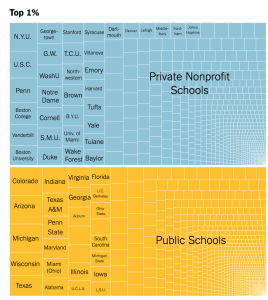
The article discovered that 38 elite schools, including some caught up in the current scandal, have more students enrolled from the top one percent of the income scale than from the entire bottom 60 percent.

If you check out the article, you can type in the name of any state or private college and see how many one percenters attend any institution that interests you.

Here is a screenshot that show the schools that attract the most one percenters:

Here is something else the The New York Times discovered:

Roughly one in four of the students in households with the top 0.1 percent of income attend an elite college – universities that typically cluster toward the top of annual U.S. News & World Report rankings.

In contrast, less than one-half of one percent of children from the bottom fifth of American families attend an elite college; less than half attend any college at all.

The allure of full pays.

People gripe about affirmative action, but affirmative action overwhelmingly favors rich teenagers. You don’t have to be as accomplished if mom and dad makes a lot of money.

Schools love to attract what they call “full pay” (I.e. rich) students. Most colleges must give these children merit scholarships to attend their schools, but the most elite don’t.

These schools aren’t dummies – they know that parents are desperate to get their kids into the U.S. News’ darlings and they will pay any price.

The super rich can start at the development office.

A book published back in 2006, and still very much relevant, captured many ways rich students are treated preferentially. He revealed, for instance, that some wealthy parents simply start the admission process by heading to the development office with promises of a hefty donation.

You may want to check it out:

The Price of Admission: How America’s Ruling Class Buys Its Way into Elite Colleges–and who Gets Left Outside the Gates

The author is Dan Golden, a journalist who won a Pulitizer Prize on the subject for The Wall Street Journal.

In a recent article in the Washington Post, Golden remarked that some rich parents treated his book as a how-to-guide to game the college admission system!

News articles since the current scandal broke suggests that the donation required for an easy admission at some elite schools has risen. A $10 million donation might not be a guarantee at some elite schools.

The thirst for prestige is insatiable.

Harvard and a few others could charge $1 million a year for tuition and they would still turn away most applicants.

Test-optional practices favor affluent families.

When colleges roll out test-optional policies, they like to emphasize that this will boost the diversity of their campuses.

That’s because SAT and ACT scores are highly correlated with income. Teenagers with a household income of $200,000, for instance, will, on average, have higher test scores than students whose parents make $150,000 and on down the income ladder.

Peer-reviewed research by my friend Andrew Belasco, the CEO of College Transition, however, suggests that colleges tend to be no more diverse than before they roll out their test-optional policies.

The practice, however, does benefit colleges by increasing applications and boosting published test scores. The practice also favors high-income students, who can pay full price while keeping their mediocre test scores private.

There is a reason why schools inquire about parents.

Ever wonder why the Common Application wants to know the identity of the parents’ occupation and the colleges they are attended?

A parent who got an MBA at Harvard University and is now a venture capitalist is going to be more attractive to a school than a parent who got an associate degree and is a dental hygienist.

And schools can discriminate against those who need help. Parents are understandably freaked out by a question on the Common Aopplication that asks if the family intends to apply for financial aid.

No school would admit that answering yes to the aid question will jeopardize admission chances, but it certainly happens.

Don’t expect anything positive to happen.

Some people are hoping that this scandal will encourage schools to examine their practices that are so heavily weighted towards helping those who don’t need it.

In an article in The Chronicle of Higher Education, Todd Rinehart, the vice chancellor for enrollment at the University of Denver, said that after the scandal broke he was encouraged to see many of his peers double down on their promises to examine and remove barriers to low-income students.

I wish I could be encouraged, but I’m not.

The wealthiest universities in the country that could end legacy admissions and accept more “normal” students haven’t done it.

These institutions have always catered to the powerful and the wealthy. Despite what they say, it’s their mission.

Stop stressing!

Rich parents need to stop thinking that they have failed as a parent if their children don’t attend an elite research university.

Conveying this attitude towards a child, even if it’s unspoken, is toxic. And, yes, heart breaking.

This, by the way,  is only a preoccupation of parents from very affluent communities.

Learn more…

If you want to learn more about this topic, The Chronicle of Higher Education has gathered what its staff has written in a special report. Some of it is only for subscribers, but a lot is available to anyone.

Admission Through the Side Door

Fight Back!

Okay, so you don’t have millions to get the attention of some Harvard big-wig. Big deal.

Lynn O’Shaughnessy is a nationally recognized higher education expert and financial journalist, who helps high school counselors and parents of teenagers understand how families can find good schools and cut college costs. Lynn, a former Los Angeles Times reporter, shares her knowledge through her blog (TheCollegeSolution.com), her Amazon bestseller (The College Solution) and her online course for parents and counselors (The College Cost Lab). 

You can sign up here for her newsletter and receive a free guide on finding generous colleges. 

Admissions Officers Share Essay Writing tips for Your Students

Last fall, during the National Association of College Admission Annual Meeting in Salt Lake City, Duke University Dean of Admissions Christoph Guttentag told me he would like students to answer questions, rather than write beautiful prose in a college admissions essay. He and I had been chatting about all the misinformation on the Internet, inside the schools and elsewhere about the essay when he shared this insight.

After I told him I was a journalist before starting this company, he shared that he has an ongoing disagreement with his wife (also a journalist) about the college essay. She thinks college admissions essays should resemble gorgeous prose; Guttentag just wants the students to write the essays themselves – and show some reflection.

“Students are often so focused on writing beautiful pieces of prose that they fail to answer the question and do not write authentic, meaningful personal statements,” he said. “The hook gets in the way; the writing gets in the way.”

I like to talk to college admissions officers like Guttentag to get insight into the essay and its role inside the complex and competitive admissions field. Over the years, I have discovered that whether they work at large, small, public, private or Ivy schools, admissions representatives want the same thing, no matter how they use them. They want reflective stories written by the student, in the voice of a 17-year-old student.

You already know that colleges use essays to find out if a student is compatible with the educational environment on their campus. But it goes deeper than that. They want to know how a student thinks, what they’ve learned, how they’ve grown. Will they add value to the campus? Will they fit in? The essay provides admissions with additional insight to help them make admissions decision.

Your job is to let your students know they should write college essays that colleges will want to read to help them make an impression on their reader.

Here are some more tips direct from college admissions offices throughout the U.S.

HEATH EINSTEIN, DEAN OF ADMISSION, TEXAS CHRISTIAN UNIVERSITY

Don’t get hung up on the right topic. Most 17-year-olds haven’t scaled Kilimanjaro, so don’t worry about finding an angle that hasn’t been tried before. Write about what you know. If the most meaningful experience to you has been serving as a camp counselor, it doesn’t matter that other students have addressed it. People will try to talk you out of certain ideas, but trust your gut. Ultimately, be yourself, and that will be good enough.”

TAMARA SILER, SENIOR ASSOCIATE DIRECTOR OF ADMISSION & COORDINATOR OF MINORITY RECRUITMENT, RICE UNIVERSITY

“Sometimes an essay can be the conduit for a student to reveal something to the admission committee that we would never have thought to ask. In terms of selective admission, personal statements are very important in adding needed texture to an application file. Quantitative factors such as transcripts and test scores only tell part of the story; a personal statement can provide context and truly show why a certain student is a better match than other clearly capable applicants.”

CHANDRA MITCHELL, INTERIM DIRECTOR OF FRESHMAN AND INTERNATIONAL ADMISSIONS, UNIVERSITY OF FLORIDA

Admissions is competitive. Having a strong essay that stands out is important. Tell a story from your life, and demonstrate your character. It is your story, and we want you to speak in your own voice. Make it unique to you. If you want to impress us with content, you don’t have to use big words.”

SHAWN FELTON, DIRECTOR OF UNDERGRADUATE ADMISSIONS, CORNELL UNIVERSITY

“What are we looking for? We are creating a class.  We look at numbers, grades and test scores. But there’s more to it. We are trying to put a face with all of this information.”

GREGORY SNEED, VICE PRESIDENT FOR ENROLLMENT MANAGEMENT, DENISON UNIVERSITY

“Even after reviewing a mediocre transcript or seeing a limited activities list, I can be swayed to admit a student who writes an essay who really blows me away. The topic of the essay doesn’t need to be mind-blowing (in fact, the most mundane topics are often the most relatable and enjoyable), but if it reveals someone who would be highly valued in our campus community, that could tip the scales.”

LEONARD SATTERWHITE, SENIOR ASSOCIATE DEAN OF ADMISSIONS, WASHINGTON & LEE UNIVERSITY

“How authentic is the voice in the writing? What issues does the student tackle in the essay? Is the writing memorable, and does it illuminate vividly the student’s personality, perspective and/ or background? Does the writing reveal deep intellect and the potential to be an academic leader at W&L?”

JAN DEIKE, VANDERBILT UNIVERSITY, ASSISTANT DIRECTOR OF ADMISSIONS

“Sometimes students feel that because they haven’t found the cure for cancer, they have nothing to share.  Life is truly lived in the smaller moments, and that can be a powerful essay.”

ROBERT SPRINGALL, VICE PRESIDENT FOR ENROLLMENT MANAGEMENT, MUHLENBERG UNIVERSITY

“At Muhlenberg, we use the essay to get a better sense of the person behind the application. For strong students, it helps us gauge potential fit with one of our honors programs and eligibility for scholarships. For candidates in the middle of the applicant pool, the essay can help us form better impressions of an applicant’s potential to excel at Muhlenberg.”

KIM BRYANT, UNIVERSITY OF MICHIGAN, ASSISTANT DIRECTOR OF ADMISSIONS

“This is your interview. Let me know who you really are.”

Kim Lifton, a 2018 Top Voice in Education, LinkedIn, is President of Wow. We are a team of professional writers and teachers who understand the writing process inside and out. The Wow Method has been used by students to write application essays and resumes; by business owners to create blogs, websites and other communication materials; and by English teachers to improve student writing skills. We can even help you write a great poem or short story. If it involves words, we can help!Email your questions to Kim@wowwritingworkshop.com.

Our Gift to You and Your Students

As our way of saying thanks to you for the great work you do every day, we’d like you to have a complimentary copy of our College Essay Crash Course, the Common App, a 1-hour simple video course. It will give your students the insight and tools they need to write a compelling

Common App personal statement. Our College Essay Crash Course is designed to simplify the writing process, while giving your students the confidence they’ll need to write genuine, meaningful essays that will get attention where it matters most — inside the admissions office.

Click Crash Course to access the video course, and to find out how to give it to your students. And please let us know what you like about the Crash Course!

Why this College Counselor has a 100% placement rate


The nation’s high school students are well aware that it’s never been harder to get into a top college.

Just last year, Yale’s acceptance rate hit 6.31 percent, near an all-time low. Princeton offered admission to just 5.5 percent of a record 35,370 applicants and at Harvard, the admission rate fell below 5 percent for the first time ever, to 4.59 percent of applicants securing spots in the Class of 2022.

With competition among college applicants at an all-time high,more families are turning to expensive private consultants, but the number of high school guidance counselors available to students has been steadily dwindling.

Currently, the national student-to-counselor ratio is 482 to 1, according to the National Association for College Admission Counseling.

“Research shows that access to a school counselor can make a significant difference in student persistence/retention, students’ postsecondary aspirations and students’ likelihood of enrolling in postsecondary education,” the association said.

That’s particularly clear at Southland College Prep Charter High School in suburban Chicago.

Robert Lane is the assistant to the CEO and the school’s only college counselor. Yet, he said his approach has resulted in a 100 percent college acceptance rate, including getting graduates into top universities such as Princeton, Stanford and Yale. (This year there are 117 members of the class of 2019 who will graduate in May and so far every member of every one of Southland’s first five graduating classes has applied to college — and every member of every class was accepted.)

“We are not only finding that right fit, but we make sure they are selecting school where they’ll graduate in four years,” he said.

Southland, founded in 2010,also credits itsnine-hour school day, small classes and focus on extracurricular activities as contributors to its high college admissions and persistence rates.

In fact, Southland is the only public school in Illinois with a population that is more than 90 percent African-American to be ranked “exemplary” from the Illinois State Board of Education, which means it does not have any underperforming student groups. Students gain admission through a public lottery system, and enrollmentis capped at just over 500.

To help each upperclassman be highly competitive in the college admissions process, Lane does not rely on academics alone. “Your grades will only get you into the conversation,” he said. He advises students to start journals early in high school, which will lay the ground work for a compelling college essay down the road.

“When you go back and look at your journal, you are full of stories that speak to your perseverance,” he said. “These are the things people want to know.”

Lane also works with families to determine which schools will be more cost-effective in the long run. Picking a college based on sticker price “is one of the biggest mistakes I see families and students make,” he said. “A public school might be a third of the cost but they provide no need[-based aid].”

When it comes to offering financial aid, private schools typically have more money to spend, and that can bring costs way down, Lane explained. “You have to know the financial resources that schools have to provide more support,” he said.

Poor counseling leads to bad decisions, he added — and that results in “too many loans and too many defaults.”

Lane also plays a large role helping the students find scholarship funding, helping secure more than $100 million in merit scholarship offers for the first five graduating classes of the charter school.

But it’s not just about paying for college, Lane added. “We work with a population that has a lot of first-generation college students,” he said. “We have to have real conversations about finding the schools that meet and suit your interests.”

That means “this student is going to be able to balance a course load and find happiness,” he said.

Do you have any students with Disabilities that want to start their own business?

Fact: Self-employment is a more popular choice among people with disabilities than it is with the general population. The Small Business Administration reported that 12.2 percent of the general population chose self-employment, and 14.3 percent of people with disabilities started businesses.

Business.com has put together a complete guide for people with disabilities that want to become an Entrepreneur. Identifying what type of business they want to start can be their first challenge. Here are a few links that might help:

The PASS program

Usually, federal supplemental security income (SSI) payments are reduced or eliminated once the recipient finds a job. With the PASS (Plan to Achieve Self-Support) program, SSI recipients wanting to start a business can continue to accumulate SSI payments while they work and use the money to fund their startup.

PASS money can be saved up and set aside to pay for the following:

  • Transportation to and from work
  • Tuition, books, fees and supplies needed for school or training
  • Childcare
  • Attendant care
  • Supplies to start a business
  • Equipment and tools to do the job, and
  • Uniforms, special clothing and safety equipment

The Social Security Administration will not count money set aside under this plan when they decide on an SSI payment amount, so recipients may end up getting a higher payment. However, they won’t get more than the maximum payment for the state in which they live.

To qualify for PASS, the intended recipient can’t have a net worth exceeding $2,000 or $3,000 for couples. However, assets or equipment to be used for the business don’t count toward this amount.

PASS participants must get their plan approved by the Social Security Administration. Examples of businesses that have been approved include a carpentry business, a music production business and a candy vending business.

To qualify, recipients must complete paperwork, including the creation of a business plan. Here’s more about the PASS program:

Writing a business plan

Creating a business plan is a requirement of applying for PASS. It’s a vital step for any business owner.

A business plan outlines the goals of the business and details the steps needed to achieve them. The plan will include specifics like equipment needed, how the business will be promoted, and anticipated revenue.

For business owners with a disability, the plan may also include specifics for their unique situation, such as flexible work hours, assistive technology services and devices, bookkeeping services and transportation.

The Social Security Administration advises that a business plan should include, at a minimum, the following elements:

  • The type of business (for example, a restaurant, a print shop)
  • Where the business will operate (for example, rent a store, share space)
  • Hours of operation
  • Who customers, suppliers and competitors will be
  • How the product or service will be advertised/promoted
  • Items and services are required to start the business
  • What these items and services will cost, and how they’ll be paid, and
  • Expected earnings for the first four years of business

The goal of a business plan isn’t to force a person to prove their idea will work. It’s to start them on a path to success, and there are many supportive people and organizations who’ll help.

In addition to PASS, potential business owners with disabilities are eligible for many other forms of funding from government loans to private investment. A business plan is required for all.

Finding funding

The PASS program is a terrific way to stockpile SSI payments for a business venture. But people with disabilities who want to pursue self-employment can also take advantage of additional forms of funding.

A local Small Business Development Center is the best place to start. Managed by the U.S. Small Business Administration, these centers employ folks with local expertise on successful business ventures and available loan programs.

There are thousands of loan programs for small businesses ranging from loans given out by the federal government to loans offered by counties and towns. There are also loans for specific groups: veterans, women, people with specific disabilities, and many others. That’s why it’s worth talking to the experts at a Small Business Development Center. They can save weeks of research by identifying the best loan resources for a particular person and their business.

State vocational development or vocational rehabilitation offices are also good resources for identifying little-known forms of business funding for people with disabilities.

Business training and education

The first step to starting a business may be additional training and education. This can take the form of anything from vocational training to support a business dream, or a traditional business education to acquire entrepreneurial skills that will last a lifetime.

State vocational development offices are the best resources for local skills training. The same skills training that attracts employers could give someone the skills to start a business.

Federal law requires that people with disabilities have equal educational opportunities. So nearly all colleges and universities have an office of disability services to ensure compliance.

Students seeking additional business education can get resources and support before and during their college career. 

Additional resources

Listed below are resources for people living with specific disabilities who are interested in self-employment.

Resources for people with visual impairments

With business marketing and communication increasingly taking place online, people with visual impairments face obstacles to business success that didn’t exist a generation ago. Speech-accessible computers can help.

Prospective business owners who are visually impaired should also consider reviewing these resources:

Resources for people with hearing impairments

Video relay services have revolutionized person-to-person communication for business owners with hearing impairments. The technology is improving and so is adoption in public areas like airports. Many how-to videos include easily accessible captions. Still, business owners with hearing impairments face unique challenges.

These resources provide support:

Resources for people with developmental disabilities

Studies show that more than 80 percent of people with disabilities don’t work, and of those who do, 80 percent work in sheltered workshops. Over the past 30 years, an increasing amount of nonprofit and government funding has been employed to improve these outcomes.

Many states have launched loan and special mentorship programs to support “self-directed employment.” Self-directed employment supports people with intellectual and developmental disabilities in choosing a career path that fits their individual interests – often this process suggests that self-employment is the most viable path.

Resources for people with mobility issues

The rise of the internet has led to a golden age of home-based businesses. For people with mobility issues, eliminating the need for a daily commute is a powerful incentive to consider self-employment. Of course, working in the digital world can present obstacles to people with mobility issues as well.

  • Home-Based Business Resources from SCORE – A collection of articles about home-based businesses compiled by the nation’s largest network of volunteer, expert business mentors.
  • Shortcut – Human interface device designed for people wearing a prosthesis.
  • VELA Tango ChairsThese chairs can be configured in endless combinations to satisfy multiple situations and requirements.

Business.com also includes some specific examples of people with disabilities that have successfully started their own businesses. Here is a link to their article: https://www.business.com/articles/resources-business-disabilities/

Cyber Bullying continues to be a problem with teens – Here are some statistics

73 percent of students felt like they have been bullied at some time in their life. 44 percent say it has happened within the past 30 days. The advent of social media has opened the door for a new type of bullying: cyber bullying.

Here are some stats from a Ditch the Label Survey:

where are people cyberbullied

Here are some other cyberbullying statistics to consider:

  • Over half of students who identify as being LGBTQ have experienced cyber bullying at some point (StopBullying.gov)
  • Girls are more likely to be the victim of cyberbullying than boys. Overall, around 36 percent of girls have reported being cyberbullied, as compared to 26 percent of boys (Pew Research Center)
  • 83 percent of those who have been cyberbullied have also been bullied in person, and 69 percent of those who admitted bullying online have also admitted to in-person bullying. (Florida Atlantic University)

Here are some additional stats from the Ditch the Label Survey:

issues kids feel result from cyberbulling

How can you tell if someone is being Cyberbullied?

According to the National Crime Prevention Center, there are several behavioral changes that someone being cyberbullied may undergo:

  • become shy and withdrawn
  • become moody, agitated, anxious or stressed out
  • act more aggressively towards others
  • protest more about going to school
  • get into trouble at school
  • skip school
  • experience a dip in academic performance
  • change eating and sleeping habits
  • stop using the computer or other devices that connect to the internet
  • attempt self-harm or threaten suicide
  • suddenly begin hanging out with a new group of friends

These tips come from a larger piece published by Broadbandsearch linked here: https://www.broadbandsearch.net/blog/cyber-bullying-statistics

They provide some great info that can help you recognize when one of your students is being cyber bullied and some of the steps you can take to help them.

Further Statement from NACAC CEO, Joyce Smith, about the Admissions Scandal

This week, the news media featured extensive coverage of criminal indictments alleging fraud and bribery aimed at securing students’ admission to selective colleges and universities across the country.  

While, at this point, no NACAC members on either side of the desk have been named in the investigation, the story is still a shock and a challenge to our profession. Members, institutions, and sister organizations might take a moment to consider the context of these acts and what can be done to help restore trust in the college admission process.

We understand too well the pressures that can be brought to bear on the admission process, on both the postsecondary and secondary sides, and from both inside and outside our institutions. The current scandal has come to light at a moment when the US college admission process seems to be under challenge on several fronts – as Harvard University is on trial for alleged discrimination against Asian American applicants, and an impassioned debate is underway concerning the essential fairness of policies such as Early Decision and legacy, and NACAC’s own code of ethics is the subject of a “restraint of trade” investigation by the Department of Justice.   

The scandal also draws into stark relief the role of wealth and privilege in college admission and in our society in general. While this week’s news reveals an extreme case, where the indicted individuals are accused of trying to influence admission decisions in a clearly illegal way, we know that wealthy people have always enjoyed many legal advantages in the process, such as the ability to pay for tutoring, test preparation, and application coaching, or for the truly wealthy, to make sizable donations, fund scholarships, or endow buildings or faculty seats. And we know that economic status affects one’s educational choices at every stage of life.

This case also sheds light on what some have called the “commodification” of higher education, where gaining admission to a selective institution becomes the goal itself, and prestige and status matter most of all — and where securing bragging rights becomes more important than finding the college or university that is the best fit for the student’s life and career plans. Parents and students alike need to understand that college is not a commodity to be bought or sold, and that there are deeply-rooted phenomena in our culture that allow wealth to be used to preserve privilege, particularly in areas that are “public goods,” such as education.

We recognize that the shameful behavior revealed in these high-profile indictments is not common. Most colleges work diligently to admit and serve the full range of applicants, and NACAC’s members remain committed to integrity within the admission process. We also recognize that colleges and universities can be large operations comprising many different divisions that, by necessity, rely on trust and respect in their dealings with one another. Whatever the structure, our members assume that we can trust the counsel and recommendations of other campus representatives on prospective students and their unique talents or abilities, and we assume our colleagues throughout the institution work with the same values, integrity, and ethics as we do.

The problems associated with wealth and privilege in our country have been well understood and require comprehensive solutions that focus not only on educational inequities but also extend well outside higher education. Our hope is that this extreme case will inspire discussion among stakeholders across our country, including policymakers, university presidents, administrators, and others, about fairness and equity in higher education in general and the college admission process in particular.

These issues require the input of a wide range of persons of different perspectives so that we can better understand the scope and realities. Our members’ voices will be vital as this conversation proceeds.

Joyce Smith
NACAC CEO

March Madness Contest – The winner gets free assistance for one of their students in helping them write their College Essay

The College Spy is hosting a 2019 NCAA Tournament Contest and it is free to apply


March means basketball. 68 of the best men’s college basketball teams compete in the Division I NCAA national tournament. It’s the Big Dance. It’s March Madness.


Join The College Spy in the college hoops madness by participating in their NCAA Tournament contest. Fill out a bracket and qualify to win a free College Essay Package. Don’t have a student applying to college? The winner may also give the College Essay Package to a friend or family member.


Throughout the tournament, they will be sending updates on the contest, interesting information on the colleges and universities in the tournament and tips on the college selection and application process. A little fun and a little learning. You can’t lose.


Click HERE and follow the instructions to join the contest.

Newer Posts
Older Posts

Link for Counselors

Current Publication

View Current Publication

Advertisements

LINK Newsletter for Counselors

Sign up to receive our bi-weekly e-newsletter.