Menu Sidebar
Menu

Cabin Fever: Camp-In – Opportunity for your students to experience the joys of camping virtually and to learn about STEAM careers

Gateway to the Great Outdoors (GGO) is hosting a livestreamed real-time global camping event on October 24! “Cabin Fever: The Great GGO Camp-In” kicks off at 3:00pm. And continues through 9:30 with a live concert from the rock band The Disestablishment.

Registration is free, and all are welcome to participate! This virtual event will allow campers of all ages to join GGO for an evening filled with everything that makes camping great. “Cabin Fever: The Great GGO Camp-In” gives your students the opportunity to have an engaging camping experience in their own home, and to celebrate GGO’s mission of providing all children access to extensive environmental, outdoor, and STEAM (science, technology, engineering, art, and math) education.

From Camp Manitowa Cedar Point, GGO staff will lead real-time, livestreamed and some pre-taped interactive camping activities, campfire sing-alongs, camping lessons, and much more. GGO’s unique brand of STEAM curriculum will be interwoven throughout the event making it a truly one of a kind experience. Participants are encouraged to create their own “campsites” in their living room or backyard, popping up a tent in the family room or a pillow fort on the balcony.

There is no charge for students to attend Cabin Fever, GGO will be accepting donations and is offering sponsorship opportunities from corporate and individual donors. All donations and sponsorship dollars will directly benefit programming for GGO’s new Go & Grow initiative, their flagship program for distance learning. Go & Grow kits include materials for STEAM learning activities and experiments that students can do in their own homes. Kits cost approximately $5 to assemble and are distributed directly to the students when lunches are picked up. GGO works to ensure equitable access to nature, STEAM learning, and mentorship to schools in St. Louis and Chicago that are 95% on the free and reduced lunch program. Lessons range from: The Green Belt Movement and Great Environmental Scientists, learning about the rock-cycle with chocolate, community mapping, and learning about water pollution by testing samples from local streams. GGO provides children a comprehensive understanding of the environment and communities they live in, while also providing nature-based adventures.

GGO is a non-profit organization, dedicated to providing at-risk youth access to environmental education and nature-based outdoor experiences. Throughout the COVID-19 pandemic GGO continues to fulfill their mission by designating 100% of all proceeds raised from Cabin Fever to programming. By doing this GGO will be able to continue to provide STEAM education kits to the students. Please join us on October 24th to help support GGO’s commitment to the kids we serve.

For more information of this event, visit Gateway to the Great Outdoors on Facebook or contact Daryl Huitt at 314-313-8182 or daryl@gatewayoutdoors.org. https://www.gatewayoutdoors.org

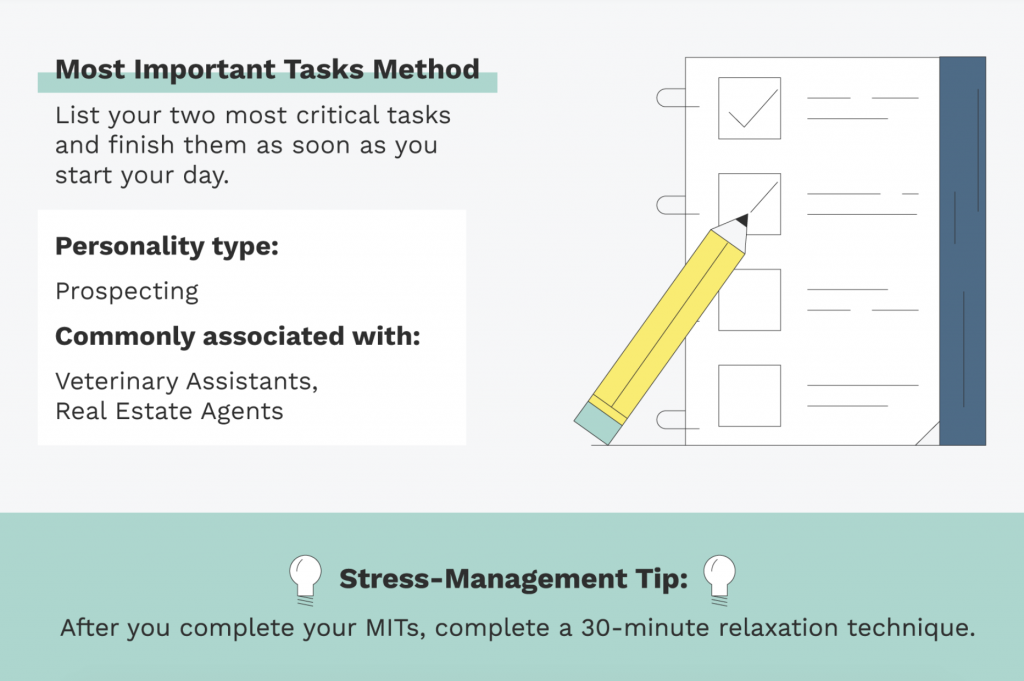
Best Time Management Strategies for Students

Helping students figure out how to manage their time can be tough, and there’s no one-size-fits-all solution to the problem. What works for someone else may not work for them — and that’s one of the reasons finding a time management strategy that works for each student is so difficult.

Someone who is a rocket scientist likely has a different time management strategy than a college student trying to figure out their major, so it doesn’t make sense to expect the same time management technique would work for both of them. No matter where they are in your education process, understanding your time management style based on their personality type is key to succeed long-term. 

For example, more outgoing students might benefit from the Eat That Frog technique, in which you do the tasks you like the least first thing. That way, you can get the things you are dreading out of the way to focus on tasks you enjoy more. 

More introverted students could benefit from the Einsenhower principle, in which you divide your tasks for the day into 4 sections: urgent, not urgent, important, and not important. This helps students segment their days to learn how to prioritize better and feel prepared to tackle the tasks ahead of them. 

Another great technique is the time-blocking technique, which works well for observant and analytical types. With the time-blocking method, you create a list of higher and lower level priority items and set aside a certain amount of time for each. This can help your students learn to multitask without getting overwhelmed, and is a great way to split up their days into more manageable tasks. At first, your students should build buffer time into each of the sections and once they are more comfortable, they will then have a better idea of how long each task will take. 

For students filling out college applications, time management is more important than ever. Learning to juggle multiple applications (while keeping track of deadlines, stages of applications, and more) can be difficult for teenagers, but with your help, they can learn the skills they need to thrive in college. 

No matter if a student would consider themselves traditionally “good at time management” or not, it’s important to support them in their journey to find a time management tactic that works for them. Time management can be a trial and error process, but teaching students how to manage their time early on can lead to years of success down the line. As they say: give a man a fish and he will eat for a day, but teach a man to fish, and he will eat for a lifetime. 

The process of teaching time management to students can be exhausting — it’s no easy feat on either side of it. However, being patient and supporting your students is key to helping guide them to success. 

The Self-Defeating Metaphor that Corrupts the College Search

Google the phrase “assembly line education” and you’ll see that, for decades, folks have likened our education system to an assembly line in a factory. In some ways, this is a very useful metaphor. It highlights the regimented way that we expect students to develop, setting up a fair critique of our education system as overly industrial, automated, and lacking a human touch. This metaphor also highlights the way that our current system encourages students to disengage and treat their education as something that is stamped on then by the all-powerful factory machines.

The assembly line education metaphor might also help to explain why students and families are so obsessed with attending the “best” college, and why so much of the college search literature emphasizes the concept of “fit.” Ken Robinson’s famous TED talk uses the assembly line metaphor to explain the way that creativity and individuality are pounded out of students. An assembly line manufacturing process values conformity and is assessed by the degree to which it can most efficiently produce the same product over and over. Students in this metaphor are the raw materials and are expected to allow the machinery to cut, twist, attach, shape, and mold them at will. In fact, the best raw material doesn’t do anything except whatever the machinery wants it to do. Individual agency isn’t just irrelevant; it’s detrimental because students (the raw materials) with agency are likely to take things into their own hands. All this does is gum up the works.

So what happens if these students, conditioned to believe that the assembly line does all the work, are given the opportunity to choose the factory that will complete the final stage of their production? It seems reasonable to expect these students to want to get into the best possible factory, assuming that if the best factory completes their assembly, then they will be the best and most successful product. Widen the gap between “successful” and “not successful” and getting into the best factory will seem even more and more important.

Maybe this helps to explain why so many students and parents spend countless hours and millions of dollars on test prep, college applications, essay writing tutors, and all the other resources that might give them a leg up in getting into the most elite college or university. After all, if the educational assembly line makes the student, then getting into the best factory matters a lot. By perpetuating a system that is grounded in conformity, we aren’t just telling students that agency doesn’t matter. We are telling them that it actually could be a bad thing.

Yet, it turns out that agency is fundamentally important to success during and after college.  Four decades of research tells us that success after college and learning in college is a function of what you do in college, not the school you attend. In other words, there is no best college. At most, there might be a long list of colleges and universities that are an equally reasonable fit.

Don’t get me wrong – colleges and universities can vary substantially in the quality of their educational design. Some schools make it easy to make the most of your education. Others make it insanely difficult. Often, variation in design quality can even exist between departments within an institution. In other words, the life you encounter in college will be a lot like what you encounter in your professional life, your social life, and your personal life. There will be good and bad and a lot in the middle. You can certainly make choices that increase the likelihood of good and minimize the likelihood of bad, but there will still be a lot in the middle. And what you do with the circumstances you encounter will make the difference.

In other words, find a college that is good enough and won’t cost you too much, then learn everything you can about how to make the experience meaningful. We spend far too much energy in our culture framing the college search as a high stakes hunger game in which the best you can do is hope to avoid the bad and get lucky sneaking into the good. In end, all this approach gets you is a deep sense of helplessness and an utter lack of agency. But if you start the college search knowing that you can make almost any institution work for you . . . then you are in charge throughout.

Turns out, that is the way to succeed in life.  Might as well tackle college in the same way.  If nothing else, it will be good practice.

Mark Salisbury, Ph.D., spent 25 years in higher education as a coach, admissions counselor, instructor, and academic dean.  His research on college students and organizational design has been featured on NPR and WNYC and has been published in the Chronicle of Higher Education and Inside Higher Ed.  Dr. Salisbury launched TuitionFit (tuitionfit.org) in 2018 to empower the public to create college price transparency through crowdsourcing and sharing information.

Steps Your Students Can Use to Pick a Major

Choosing a major is the complex process that involves considering not only personal preferences and already obtained skills but also financial and career expectations along with the major’s relevance in a long-term perspective. While it may appear to be a tough decision accompanied by the fear of making the wrong choice, every student must realize that while the possibility to change the major is always available, it is more beneficial to pay a lot of attention to the initial choice as it will save much time and effort in future.

Steps Your Students Should Follow While Planning for their Future

  1. Consider their personality. It is extremely important to choose the professional path that they might follow throughout their entire life based on their own interests and abilities. One could not achieve success in the chosen field while hating a job or lacking the necessary skills to cope with responsibilities. Choose the sphere of occupation where they can be the best.
  2. Think about perspectives. Will their chosen major be useful for humanity in the near future? What about a distant future? It is hard to predict all turns of events but if they dedicate some time and think about these things, they will make a more justified choice. The usefulness of a profession is an important factor as it predicts employability and, consequently, their safe and wealthy future.
  3. Choose educational institution wisely. If there is a possibility to apply to any of the Ivy League universities, go for it. Do not be afraid of difficulties or any other possible downsides since employers and other influential people do notice the issuer of their diploma. It is always a good decision to have some additional benefits. However, do not make elite schools their only focus as the other ones may be much more efficient in the specific field of study they choose. For example, the University of California, Berkeley, could be a much better choice for young people who want to earn a degree in General Architecture based on the recent data on quality of education.
  4. Ask for help. While the choice of their future is entirely their own responsibility, a fresh perspective and objective estimation of all present factors made by a school advisor or counselor, teachers, parents, or other important people might show new horizons for them. There is no need to accept everything these advisors say but it is good for them to hear different opinions and perspectives. They should listen to what other people want to say, synthesize all viewpoints, and come up with their own decision.
  5. Don’t be afraid to change their mind. Remember, they are not obliged to stick to the chosen career for their whole life. The modern world is changing so rapidly that the ability to change becomes vital. It is perfectly normal to change a major, even during the last year of study if they think that it will be the right decision for their long term future.

This post was from a blog that EduBirdie submitted which also includes information about some hot careers and a summary of some of them with expected salary information. Here is a link to their post: https://edubirdie.com/blog/guide-to-choosing-major

What Do You Do if a Student Misses a College App Deadline?

Are your students forgetting things? Missing deadlines?
 
That’s not uncommon. We see this every year. On the college essay.
 
And we can’t blame COVID. Kids are kids. They need reminders during normal times, too.
 
To address this issue, we give our students a schedule before we start working together. It helps keep them on track, so they don’t lose momentum. It also helps us manage them – and our business – because we know what to expect when.
 
You’d better believe we stick to that schedule, especially at the start.
 
Here’s a story to illustrate what I mean.
 
Ari was enthusiastic about applying to college. He had a schedule, and so did his mom. Still, he missed his first real deadline: setting up a brainstorm appointment.

No big deal, right? The appointment wouldn’t take place till the next week.
 
In the larger scheme of things, it was a big deal, because I needed him to understand that the schedule mattered. We intentionally start with a low-stakes task, so if a student misses that deadline, we won’t be thrown completely off kilter.
 
Monday morning, I emailed Ari:
 
I was expecting you to set up your brainstorm appointment, but I don’t see one on my calendar. Please schedule it today. Just take a look at the email I sent earlier with the instructions to start writing your college essay, and you’ll see the dates that are available for brainstorm appointments. Thanks. I am looking forward to working together.
 
I copied his mom on the email too. And guess what? Ari set up that meeting. That day. Best of all, he never missed another deadline.
 
When a student misses a deadline, what do you do?
 
If you set everything up at the beginning of the process, create a schedule, and give it to your students before you start, you won’t have to chase them after the fact. 


Here’s a sample schedule from the Wow Method, so you can see how we do it.

Kim Lifton is President and Co-founder of Wow Writing Workshop a premier college application essay coaching and professional training company, offering private, virtual writing coaching services to professionals and students throughout the world.  Since 2009, Wow has been leading the college admissions industry with our unique approach to communicating messages effectively through application essays, including personal statements, activity and short answer essays and supplements.  Kim leads a team of writers and teachers who understand the writing process inside and out. Kim blogs regularly about the college essay’s role in the admission process for multiple industry publications and websites. In 2019, she was named a LinkedIn Top Voice in Education.

Questions? We’ve got answers.

MONTHLY FREE WEBINARS FOR STUDENTS AND PROS
 

Pro Chats: Every month we record a new College Essay Pro Chat. Check out the recording, or sign up for next month’s webinar. Wow CEO Susan Knoppow answers questions live for 30 minutes.

Free Student Classes: If you’re a school counselor who wants to help students with the basics, encourage them to sign up for my next free student class, or listen to the recording. You are welcome to sign up, too.

Jobs of the future – 10 fastest growing occupations your students should know about

The U.S. Bureau of Labor Statistics (BLS) recently updated its list of the 10 fastest growing careers. BLS’ top-10 list of fastest-growing American occupations between 2019 and 2029 is comprised of six health care-related jobs and three tech/green energy-related jobs, though projections do not include the impact of the coronavirus pandemic, BLS said.

The top 10 jobs are:

-Wind turbine technicians (median pay of $52,910 per year)

-Nurse practitioners ($109,820)

-Solar photovoltaic installers ($44,890)

-Occupational therapy assistants ($61,510)

-Statisticians ($91,160)

-Home health and personal care aides ($25,280)

-Physical therapist assistants ($58,790)

-Medical and health services managers ($100,980)

-Physician assistants ($112,260)

-Information security analysts ($99,730)

“Factors that are expected to contribute to the large increase [in the health care sector] include increased demand to care for the aging baby-boom population, longer life expectancies, and continued growth in the number of patients with chronic conditions,” a press release from the Bureau reads.

All baby boomers are expected to reach age 65 by 2029.

So if your students are looking to you to recommend possible in-demand career paths these are some of the careers you might want to discuss with them.

The Five Essential Components of an Effective College Application Lesson

Whether you’re meeting with your seniors face-to-face or connecting with them remotely, the college application clock is ticking!  If you’re like me, you want to make sure your students are as prepared as they can be for the college application process so they don’t miss important steps… which often end up being last-minute emergencies for you!

For the past three years, our school has hosted an in-person College Application Boot Camp, a late-summer in-person event that allows seniors to get a head start on their applications.  It’s a great way to teach the most important parts of the application process, establishing a common baseline of knowledge so seniors and their families can have confidence throughout the process.

If you’re interested in offering college application lessons to your seniors, which topics should you include?

We’ve learned that these five pieces of the application puzzle are vital for a comprehensive – yet not overwhelming – college application resource:

  1. Career direction – Your school has likely provided your students with a variety of career development tools over the past few years; now is a great time to get (back) into them!  Seniors are beginning to realize the investment of time and money they’re going to make in the coming years and the importance of choosing well.  Career direction – if not career selection – is important for self-awareness and decision-making during the college application season.
  • College search – If your students are anything like mine (or like I was when I was 18!), they’ve already created a list of schools based on a cross-section of U.S. News & World Report rankings and NCAA national championships.  Or they have no list at all.  Either way, helping students consider a larger number of factors in their college search equips them to find more schools that are a good fit for them.
  • Personal statement – The college essay – or essays as has become the norm for Tier I schools – is often an afterthought for seniors, who treat it like as if it’s another reflection paper for English class.  Especially this year with a glut of test-optional schools, the essay could not be more important.  Our seniors need to know this and we need to teach them about how to craft an effective essay.
  • Paying for college – While you might typically focus on this topic at a financial aid workshop (and then only with parents), we have found that including an introductory lesson on paying for college – and particularly on some ways they can pay less – has been very well received by many of our students.  They are likely aware of the growing burden of student loan debt ($1.7 trillion and rising), and a school counselor can provide tools and information without diving too deeply into the intricacies of financial aid.
  • Project management – Probably the area that trips up most students and their families, managing all the moving parts of the college application process is vital.  Seniors need to realize that they (not their mom) are in charge of making sure that the application, transcripts, letters of recommendation, test scores, etc. make it to the specific colleges by the specific college’s deadline.  Teaching seniors this skill might be the most important lesson of all.

If that seems like a lot of content to you, don’t worry!  What’s great about delivering this content to your students is the growing number of resources that you can provide without having to come up with all of it on your own!  Our role as counselors is to provide tools and equip students to use them, and a college application boot camp – whether delivered online or in-person – is a great way to do that!

Sam Feeney is the Dean of Career and College Success at Falcon High School in Colorado and a consultant for SimpliCollege.com, which is offering their 2020 College Application Boot Camp for free to seniors and their families. 

Help Your Students Find Their Career Path with the Five Whys!

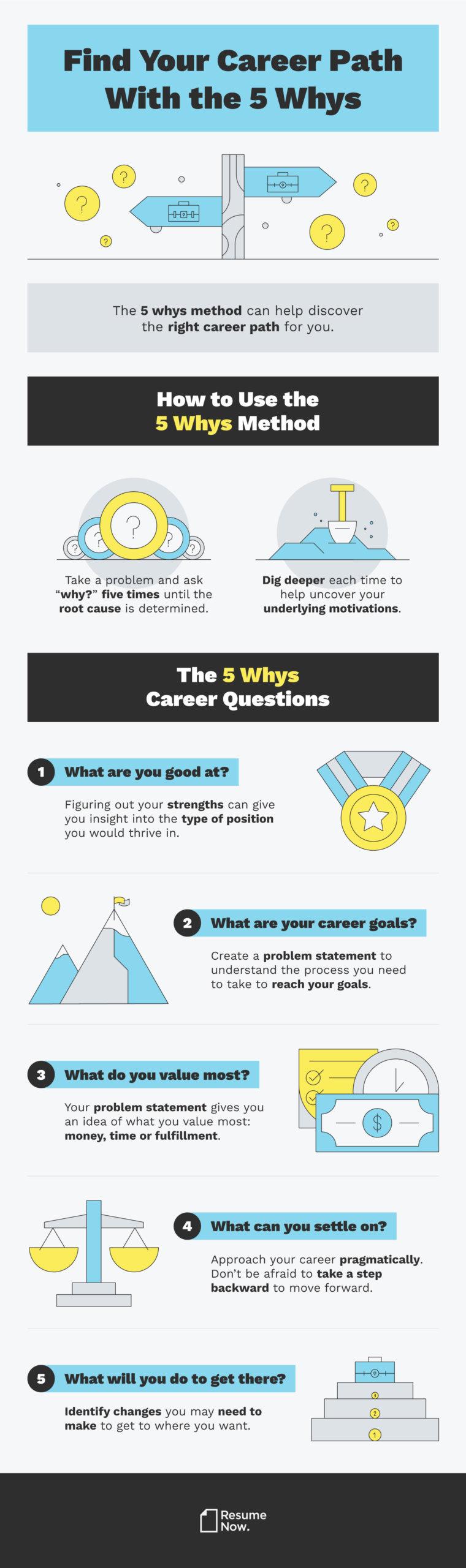
Many high school students have no idea which career path they want to pursue, but with College approaching they will soon have to soon decide which major(s) they want to study and map out a possible career path. Resume now has put together a summary of the five whys method your students can use to determine what areas might interest to them.

The Five Whys Explained

The five whys method was created by Sakichi Toyoda, founder of Toyota Motors, to help streamline the production process. The premise of this method is to start with a problem and ask “why?” five times until the root cause is determined.

While at first glance this technique may seem simple, it is actually an extremely powerful tool for understanding cause-and-effect relationships. The brilliance in this method comes from the bare-bones framework that allows it to be applied to all kinds of problems — including understanding your career path.

1. What Are You Good At? Why?

Although it may seem obvious, the first step to discover a career path is to look inwards and analyze. By starting from square one, your students will be able to dig down to the root of their strengths, motivations and skills to determine the career path that is right for them.

To get their self-evaluation started, they should try answering these questions:

  • What are your interests?
  • What are your skills?
  • What are your strengths and weaknesses?
  • What comes easily to you?
  • What time of day do you work most efficiently?

By answering these questions (and then asking why), they will be able to reflect on their strengths and skills to understand the types of positions where they would succeed.

2. What Are Your Career Goals? Why?

Figuring out their career goals starts by defining what they want in terms of career development. Clearly defining their career goals is crucial to creating a plan to get there.

A great way to foster this process is by creating a problem statement. The importance of crafting a problem statement cannot be overstated — a problem statement for determining their career path is just as important as a hypothesis when writing a research paper.

For example:

I am uncertain of my current career path as a realtor because I worry that I may not be able to sustain a healthy work-life balance long term due to the uncertain hours of this position. I want a job where I can balance my career development with my passions, and having dedicated time off from work is crucial to do that.

In this problem statement, the issues are clearly established and both short- and long-term goals are considered. To apply the five whys to the problem statement, try asking questions like:

  • Where do I want to be in one, five, 10 or even 20 years?
  • Do I want to live to work, or work to live?
  • What exactly are my outside passions, and how much do they intersect with the career paths I’m considering?
  • Why do I care about those passions?

The answers to these questions should give them an idea of what they value most: money, time or fulfillment.

3. What Do They Value the Most? Why?

The ideal career for them is one that encompasses what they need from each of these three pillars: money, time and fulfillment. However, it’s important to remember that these three pillars are not a zero-sum game. It’s possible to find a career that achieves all three, or sacrifices in areas where they are willing to change while still meeting their needs.

To help them determine what they value most in their career, it’s important to take a look at the boundaries they want to set. Some things to consider are:

  • Do you want to work 9-to-5 or are you willing to work nontraditional hours?
  • What type of work environment do you prefer?
  • How much weight do you place on work-life balance?

Work-life balance is a scale where the gain of one requires the loss of another. Try to instead view this as work-life fulfillment, which allows them to ask, “how should I spend my time to lead a fulfilling and productive life while meeting my goals?”

4. What Areas Are They Willing to Compromise On? Why?

Although it’s possible to find a career where they can balance money, time and fulfillment, it’s important to take a pragmatic approach to finding their career path. Think of their minimum, ideal and dream requirements, and use this framework to find an intersection that meets their needs. Some questions to get this process started include:

  • Have you considered the industry standard for the field you want to enter?
  • How much do you want to earn? How much do you need to earn?
  • Are you willing to take a step backward to move forward in a new path?

5. What Are They Willing to Do to Get There? Why?

Lastly, it’s important to take into consideration the sacrifices they are willing to make to get where they want to be. They should answer the following:

  • Would you pursue more schooling or certifications
  • What about moving to a new city for a career?

Regardless of the professional path they choose, it’s important to stand out from the crowd. Investing in their personal branding can open the door for new opportunities and pave the way for an upwards trajectory in their career.

https://www.resume-now.com/wp-content/uploads/2020/08/5-whys-mini-IG-scaled.jpg

Resume now has also provided some worksheets your students can download for free:

Self Evaluation Worksheet

Problem Statement Worksheet

The Top 12 Questions Your Students Should Ask Their Future College About Safety

With COVID-19 there are a lot of unanswered questions about how schools will handle safety protocols. There have already been breakouts at a number of schools including the University of Alabama which reported positive tests for more than 500 students today. If your students are concerned here are 12 questions they can ask their future schools.

  1. Who do I alert if I believe I am sick or have symptoms of the coronavirus?
  2. Will face coverings or masks be required?
  3. What regulations and requirements will be enforced to reduce the risk of spreading COVID-19 on campus?
  4. How do I get tested on campus?
  5. Is there a place nearby?
  6. What happens if my roommate or I have to self-isolate?
  7. How will we practice social distancing in classrooms and other common areas of campus?
  8. How will my campus track the number of positive cases and tracing?
  9. How will students be notified about new Coronavirus cases and the spread?
  10. How will my college handle remote meetings, classes, office hours and tutoring?
  11. What virtual resources will be available?
  12. What activities will be available that meet social distancing guidelines? (Intramural sports, gyms, etc.)

These came from a Guide to College Safety During the Pandemic published online at Safety.com. Here is a link for your students to check it out: https://www.safety.com/coronavirus-college-safety/

How the College Admissions Process Can Stick Your Students with a Higher Price

Unless you’ve had to fumble your own way through the college search process recently (as a student or as a parent), you might be tempted to discount stories of students graduating with crazy-high student debt as silly financial decisions made by naive folks. After all (you might ask), how could someone come out of college with such massive debt when there are plenty of less expensive schools?

Although we can’t presume to know why some people do what they do, we can take the publicly available college pricing data and see if it’s plausible that someone could make rational financial decisions using the available information and still end up paying more than they should–or could–have paid.

So first, let’s outline how the college search process plays out in most cases.

  1. You know that you want to go to college.
  2. You know that you only have so much money to pay for college.
  3. You have access to some information, but you certainly aren’t an expert on college admissions.
  4. You assume that similar schools give similarly-sized scholarships to similar types of students and therefore assume that the sticker price is an appropriate gauge of which schools will be more and less expensive for you.
  5. You don’t have the time or the money to apply to every possible college or university, so you narrow your choices to a set of finalists and (see bullet point #4) your educated guess about price is one of the factors you use to narrow your list.
  6. You are accepted to some of the schools to which you applied, and you now assume that your choices are limited to the schools that accepted you.

Then let’s take a hypothetical individual; let’s say that someone wants to attend a challenging college or university in Boston (you can run this same scenario in any region of the country and get similar results).  I’ve picked three well-known institutions that would be a reasonable fit: Boston College, Boston University, and Northeastern University.  Let’s posit that our hypothetical student is typical academically for the kind of student that is accepted and enrolls at each of these institutions.  In other words, she has a very high GPA and a composite SAT in the low to mid 1400s.  As a result, let’s assume that she will be accepted and offered a financial aid package of scholarships and grants that end up charging her the average actual price.  We will have to make do with the most recent pricing data available – prices paid by students entering in the fall of 2017 (yes, the time lag in current available data is another problem, but one we won’t be able to tackle that fully today).  And let’s posit that, like most students, price matters a lot and she (and likely her parents as well) will be borrowing to pay for college.

The Department of Education collects pricing information from all colleges, and I’ve pulled a few key data points from the Integrated Post-secondary Education Data System (IPEDS).  Schools must report a “total cost of attendance,” which include the listed tuition, fees, room and board, and an estimate of books, travel, and other necessary expenses.  Schools must also report the average actual price that students pay, calculated by subtracting the average amount of federal, state, and institutional grants and scholarships awarded from the the total cost of attendance.  Finally, colleges must report the average actual prices paid across five different income categories: families making between 0 and 30,000 dollars per year, between 30,000 and 48,000 dollars per year, between 48,000 and 75,000 dollars per year, between 75,000 and 110,000 dollars per year, and above 110,000 dollars per year.  Have a look at the price tags below.

17-18 pricing data (source – IPEDS)Boston CollegeBoston U.Northeastern U.
Listed Cost of Attendance70,58870,30267,957
Avg actual price across all new students26,56729,15434,246
Avg actual price: 0-30K income7,25115,66112,168
Avg actual price: 30-48K income9,69313,21114,186
Avg actual price: 48-75K income16,64820,80118,627
Avg actual price: 75-110K income23,17232,26527,272
Avg actual price: above 110K income47,67547,58644,248
Middle 50% test score, new students1320-1490 SAT1330-1500 SAT1360-1540 SAT

Let’s look at these prices in the order in which they would be revealed.  If our hypothetical student uses the sticker price as an indicator of which institution will end of up being the least expensive (a reasonable assumption), she would lean toward Northeastern, since their sticker price is the lowest of the three.  If our student is like many who don’t have a blank check to spend on college applications, she might only apply to one or two of the three schools, but probably not all three.  So rational decision-making would likely lead our bright young mind to apply to Northeastern and either Boston University or (although slightly less likely) Boston College.

So what happens when she gets accepted and sees the financial aid packages she is offered?  Unlike the sticker prices, we can see that the range of most to least expensive institutions is reversed. Although Boston College and Boston University were about $3,000 more than Northeastern, when financial aid awards arrive Northeastern is almost $8,000 more expensive than Boston College and just over $5,000 more expensive than Boston University.  What’s more, if you look at the differences in average actual prices across the different income brackets, Boston College would be the least expensive of the three institutions in every category except families making more than 110K/year, and Boston University jumps into the most expensive spot in four of the five income categories.

But the problem for our hypothetical young student is that she doesn’t have the benefit of this table.  We only know these prices because they have become public two years after the fact.  Moreover, since our student only applied to two of the three institutions, she has no idea what that third institution’s price would be.  If she applied to Northeastern and Boston College, fortune has smiled on her.  But if she applied to Northeastern and Boston University . . . ugh.  Imagine if her family’s income is less than 110K/year.  In any of these situations, we have a student who is going to pay substantially more than she could have paid, if she had only known.

You can find a combination of relatively similar institutions in every region or metropolitan area in the country where this same scenario plays out like clockwork.  Still wondering how it is that so many students end up with disproportionately high debt?

Mark Salisbury, Ph.D., spent 25 years in higher education as a coach, admissions counselor, instructor, and academic dean.  His research on college students and organizational design has been featured on NPR and WNYC and has been published in the Chronicle of Higher Education and Inside Higher Ed.  Dr. Salisbury launched TuitionFit (tuitionfit.org) in 2018 to empower the public to create college price transparency through crowdsourcing and sharing information.

Newer Posts
Older Posts

Link for Counselors

Current Publication

View Current Publication

Advertisements

LINK Newsletter for Counselors

Sign up to receive our bi-weekly e-newsletter.